
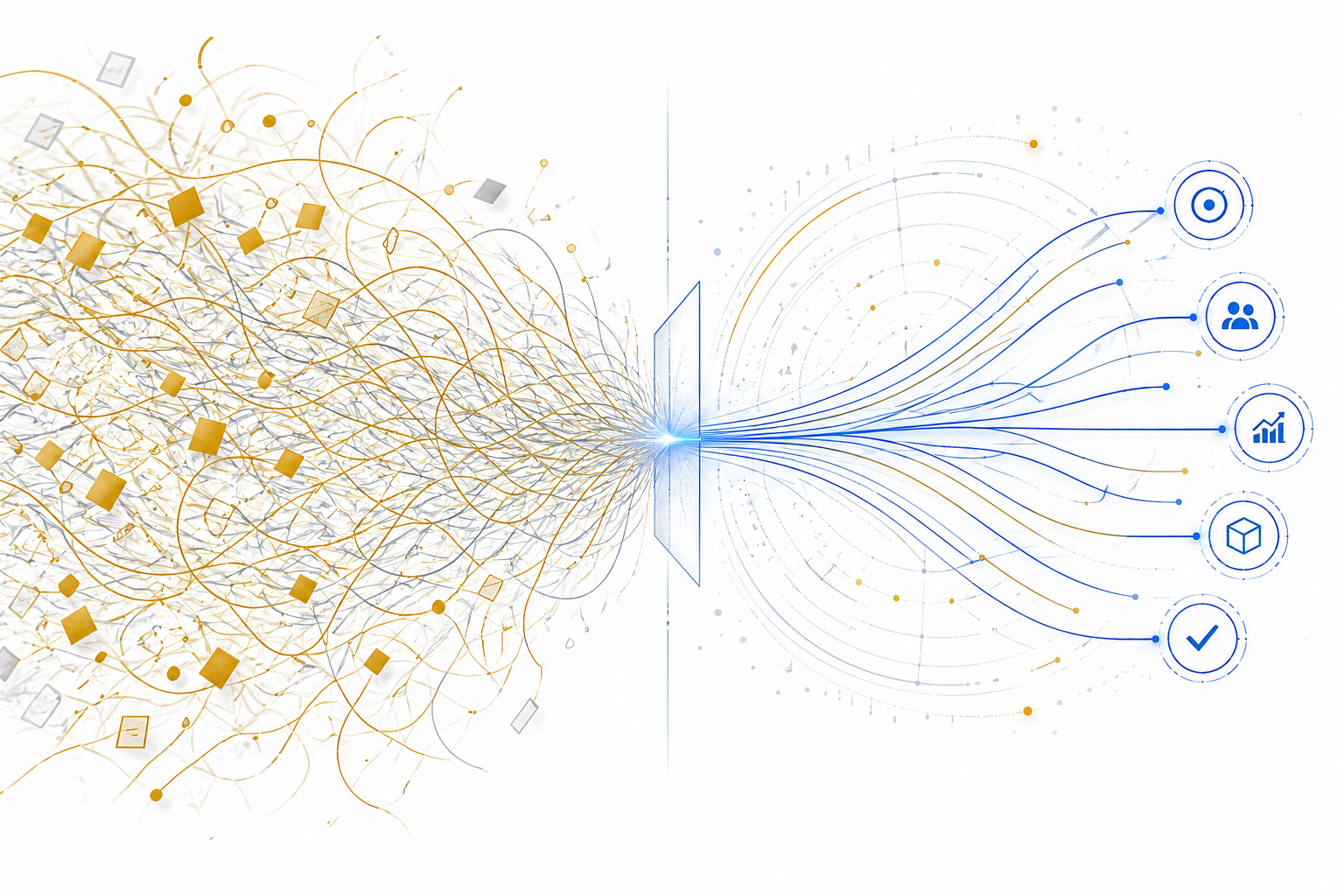
Practicing Agile at scale well is one of the hardest organizational problems there is. As a delivery coach in the enterprise, I have helped organizations find their own path to it many times. Some went with SAFe to the letter. 125 people, two days, string on a board, the full ceremony. Some went with LeSS or Nexus. Some built their own scaling approach from scratch. Most found a compromise that fit their reality. The half-day conference call where half the teams are on mute. The "PI Planning lite" that is really just a status meeting with better catering. The version where leadership flies in for the kickoff and leaves before the hard conversations start. My job was helping them figure out what their version of alignment at scale actually needed to look like. Even the organizations that did it well knew the coordination tax was heavy. It worked. But it took a lot of shepherding to keep it working.
The people in those rooms are not the problem. They are smart, capable professionals who think that all of this planning activity is unhelpful overhead taking time away from work they need to be getting done. And yet the event works, often in ways that are hard to measure. If the ceremony creates enough shared context that the right conversations happen in the hallway afterward, then the process shepherds have done their job. The question was never whether the coordination had value. It did. The question is whether it required that much overhead to produce it.
Let me be direct. The scaling frameworks solved a real problem. SAFe, LeSS, Nexus, the Spotify model, and every serious scaling approach that emerged over the last decade. The problem was not trivial, and the people who built careers implementing these frameworks were not wrong to do so.
The problem was coordination at scale. Hundreds or thousands of people, working on interdependent systems, trying to deliver something coherent. That is genuinely hard. It was hard in 2015, and the underlying challenge has not gone away in 2026.
What has changed is the economics of how coordination happens. And that changes everything.
The Coordination Tax
Every scaling approach, if you strip away the branding and certification structure, is fundamentally a coordination mechanism. Big-room planning exists because large organizations need alignment. Release Trains and feature teams exist because someone has to sequence work across teams. Program-level structures exist because you need a unit of organization big enough to deliver something meaningful but small enough to stay coherent.
All of this is human coordination infrastructure. It exists because humans are expensive to align, slow to re-align, and terrible at maintaining shared context across large groups.
Fred Brooks identified this in 1975 [1]. Communication overhead grows as n(n-1)/2 with team size. A 10-person team has 45 communication channels. A 50-person program has 1,225. A 125-person planning room has 7,750. That is not a coordination challenge. That is a coordination crisis, and the framework is the tourniquet.
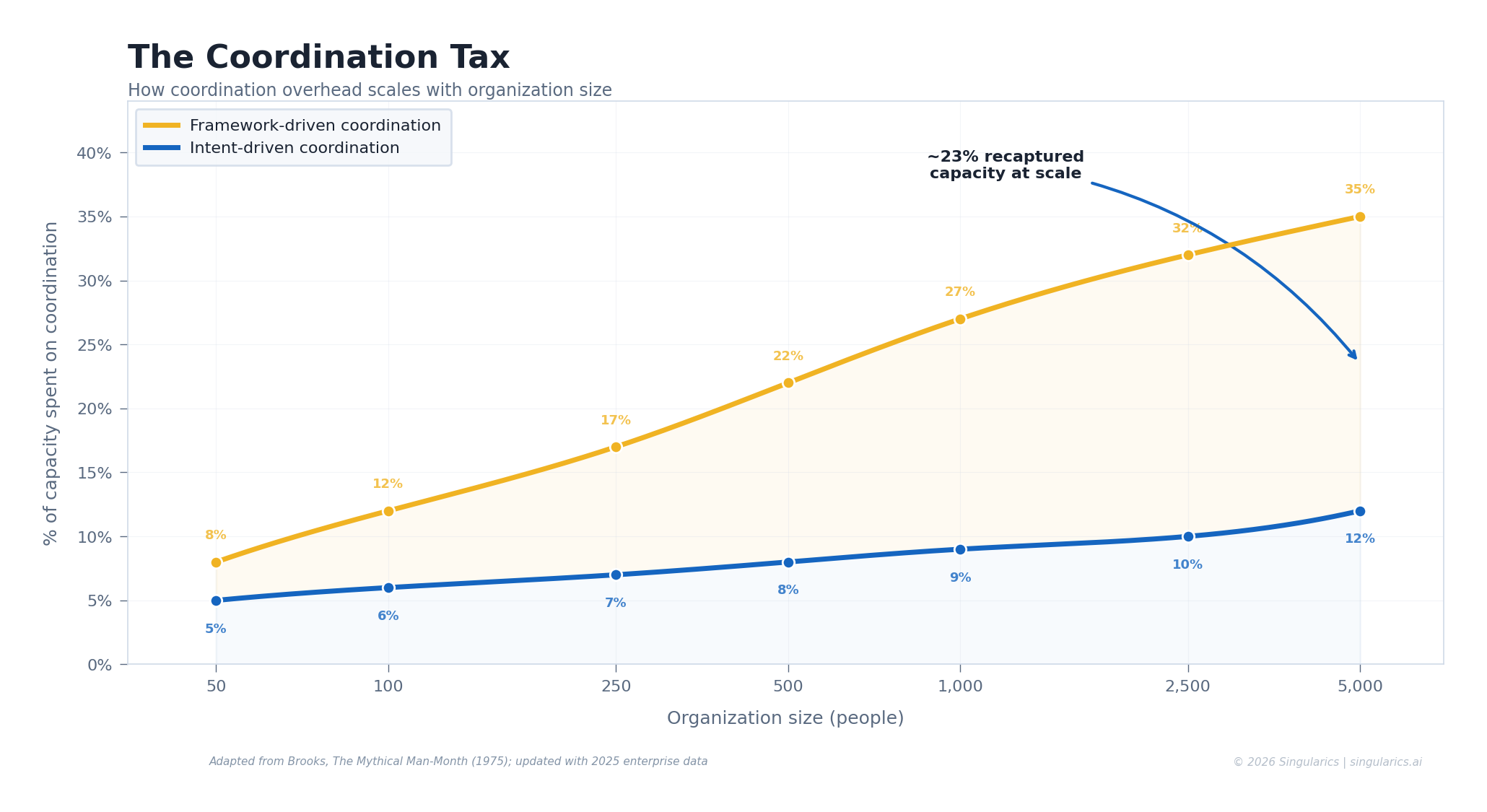
The 17th Annual State of Agile Report found that 53% of organizations using scaling frameworks cited "coordinating across teams" as their primary challenge [2]. McKinsey's 2024 research on organizational agility reported that large enterprises spend 20-35% of their capacity on coordination activities rather than value delivery [3].
Here is the math that made scaling frameworks work. The cost of the coordination tax was less than the cost of coordination failure. The frameworks were expensive, but misalignment was more expensive.
That math is changing.
Where the Time Actually Goes
Consider what actually consumes time in a large-scale planning event. Having facilitated over 200 of these across financial services, healthcare, technology, and manufacturing organizations, the pattern is remarkably consistent regardless of which framework the organization uses.
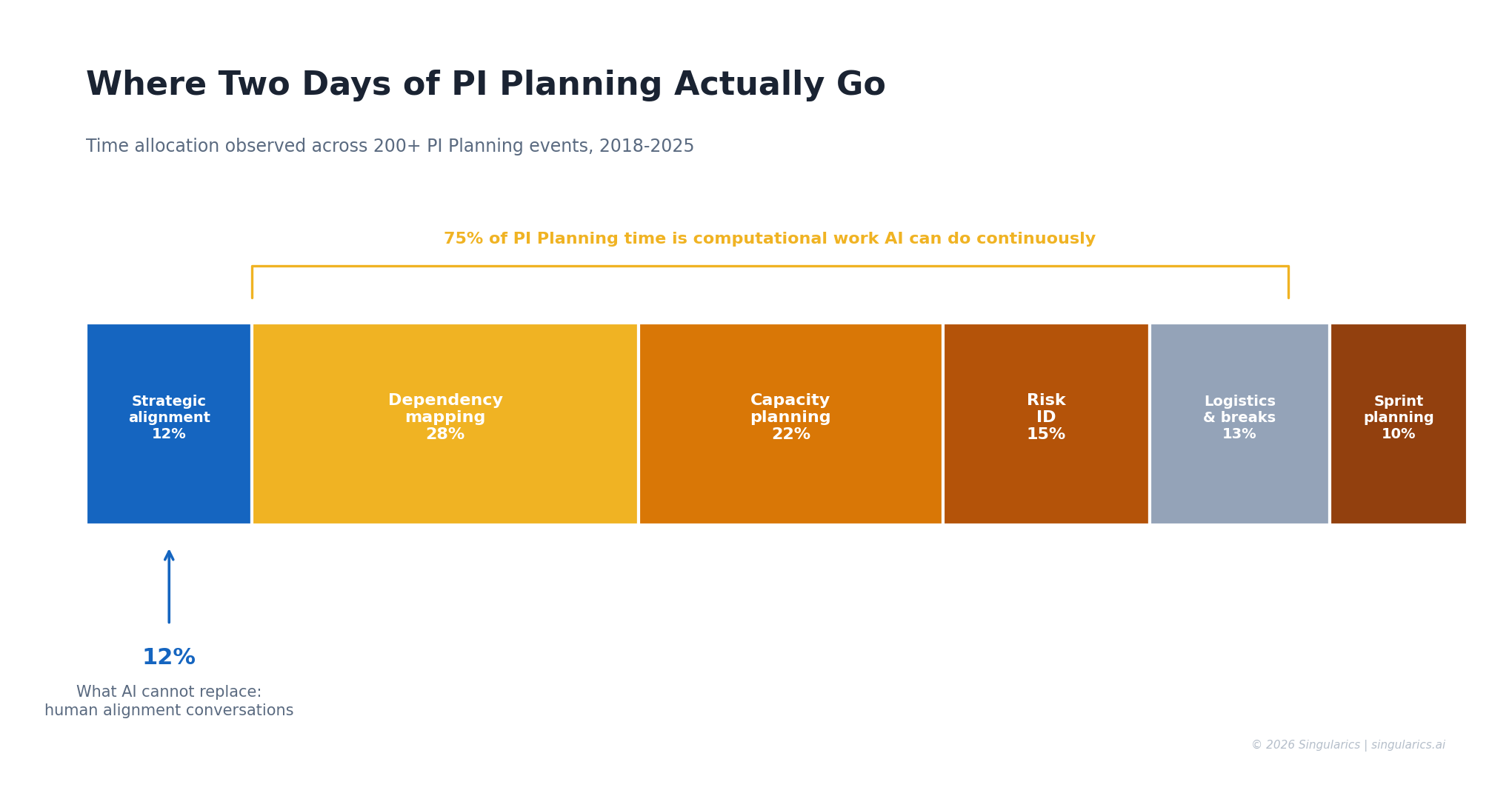
The strategic alignment conversation, the part where leaders articulate direction and teams connect their work to outcomes, takes roughly 12% of the event. That is the part that matters. That is the part AI cannot replace.
The other 88% is information logistics. Dependency mapping, capacity negotiation, risk identification, context-setting, and sprint-level planning. This is work that AI can do continuously, better, and without requiring everyone to be in the same room at the same time.
According to Atlassian's 2024 State of Teams report, knowledge workers spend 58% of their time on "work about work" rather than skilled work [4]. In a scaled Agile context, big-room planning is the most concentrated expression of that overhead. Two full days where the entire program stops delivering in order to coordinate future delivery.
AI can handle the logistics. Dependency tracking, capacity modeling, risk identification. All of that can run continuously without assembling anyone in a room.
And yet. Humans are tribal creatures. We need to be in the same room sometimes. That has not changed and it will not change. What has changed is what the room is for. It is no longer for wiring together a plan that keeps 12 teams from blocking each other. It is for deciding which hill to take next. For forming the hypothesis of what to build and why. For agreeing on what acceptance looks like before a single line of code is written. Because the delivery side, the coding, the execution, is heading toward zero cost and near-zero time. When building is nearly free, the only thing that matters is building the right thing. That is a deeply human conversation, and it deserves the room. Dependencies still matter, but they are a computational problem now, not a social one. AI resolves them continuously, at machine speed, without a two-day offsite and a roll of string.
The Speed Mismatch Problem
There is a harder problem here than cost, though. It is speed.
Most scaling frameworks operate on a quarterly cadence. Planning happens every 8 to 12 weeks. That cadence made sense in a world where the planning horizon matched the execution speed. You plan for 10 weeks because that is roughly how long it takes teams of humans to build, integrate, and deliver something meaningful.
AI execution operates on a fundamentally different clock.
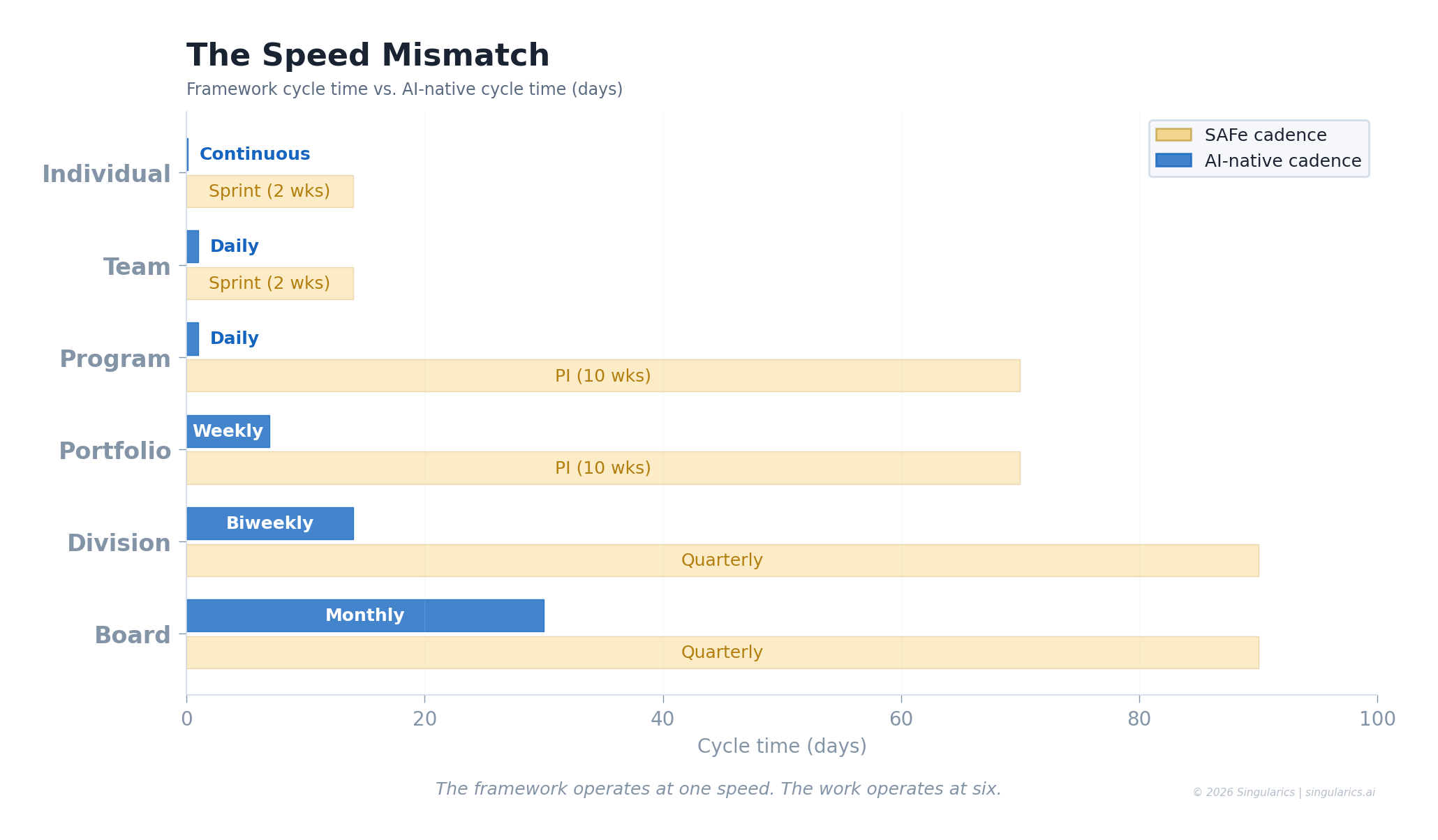
GitHub's 2024 research on Copilot found that developers using AI complete tasks 55% faster [5]. Google's internal randomized controlled trial with 96 engineers measured a 21% acceleration on complex enterprise tasks [6]. But that is just the delivery level. At the portfolio level, AI-augmented planning tools can rebalance resource allocation in hours, not weeks. At the strategic level, AI can model scenario outcomes that used to require a consulting engagement.
The define-propose-judge-execute-verify cycle that used to take a sprint now happens multiple times per day at the delivery level. A quarterly planning cadence cannot govern a system that operates at that speed. By the time you finish your planning event, the assumptions that informed it have already been overtaken by what the organization learned from the work AI delivered in the intervening weeks.
This is the real tension. It is not that the frameworks are bad. It is that their cadences were designed for human execution speed, and AI execution speed is different by orders of magnitude. Organizations that try to bolt AI onto an existing cadence structure will experience this as a constant, frustrating mismatch. AI wants to go fast, the framework demands everyone wait for the next planning boundary.
What You Actually Lose When You Lose the Framework
Now let me push back on the naive version of this argument, because I have heard it and it is wrong.
The naive version says AI replaces the framework. Tear it down. Move fast. The market will sort it out.
That misses what these frameworks were actually providing. Behind all the ceremony, there were real functions being performed.
Alignment. People at different levels of the organization understood what they were building toward and why. Not perfectly, but better than nothing.
Prioritization under constraint. Limited capacity forces prioritization. The framework created a visible mechanism for making those trade-offs.
Cross-team coherence. Teams that needed to integrate their work had a structured way to negotiate that integration.
Governance. There were checkpoints where someone asked "is this still the right thing to build?" before too much momentum built in the wrong direction.
Shared context. 125 people in a room for two days is expensive, but every one of them walked out with a mental model of what the whole organization was doing. That shared context has value that is hard to replicate through documentation or dashboards.
If you remove the framework and replace it with nothing, you lose all of this. And you lose it at exactly the moment when AI is amplifying execution speed, which means misalignment compounds faster than ever.
Deloitte's 2025 Global Human Capital Trends report found that only 14% of organizations feel their governance structures are keeping pace with AI adoption [7]. Removing the coordination framework without replacing its function is the worst possible move.
The question is not whether you need alignment. The question is whether quarterly ceremonies facilitated by humans are still the best mechanism for producing it.
From Ceremony-Driven to Intent-Driven Alignment
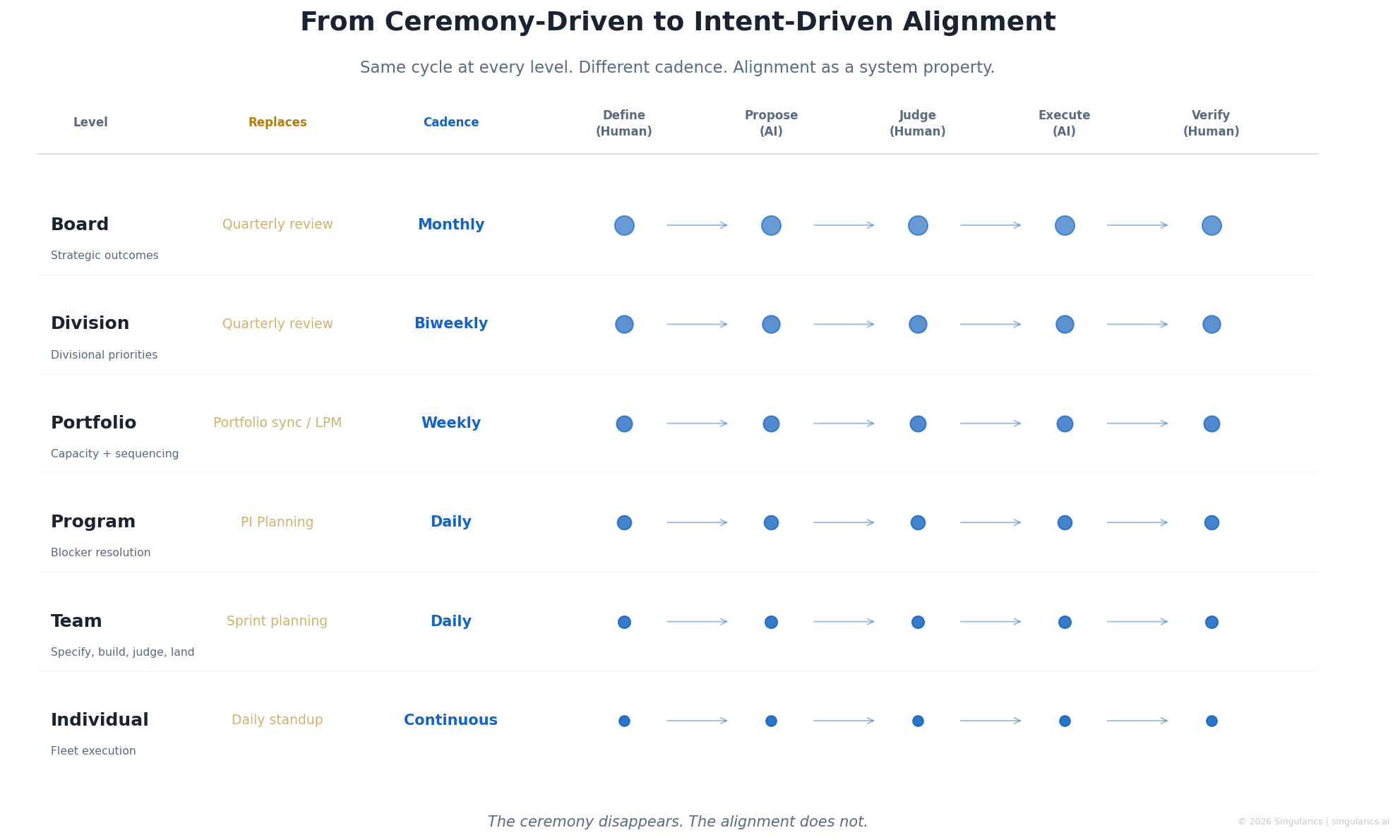
There is another way to produce alignment, and it does not require assembling 125 people in a room four times a year.
The core insight is this. Alignment does not have to be an event. It can be a system property. If every level of the organization has clearly defined intent, and that intent cascades coherently from strategic outcomes down to daily execution, then alignment is something the system maintains continuously rather than something you manufacture periodically.
This is what an intent-driven operating model looks like. At the board level, strategic intent is defined with enough precision that the layers below can trace their work back to it. At the executive level, that intent is translated into measurable outcomes. At the portfolio level, those outcomes are decomposed into programs. At the delivery level, work is defined with acceptance criteria that AI can execute against.
Each level runs a cycle. Intent is defined, AI proposes options and surfaces conflicts, humans exercise judgment on the proposals, AI executes the approved direction, and outcomes are verified against the original intent. That cycle runs at different speeds at different levels. The board might run it monthly. A product owner might run it five times a day. But the structure is the same, and the alignment is maintained by the coherence of the intent cascade, not by a calendar event.
In this model, the alignment conversation still happens. It happens more often, not less. But it is triggered by data, not by calendar. When AI surfaces a misalignment between what a team is building and what the strategic intent calls for, that triggers a conversation. When a dependency conflict emerges, the relevant people are pulled together immediately, not in 10 weeks when they happen to be in the same room.
The real value of large-scale planning was forcing alignment conversations that the organization was otherwise avoiding. That value is real, but there are better forcing functions now. Continuous intent verification is a more reliable alignment mechanism than a quarterly ceremony, for the same reason that continuous integration is a more reliable quality mechanism than a quarterly testing phase.
What Happens to the Roles
This is where the conversation gets personal for a lot of practitioners, and I want to be thoughtful about it.
If you are an RTE, a Scrum Master, a Solution Architect, or an Agile Coach working within a scaling framework, your career is not over. But your role is going to change, and the sooner you engage with that change, the better positioned you will be.
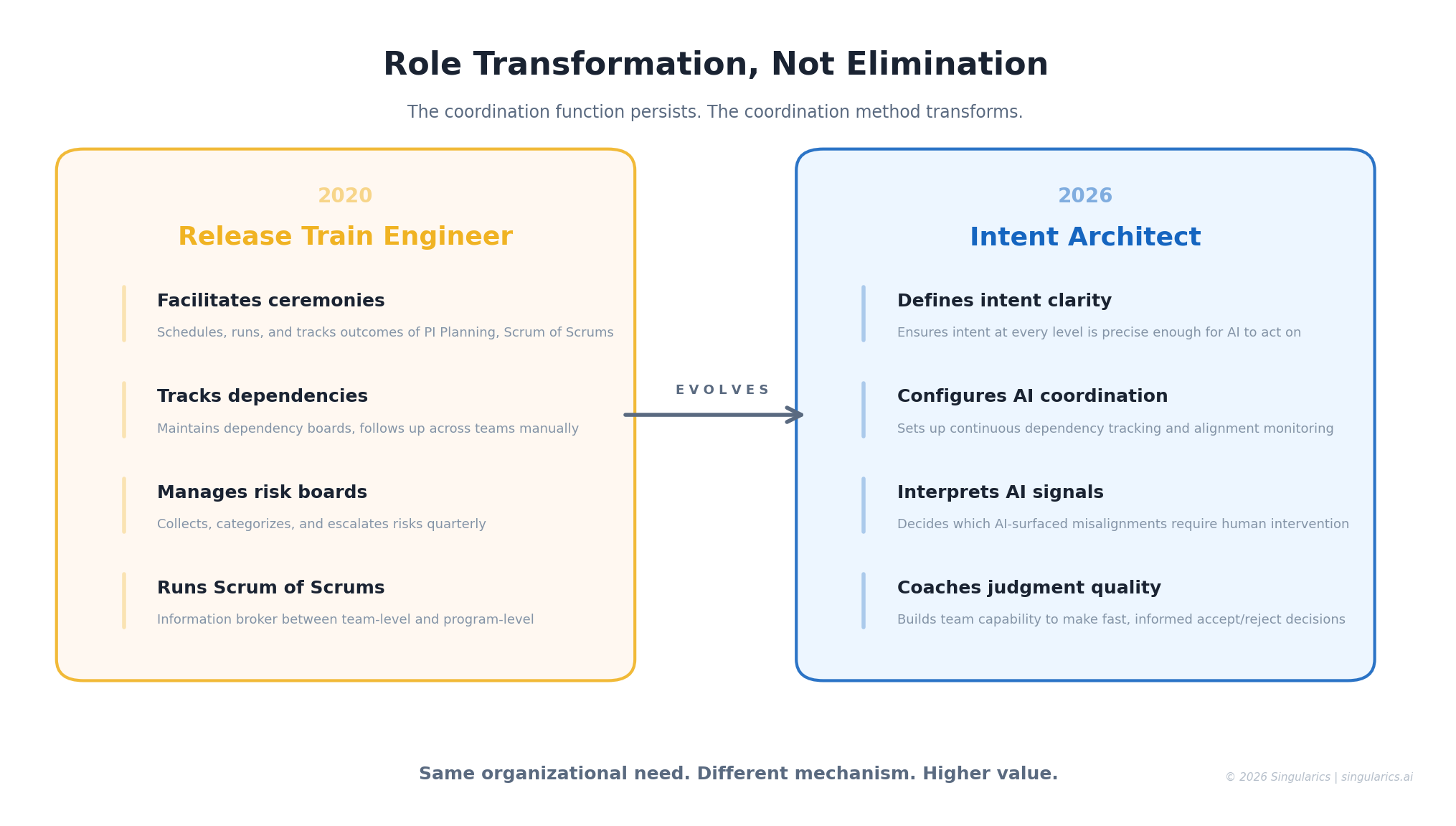
Take the coordination role, whatever your organization calls it. Today, that person facilitates coordination across a program of 10 to 12 teams. They run ceremonies, track dependencies, manage risks, and keep the program moving. A huge portion of that work is information brokering. Making sure the right people know the right things at the right time.
AI handles information brokering better than any human can. It can track every dependency, surface every conflict, generate every status report, and do it continuously rather than at scheduled intervals.
But the role also involves something AI cannot do. Making judgment calls about what matters. Deciding which risks are worth escalating. Sensing when a team is struggling before metrics show it. Building the trust that makes hard conversations possible. Understanding when the process should flex and when it should hold.
The transformation is not from coordinator to nothing. It is from coordinator to something closer to intent architect. Someone who ensures that the intent flowing into their teams is clear enough for AI to act on. Someone who defines the boundaries and success criteria that make AI execution meaningful. Someone whose value comes not from facilitating a room but from making sure the system has what it needs to maintain alignment autonomously.
That is a harder job, not an easier one. It requires deeper understanding of the business, sharper thinking about outcomes, and the judgment to know when AI-surfaced signals are real and when they are noise.
The World Economic Forum's 2025 Future of Jobs report projects that 60% of workers will need reskilling by 2027 [9]. For Agile practitioners, that reskilling is not about learning a new tool. It is about shifting from process facilitation to intent architecture. The practitioners who build those capabilities will be more valuable than they are today, not less.
The Operating Logic Underneath the Shift
The shift is easier to understand when you separate four things that scaling frameworks had to hold together through ceremony.
Direction remains human. AI can propose plans, expose dependencies, and amplify a decision. It cannot decide which business condition is worth changing. A strategic outcome still needs an officer willing to declare it and one business owner willing to carry it every day.
The constraint moves. When production accelerates, the scarce work becomes supplying context, making trade-offs, and judging what comes back. The operating model therefore has to organize around knowledge throughput rather than around keeping delivery teams utilized.
Accountability does not move to the machine. Agent fleets can build. A Fleet Lead directs the technical work, a Decision Owner accepts against a testable contract, and both remain accountable for decisions the fleet cannot own.
Governance has to travel with the work. Policy and acceptance criteria enter before the build, the harness tests them continuously, and genuine exceptions move quickly to a named decision forum. Control gets closer to the increment instead of waiting at the end of a planning boundary.
These are not four aspirations around AI adoption. They are design constraints. Together they replace the hidden operating functions that big-room planning used to provide: one roadmap for direction, a named owner for accountability, knowledge pushed to the work, and evidence returned from each cycle to change the next decision. The AI-Native Operating Model™ makes those mechanisms explicit.
The Worst of Both Worlds
There is a scenario I am watching organizations walk into right now, and it concerns me.
They adopt AI at the execution layer. Teams start using AI coding assistants, AI-generated analysis, AI-produced designs. Execution accelerates. But they keep the existing framework around everything else. Planning still happens quarterly. Dependency management still runs through someone's spreadsheet. Governance still happens at a retrospective.
The result is a system that produces work at AI speed but governs it at human-ceremony speed. Teams generate output faster than the framework can process it. Dependencies that AI could resolve in real time stack up waiting for the next sync meeting. Misalignments that continuous verification would catch immediately persist for weeks until the next checkpoint.
McKinsey's 2025 State of AI report found that 72% of organizations have adopted AI in at least one business function, up from 55% in 2023. But only 1 in 4 of those organizations have adapted their operating model to account for AI's speed [8]. The other three quarters are running AI-speed execution inside human-speed governance. They are producing thrash. Rapid work in slightly wrong directions, corrected quarterly, repeated at scale.
If your organization is heading down this path, the solution is not to abandon the framework overnight. It is to start evolving the coordination layer to match the execution layer. Replace calendar-driven alignment with data-driven alignment. Move from periodic ceremonies to continuous intent verification. Keep the human judgment, lose the human information brokering.
The Landscape Ahead
I expect scaling frameworks to follow a trajectory similar to what happened with traditional project management when Agile arrived. Waterfall did not disappear overnight. It is still in use in contexts where it makes sense. But the organizations that clung to it in contexts where it no longer fit lost ground to those that adapted.
SAFe, LeSS, and their peers will not vanish. For organizations that are early in their AI adoption, or operating in domains where AI execution is not yet practical, the coordination tax of a scaling framework is still worth paying. There is no shame in running a framework well in 2026. These are proven approaches that solve a real problem.
But for organizations that are further along in AI integration, the coordination economics have shifted. The question they need to answer is what provides alignment if not the framework.
The answer is an operating model built around intent. One roadmap carries direction from strategic outcomes into daily specs. Named humans retain ownership and judgment. Domain knowledge is pushed to the work before it becomes a blocker. Policy travels inside the spec and harness. Evidence from each cycle changes the next decision. Alignment becomes the product of those connected mechanisms rather than the memory of the last planning event.
That is not a prediction. It is something organizations are building right now. The ones that get it right will move faster, align better, and waste less human attention on coordination mechanics that a machine can handle.
The scaling frameworks had it right. Alignment at scale is the hard problem. They built the best solution available with the tools they had. The tools have changed. The problem remains. The solution is evolving.
The practitioners who see this clearly, who understand that their expertise in alignment and organizational coherence is more valuable than their expertise in a specific framework's ceremonies, are the ones who will lead what comes next.
References
- Brooks, F. P. (1975). The Mythical Man-Month. Addison-Wesley. Communication overhead formula n(n-1)/2.
- Digital.ai (2023). 17th Annual State of Agile Report. 53% of scaling framework users cite cross-team coordination as primary challenge.
- McKinsey & Company (2024). The State of Organizations 2024. Large enterprises spend 20-35% of capacity on coordination activities.
- Atlassian (2024). State of Teams Report. Knowledge workers spend 58% of time on "work about work."
- GitHub (2024). Research, Quantifying GitHub Copilot's Impact. 55% faster task completion with AI assistance.
- Murali et al. (2025). Achieving Productivity Gains with AI-based IDE Features: A Journey at Google. arXiv:2601.19964. 21% faster task completion in randomized controlled trial with 96 Google engineers.
- Deloitte (2025). Global Human Capital Trends. 14% of organizations report governance keeping pace with AI adoption.
- McKinsey & Company (2025). The State of AI in 2025. 72% of organizations have adopted AI in at least one function. 25% have adapted operating models.
- World Economic Forum (2025). Future of Jobs Report. 60% of workers will need reskilling by 2027.
Alex Petty is the founder of Singularics. He has spent 20 years leading enterprise transformations and now helps organizations redesign how work is defined and coordinated when AI changes the operating model.
Ready to move beyond the framework? See The AI-Native Operating Model™, which replaces ceremony-driven coordination with intent-driven alignment. Take our free Readiness Assessment to see where you stand, or book a call to talk about what the shift looks like for your teams.