
Stop me if you have seen this one before. A sprint review. The team demos finished work to the person whose title says owner. The owner likes what they see, asks a good question or two, and then says, "Let me check."
The demo ends. The decision leaves the room. The work sits, done and undecided, while an email thread forms around it. Two days if the person being checked with is quick, a week if they are traveling. By the time the answer comes back the team is deep in something else, so the answer lands as an interruption to work it was supposed to precede. Nobody records any of this as a cost. It is just how things are.
"Let me check" is not a personal failing. It is the sound of a role that was named but never granted. And the naming has been going on for much longer than most people remember.
None of what follows is an indictment of the people who hold the title, and little of it will be news to them. The industry knows the aspiration cold. It has been taught, certified, and keynoted for twenty years, and in some organizations it genuinely lives. It just does not take hold in most places, and the proof is hiding in plain sight. Product consulting exists, and flourishes, because doing this well at scale is hard.
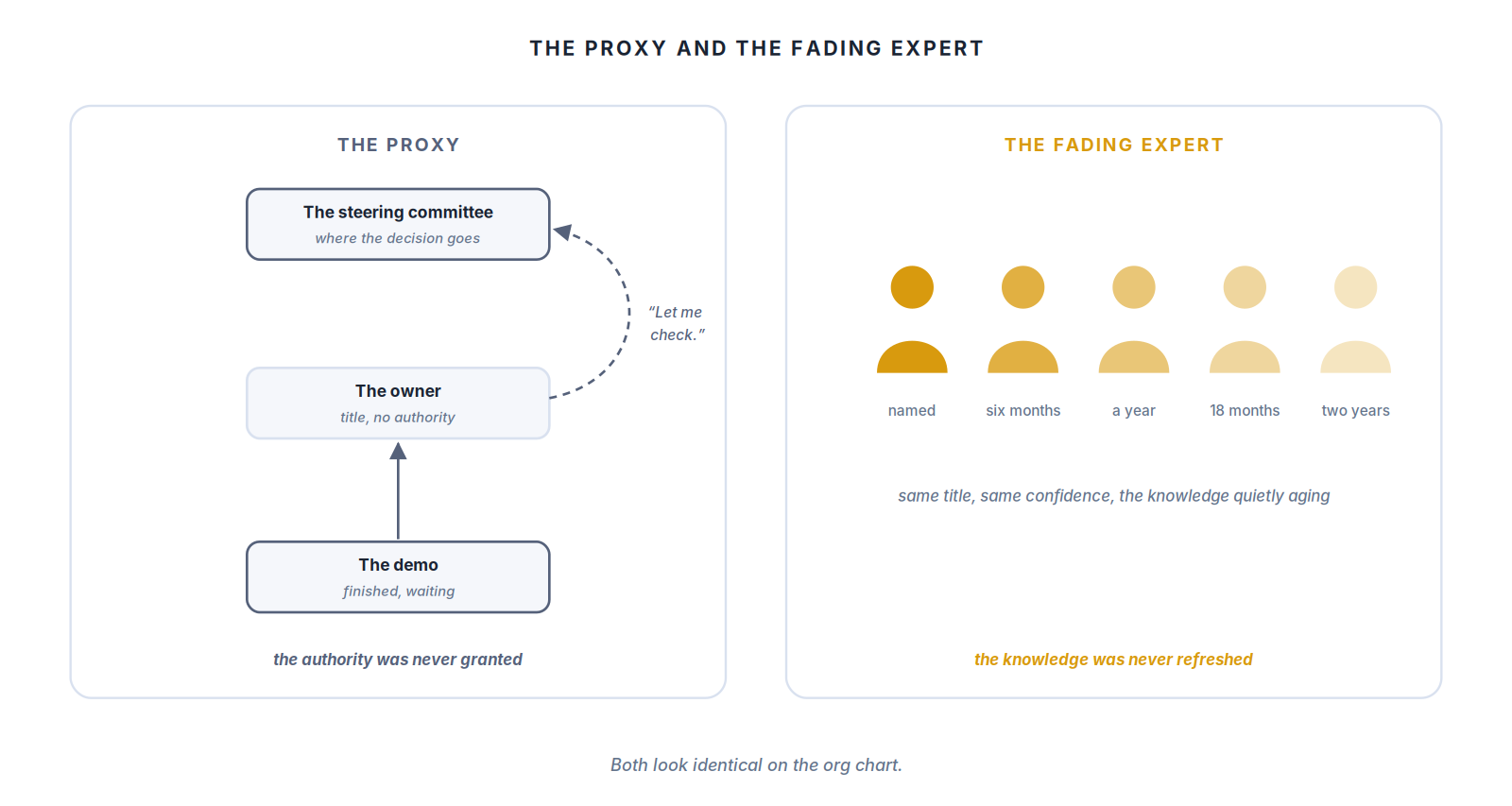
The oldest request in agile
In 1999, Extreme Programming asked for an on-site customer, an actual business person who sat with the team and answered questions the moment they arose [1]. In 2001 the Agile Manifesto put the same request in its principles, in words that could not be plainer. "Business people and developers must work together daily throughout the project" [2]. Scrum made it structural. The Product Owner is one person, not a committee, accountable for the value of the work, and the framework's authors added a condition that reads today like a warning label. For the role to work, the entire organization has to respect the person's decisions [3].
Reread the Agile Manifesto today and the striking thing is what survived. Its four values each set something human over something heavy. Individuals and interactions, working software, customer collaboration, responding to change. The practices built in their name have been renamed, merged, and retired. Whole certification economies rose and thinned out. Through all of it the values did not move. The values are permanent. The ceremonies were scaffolding. And the third value, customer collaboration over contract negotiation, was the empowered owner ask all along. Someone from the business, close enough to collaborate, trusted enough that the collaboration is the contract.
Twenty years of frameworks renamed that person a dozen times. Product Owner, Product Manager, value stream owner, business owner. Marty Cagan spent much of that time describing what enterprises produced instead, teams staffed to ship a roadmap handed down from elsewhere, fed by intermediaries who gathered requirements from the people who actually knew [4]. Melissa Perri gave the resulting condition its name, the build trap, organizations measuring what they shipped because nobody in the room was empowered to own what it changed [5].
The ask was constant. The answer, in most places, was no. The exceptions are real, and worth studying. A good empowered owner changes how everyone around them works, and there are products whose whole coherence traces back to one person who knew the domain cold and was actually allowed to decide. But nearly every one of them grew in unusual soil, a founder still in the room, an executive spending personal capital to shield the role, a company small enough that trust could stand in for structure. They are pockets of excellence, and they rarely outlast the person who made the space for them. The average reality in most organizations is the one this began with. The title shipped and the authority did not.
The tale of the proxy owner and the fading expert
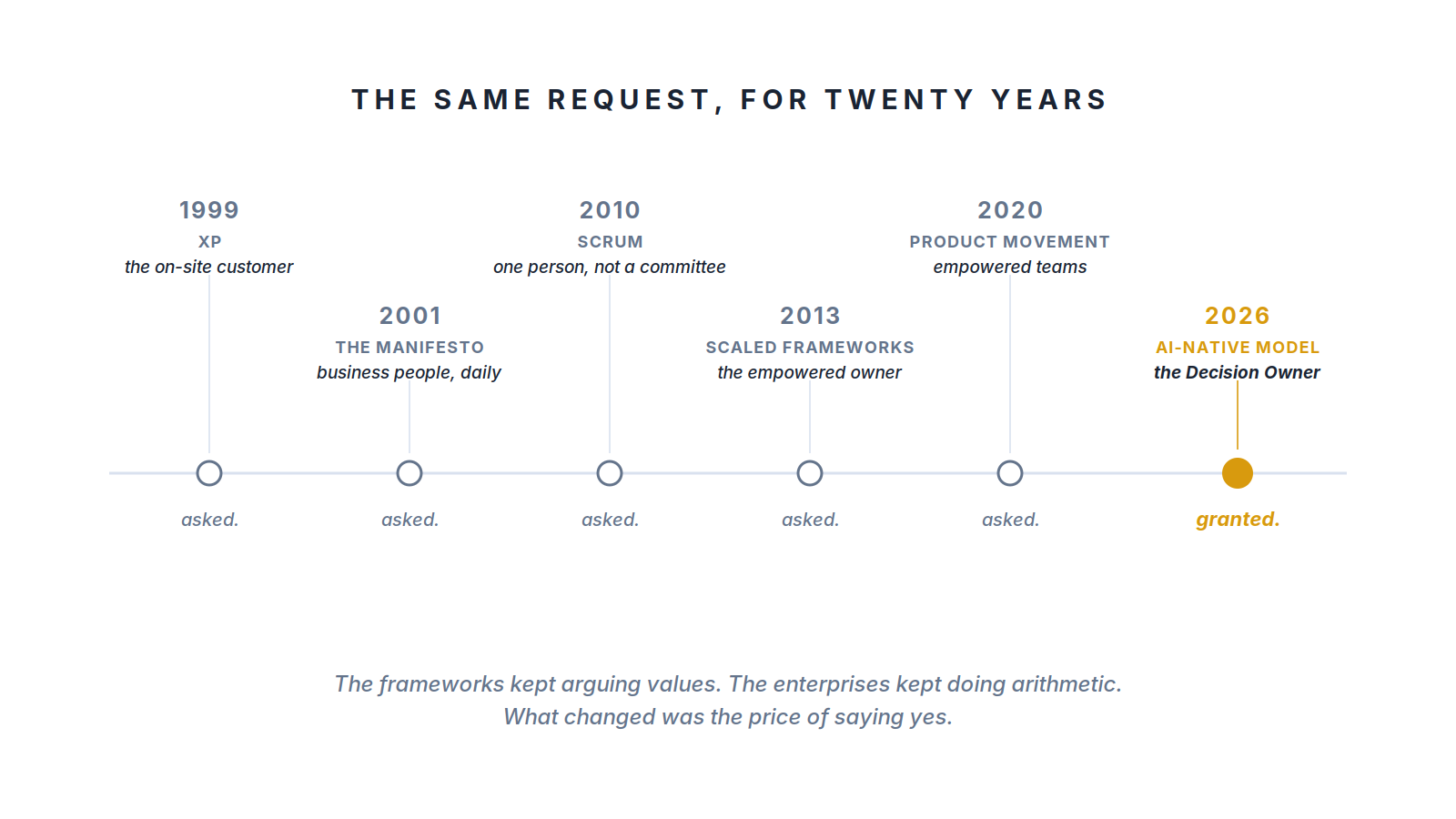
The famous failure is the proxy. The title is granted and the authority is not. The person can refine a backlog, attend every ceremony, and write acceptance criteria, but when the increment is demoed, the actual decision travels up and away, to a sponsor, a steering committee, a stakeholder review. Every acceptance becomes a round trip, and the round trip is where the week goes. This is the failure the frameworks warned about, and it is what "let me check" sounds like from the inside.
The second failure is subtler, and I have come to think it did more damage, because it happened to organizations that were genuinely trying. The company does the brave thing. It reaches into the business, extracts someone who truly knows the domain, and embeds them in delivery full time. For six months it works exactly as advertised. Decisions are fast, specs are grounded, the team finally has the context it was starving for.
Then the erosion starts, and nobody sees it, because nothing visible changes. The person still holds the same title and answers with the same confidence. But that kind of knowledge is fed by doing the job, and they stopped doing the job the day they moved. The market moved, the customers changed, the operation they used to run got reorganized twice. A year in, they are answering today's questions from last year's knowledge, and the organization has quietly converted its domain expert into a backlog administrator with excellent process skills and a fading map.
The person usually feels it before the organization does. Somewhere in the second year they catch themselves citing an example from when they ran the operation, and noticing that the example has aged. Some ask to rotate back. Most are told they are too valuable where they are, which is true in the worst way. The team has become dependent on exactly the knowledge that is expiring.
Both failures look identical on the org chart. Both produce a person called owner. One never had the authority, the other slowly lost the knowledge, and either one alone is enough to turn the role into ceremony.
The committee's arithmetic
The naive explanation for twenty years of resistance is that leaders would not let go. But that is not at all what is really happening. Executives make consequential decisions all day long. They approve capital plans, sign acquisitions, kill and launch whole product lines. Nobody who has watched a leadership team at work concludes that these people are afraid to decide. But look at what surrounds an executive decision. Staff work ahead of it, controls underneath it, audit behind it, a board above it. The enterprise has spent a century building an apparatus that makes big decisions visible, bounded, and survivable, and that apparatus lives at the top of the house.
Now look at what surrounded the decision the frameworks wanted pushed down. Acceptance was invisible. When a person accepted work, nothing independent stood behind the act, just their judgment and a demo that showed one path through the system. The blast radius was unbounded. A bad acceptance could compound quietly for a quarter before anyone noticed. The frameworks were asking organizations to hand real authority to a person standing in the open, with no apparatus around them at all. Enterprises declined, and not because they distrust decision makers. They know exactly what safe deciding requires, and the working level had none of it. The committee was the one piece of apparatus that could be stretched down that far. It is slow, and it spreads a wrong call thin enough that no single person wears it, and both properties were the point, because slowness and shared blame were the only protections on offer.
So treat the history as information. Authority in an enterprise flows to wherever the apparatus for exercising it exists. For twenty years there was no apparatus at the working level, so authority pooled at the top and the committee stood in below, charging for the service slowly, in delay and drift that never appeared on anyone's books. The frameworks kept arguing values. The enterprises kept doing arithmetic. The arithmetic wins that argument every time it is run.
The expensive part moved
Then the production layer started to industrialize. I wrote about the mechanism in Intent Architecture, and the short version is enough here. When AI fleets build at machine speed, an increment that used to take a sprint takes a day, and ambiguity that used to be absorbed by slow humans now compiles into confident, plausible, wrong software before anyone convenes anything. The committee's defining property, its slowness, flipped from safety mechanism to failure mode. A decision seat that answers weekly cannot govern a system that produces daily. The fleet does not wait for the steering meeting. It guesses.
Look at what that does to the cost of a delayed decision. It used to be nearly free. The work crawled, so judgment could afford to crawl beside it, and a week spent deciding barely registered against a quarter spent building. Now the same week of indecision idles a fleet that builds daily, or worse, leaves it building on a guess, and delay quietly becomes the biggest line item in the operating model. The scarce input is no longer the capacity to build. It is human judgment, supplied at the speed of the building.
But the same shift repriced the other side of the ledger, and this is the part I find genuinely new after twenty years of watching the standoff. Every condition that made empowerment expensive has inverted.
Acceptance is no longer invisible. The work arrives with a harness of executable checks, and every acceptance is recorded with its evidence, so authority is exercised in daylight. The blast radius is no longer unbounded. One increment, one day, rollback proven, policy constraints enforced automatically, which makes a wrong acceptance a cheap, visible, same-day correction instead of a quarter of silent drift. And the scope of the authority is written down once, at the start of an outcome, an envelope that says what this person may accept alone and what escalates. Bounded authority, exercised against evidence, inside a one-day blast radius, is simply not the risk the committee was built to manage. The apparatus that has always surrounded executive decisions finally exists where the work happens.
Be careful, though, about picturing the fix inside the old ceremonies, because the ceremonies go too. In the AI-native operating model this comes from, there is no sprint left to review. The increment is a day long. Planning is twenty minutes, the spec is the morning's work, the fleet builds at machine speed, and the work arrives the same day with the harness evidence already attached. The scene from the opening does not get improved. It gets replaced by a smaller scene that happens every day. The owner looks at what landed and what the harness proved, asks their questions, and accepts, inside an envelope written once at the start of the outcome. The acceptance is recorded with what it was based on, the decision is made in the room by the person who watched the work arrive, and the next day's increment starts knowing where it stands. None of this is scrum tuned to run hotter. The cycle is new, the seat is new, and the governing layer underneath them both existed in no framework before this one. And none of it is offered as settled science. This is the operating model we are building at Singularics, uncovering what holds by doing it and helping others do it. The claims here are the ones the work keeps proving back to us, and they deserve to be read the way everything else in this history was read at first, as a proposal with the evidence still arriving. That is all the Manifesto was on the day it was signed. There is nothing heroic in the scene, which is what makes it repeatable. Empowerment in the old argument always sounded like a leap of faith. Against evidence, inside a bounded envelope, exercised daily rather than quarterly, it looks more like a routine.
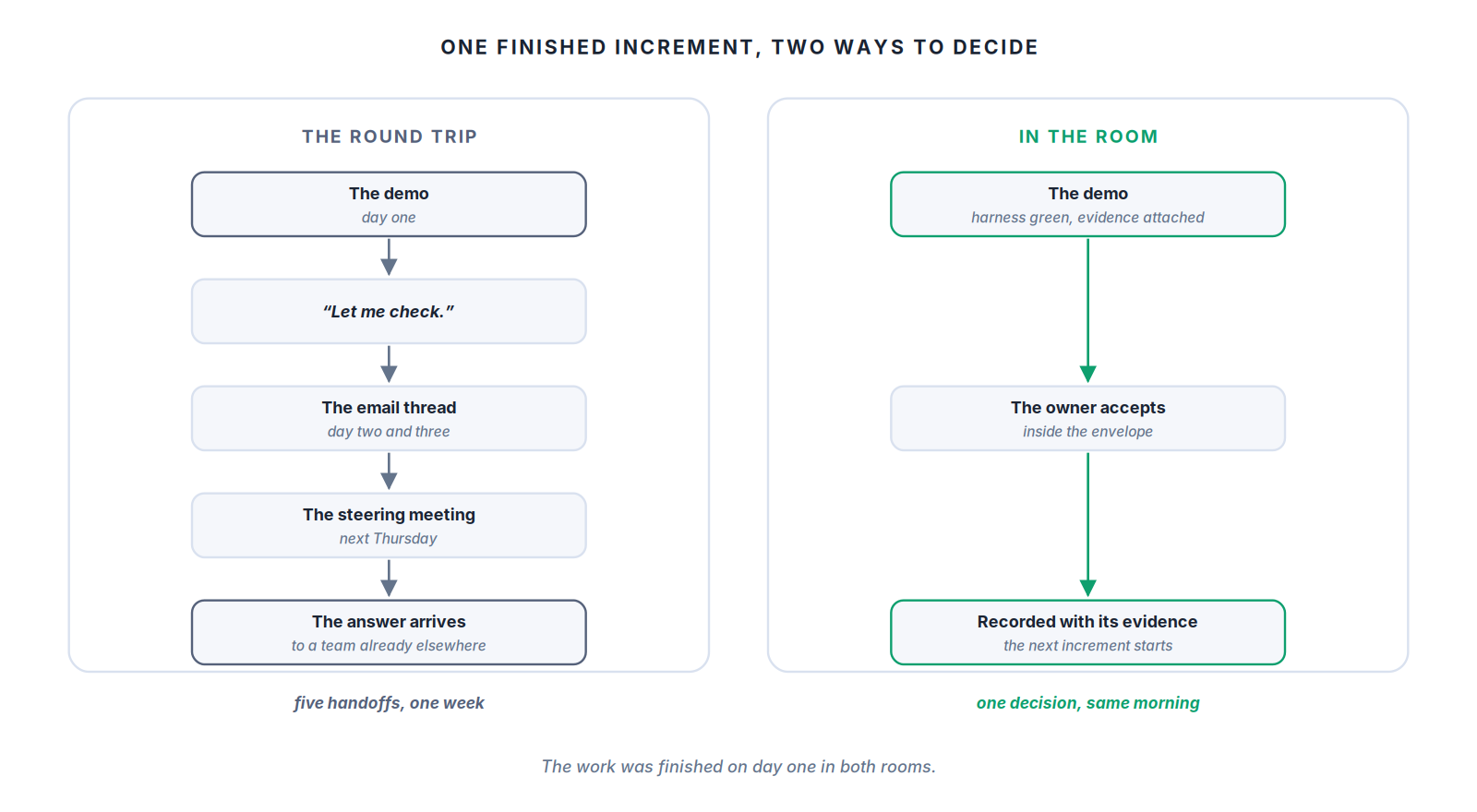
It is worth saying what that scene actually is, because it is easy to mistake it for a process tweak. When machines carry the production, the judgment in that room, what is worth building and whether what came back is right, is the most valuable work a human does anywhere in the delivery system, and none of it can be handed to the machinery that makes everything else fast. The model's name for supplying it this way is continuous governance. Judgment injected constantly, in small daily doses at the point of work, inside an envelope, against evidence, instead of summoned quarterly to a conference room. The Decision Owner is that discipline given a chair and a name.
For the first time since the Manifesto, it costs an enterprise less to empower one person than to run the committee. Nobody had to win the values argument. The arithmetic changed sides.
The Decision Owner
The role built on that new arithmetic needed a name, and in the operating model I gave it one. I call it the Decision Owner. Not product owner, because twenty years of proxies wore that title down to backlog maintenance, and because the product was never the thing being owned. The decisions were. What is worth building, whether what came back is right, and when the evidence is enough to say so. And half the time there is no product in sight anyway. Plenty of what these owners decide about is internal, a platform extended, a shared service hardened, the plumbing that never sees a customer but that everything customer-facing stands on. That work has waited for a real owner as long as any product has. A business domain expert who owns one outcome at a time, is released to it for most of their week, is present every day, and accepts the work personally against the harness evidence. The empowered product owner, finally, under a title that says what the role does.
Readers who know the product literature will hear an echo here, and the difference is worth being precise about. Cagan and Perri spent years asking organizations to be brave, to grant the authority and trust the person. The ask was right, and the track record shows what it was up against, because courage is not a system property. It arrives with individual executives and it leaves with them. The envelope, the evidence, and the one-day blast radius remove the need for courage altogether. An organization does not have to be brave to grant authority it can watch being exercised in daylight and reverse by tomorrow. Nobody is asked to trust more. Trust just got cheaper.
And if you have carried the product owner title through some part of those twenty years, you are not the cautionary tale in any of this. The proxy was never a person. It was a position description with the decision removed, and the people who did the job anyway, who learned the domain, took the meetings, and shipped through the round trips, are the obvious first names for this seat. The model does not retire those people. It seats them.
The knowledge atrophy law
Empowerment fixes the authority failure. It does nothing for the knowledge failure, and it can make it worse, because a fully empowered owner who is wrong is wrong faster and with less friction than a proxy ever was. An owner's decisions are only as good as their picture of what customers actually value, and that picture is exactly where enterprises most reliably substitute their own consensus for evidence. Every large organization believes it knows its customer. What it usually knows is what its customer wanted the last time anyone honestly checked. Ask a leadership team when one of them last watched a real customer use the product. In most rooms the question takes longer to answer than anyone expects.
The companies that got this right built mechanisms rather than sentiment. Amazon makes teams write the press release and the customer FAQ before any work begins [6]. Toyota built go-and-see into its management system [7]. Steve Blank put it on an index card, there are no facts inside the building, so get outside [8]. And Noriaki Kano supplied the finding that turns all of this from a one-time fix into a standing discipline. What delights customers decays into what they expect [9]. Customer knowledge has a half-life. The question is never only whether anyone checked, but when.
So the operating model treats customer evidence the way it treats a policy constraint. It enters the outcome brief when the brief is authored, cited and dated, and a brief that cannot point to where a customer said it, showed it, or did it records an assumption to be tested rather than a fact to build on. The rule is short. Evidence, not assumption. A fleet will execute a confident assumption about the customer with perfect fidelity, the same day, and the harness will prove that it did. Everything downstream of the brief is now rigorous. The honesty of the brief is the weakest remaining link, which is why it gets the discipline.
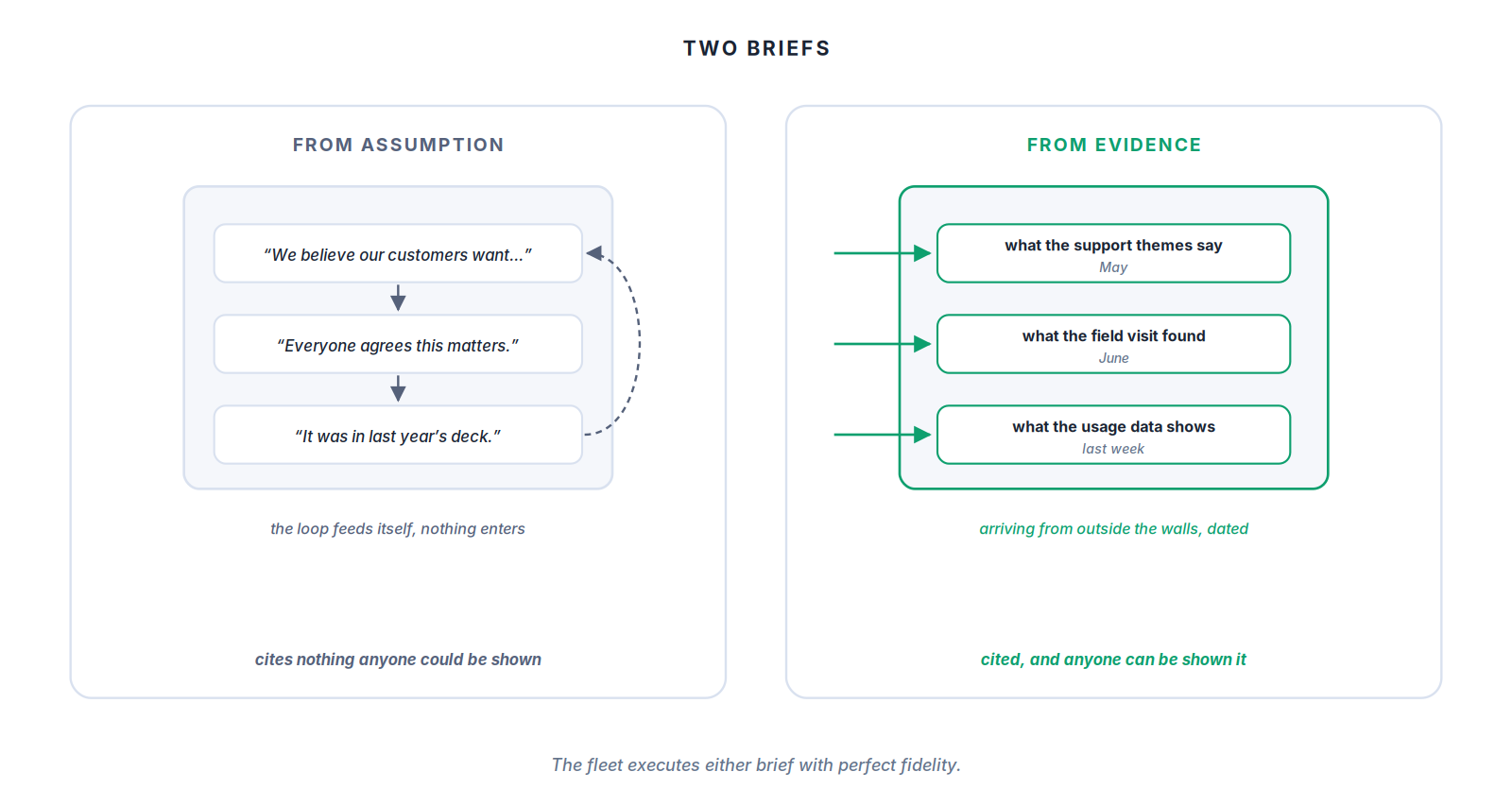
And if customer knowledge has a half-life, so does an owner's qualification. The person was named for what they knew, and what they knew has a date on it.
Stated as a law, because it behaves like one. An owner's qualification decays on the domain's clock, and only time in the business winds it back. The shape is a half-life, the same one that governs anything perishable. Let C be the currency of what an owner knows, and t the time since their last real contact with the business. Then
C(t) = C(0) · 2−t/h
where h is the half-life of customer truth in the domain, the time it takes for half of what an owner knows about their customers to stop being true. In fast consumer domains h is measured in months. In regulated operations it might be a couple of years. The fading expert two years into a domain with a one-year half-life is running on C(0)/4, a quarter of the knowledge they were named for.
Two things keep this from being decoration. First, C is measurable in principle. Write down the claims an owner would confidently make about their customers, and C is the fraction that are still true when someone checks. Second, the exponential is not a flourish. If each of those claims runs a small, roughly constant risk per month of being made false by a market shift, a reorg, a competitor's move, then the surviving fraction decays geometrically, and a half-life is the honest name for the rate. The same decay has been measured across whole fields of settled fact [10]. And note what the law is not about. Memory plays no part. The owner forgets nothing. The world moves.
The fix drops out of the same expression. The decay depends on t, the time since real contact, and on nothing else. Talent is not in the formula. Hold t small, by cadence rather than heroics, and the currency never leaves the neighborhood of full strength.
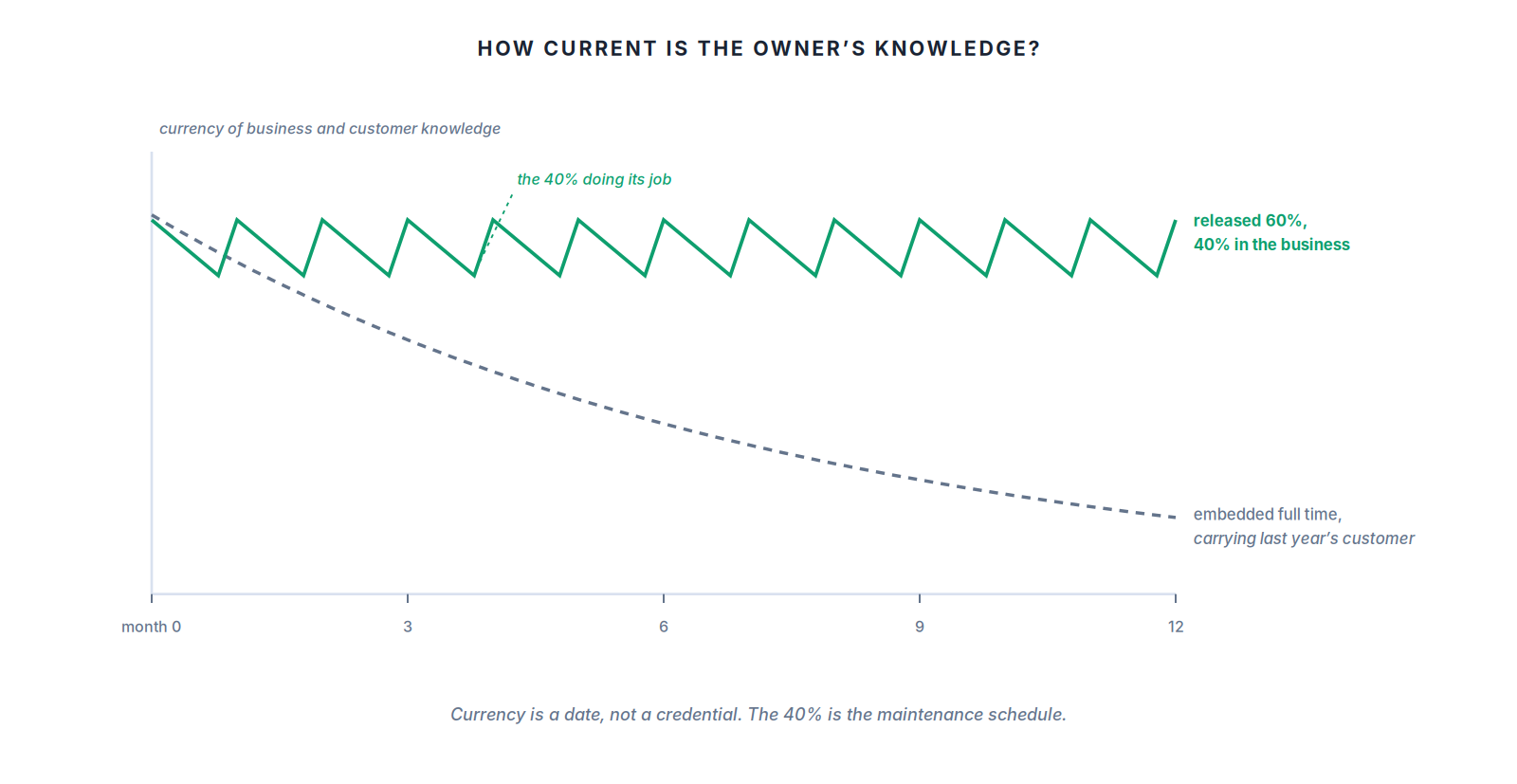
That is why the Decision Owner is released for 60% of their week and not all of it, and why the number is not the fractional allocation everyone watched fail in the agile era. The old job is gone, handed off and backfilled. What remains is one job with two seats. The 40% is the business seat, and it carries no deliverables at all. The owner keeps their chair in the rooms where strategy is set, hearing it now with delivery in mind, and spends the best of the time wherever the business touches people, scouting for the thing worth building next. The owner at an airline rides the morning bank of departures after a storm and watches what rebooking asks of a family of five. The owner of a state benefits program stands in the Monday queue and notices who brought a folder of paper because they have learned not to trust the portal. Customer means whoever the company exists to serve, and the ones who matter most are outside the walls, the people whose dollars keep cash flowing through the business, or the public an agency was chartered for. A reporter out working sources is not moonlighting. That is where the story comes from, and the desk is just where it gets written. The 60% is the tech seat, where what the field surfaced faces the delivery system and becomes a spec, an acceptance, and a daily judgment. The brief gets written in the room with the team. It gets found in the business.
Between outcomes, owners rotate back into the business entirely, because the guild they come from expects them back. An owner is an owner because of where they have been lately, not where they once were. The 40% is the maintenance schedule for the only asset the role runs on.
Request granted
The frameworks were right to ask. The enterprises were not wrong to resist. Both sides were doing honest arithmetic on the economics in front of them, and for twenty years the economics said committee. What the frameworks could not supply, and what no amount of coaching, certification, or reorganization ever supplied, was a change in the economics. AI is changing them now, mid-shift, while every enterprise watches. Waiting is becoming the expensive part and judgment the scarce input. Acceptance is turning into evidence, the blast radius is shrinking to a day, and the slow committee is sliding from insurance to the thing the whole system waits on. None of this is finished. It is the shift underway, which is exactly why the seat matters this year and not eventually.
And for the first time, the excellent version of this role does not have to be hand-built. The pockets of excellence were always assembled by one person creating unusual conditions, and they rarely outlived that person. The operating model makes the conditions structural. Owners come from the Domain Knowledge Network guild, carry its reach when their outcome crosses into a specialty they are not, write briefs against its dated customer evidence, and rotate back into the business it draws from. A guild like that is not there to support empowered owners so much as to produce them, one after another, on purpose. That is the difference between an exception you are lucky to hire and a norm you can run a portfolio on.
None of this is free, and pretending otherwise is how the old framing sold the role short. The Decision Owner is not a renamed product owner, and the network underneath it is not a committee with better branding. It is a new role standing on a new layer, and the layer is a genuine investment in how the organization operates. No prior framework had one, and no prior era could have forced one into existence, because for twenty years this layer was merely a good idea, and good ideas lose budget fights. What changes now is the consequence of going without. Every competitor is about to run the same machines, from the same vendors. The differentiating input left is the judgment behind them, and an organization that cannot inject that judgment at machine speed is running its fleets on guesses against rivals who are not. In the world every enterprise is entering, that stops being a maturity gap and becomes a competitive one, and competitive gaps at machine speed do not stay open long enough to study. The layer will get built not because it is wise but because it is survival equipment. The guild is named, funded, and scheduled. The owners' time in the business is cleared, not squeezed in around a day job. All of it shows up in the budget as a line that did not exist before, which is exactly right, because organizations have been paying for the absence of this layer for decades, in rework and stalled decisions, without ever seeing the bill. Funding the layer on purpose is cheaper than paying for its absence by accident.
So the oldest request in agile is finally being granted, not because the argument improved but because resisting it stopped being the safe option. There is a version of this story where that feels like vindication. I think the truer reading is humbler. The third value was always a conviction that a business person, close to the work and trusted with the call, beats any process built to avoid needing one. It took a machine that builds faster than a committee can meet to make the industry take that conviction literally.
The change will not announce itself. There will be no launch, no reorg, no new certification. One day a team will demo finished work to the person whose title says owner, and that person will look at the evidence, ask a good question or two, and say a different sentence. "Accepted." Nobody in the room will even notice. That is how you will know.
References
- Beck, K. (1999). Extreme Programming Explained: Embrace Change. Addison-Wesley.
- Beck, K., et al. (2001). Principles behind the Agile Manifesto. agilemanifesto.org/principles.
- Schwaber, K., & Sutherland, J. (2020). The Scrum Guide. scrumguides.org.
- Cagan, M. (2020). Empowered: Ordinary People, Extraordinary Products. Wiley.
- Perri, M. (2018). Escaping the Build Trap: How Effective Product Management Creates Real Value. O'Reilly.
- Bryar, C., & Carr, B. (2021). Working Backwards: Insights, Stories, and Secrets from Inside Amazon. St. Martin's Press.
- Liker, J. K. (2004). The Toyota Way: 14 Management Principles from the World's Greatest Manufacturer. McGraw-Hill.
- Blank, S. (2005). The Four Steps to the Epiphany: Successful Strategies for Products that Win. K&S Ranch.
- Kano, N., Seraku, N., Takahashi, F., & Tsuji, S. (1984). Attractive Quality and Must-Be Quality. Journal of the Japanese Society for Quality Control, 14(2).
- Arbesman, S. (2012). The Half-Life of Facts: Why Everything We Know Has an Expiration Date. Current.
Alex Petty is the founder of Singularics. He has spent 20 years leading enterprise transformations and now helps organizations redesign how work is defined and coordinated when AI changes the operating model.
Ready to see the role in practice? The Decision Owner, its qualification screens, envelope, and daily mechanics, is specified in The AI-Native Operating Model™. Take the free Readiness Assessment to see where you stand, or book a call to talk about what the shift looks like for your organization.