
The Decision Owner
The role that makes the daily cycle close
Every serious framework of the last twenty years has asked for an empowered product owner. Outside startups and founder-led companies, the real ones are rare enough to count on one hand. The people in the role were not the problem. They were capable professionals holding the title without the authority. They could write stories but not accept the work. They could prioritize a backlog but not say no to a stakeholder. When the increment was demoed, the actual decision went somewhere else, usually to a committee, usually next week.
Treat that history as information, not as a failure of conviction. Organizations withheld acceptance authority for a structural reason. Acceptance was invisible, the blast radius of a wrong call was unbounded, and the only control available was to route decisions through a committee. Given those conditions, withholding the authority was the rational move.
What changed is the cost of getting it wrong. When delivery time for a unit of work falls toward zero, the constraint moves to the slowest remaining human step: deciding what should be built, judging whether what came back is right, and supplying the domain knowledge needed for either call. The Decision Owner is the structural answer to that shift.
If the Decision Owner cannot accept, they are not an owner, and the daily cycle does not close. This is the most important thing to hold when the model meets an existing approval culture.
The proxy arrangement
The thing being retired is the routing, not the people caught in it. The product owner role as most organizations practiced it was an arrangement in which a capable professional sat between the business and the delivery while every real acceptance traveled past them to somebody with authority. The round trip was where the week went. This model removes the round trip and keeps the person.
The seat that replaces the arrangement belongs to a business domain expert who owns one outcome, is present every day, and accepts the work themselves. The people who held the old title are not displaced by that change. They know better than anyone where the round trips went and what they cost, and the ones who carry the domain directly are the first names for the new seat.
The qualification test
The qualification test is short. If they have to leave the room to answer a question about what the business needs or what the customer values, they are a proxy and not an owner. A proxy will silently stretch the one-day cycle back into a week, because every acceptance decision becomes a round trip to somebody else.
Four practical screens before naming someone:
- Can they describe, without preparation, what the outcome is worth and who is harmed if it is wrong?
- Can they say no to a stakeholder request without escalating?
- Have they ever been accountable for a business result rather than for a deliverable?
- Have they watched a customer use, buy, or struggle with the thing this outcome touches, within the last quarter?
Three of four is enough to start. Zero of four means you have found a coordinator, not an owner. The fourth screen is the one organizations skip, and it is the one that decides whether the outcome brief will be written from evidence or from the organization's confident assumption about the customer.
The shortlist is usually standing in plain sight. The people who carried the product owner title through the last twenty years, who did the job anyway without the authority, are the obvious first names for this seat. The model does not retire them. It seats them.
The job family
Decision Owners are a standing job family inside the Domain Knowledge Network, not a per-project appointment. Membership precedes any Effort. The desk job is gone, handed off and backfilled, and the family is paid above the business peers its members left, because this seat decides how the business shows up technologically for the people it serves.
Intake assigns rather than recruits. When an Effort clears No Owner, No Now, the Flow Council names at least one owner from the family, and a large Effort can justify two, sometimes three, the way a crew carries one to three Fleet Leads. Each owner still runs one Effort at a time. The scaling adds owners to the Effort, never Efforts to the owner.
An owner stands in three places. In the rooms where the business decides. Out where the business touches its people, in whatever way the domain makes natural. And at the crew's elbow, because a crew ships what the owner says in one-day bursts, sometimes half a day, and a question that waits overnight wastes a build.
The 60% that is not negotiable
This constraint kills the model when it is fudged, so it is stated as a hard number. A Decision Owner is released for at least 60% of their working week to a single outcome. Below that they cannot be present daily, and daily presence is the entire mechanism.
The remaining 40% stays in the business, and that split is a design decision rather than a leftover. This is one job with two seats, not two jobs run in parallel. The old duties are handed off and backfilled, and neither seat carries deliverables from the owner's former desk.
In the business seat the owner scouts. They are free to go wherever the business touches people, the airport gate during a meltdown, the claims office after the storm, the ride-along with the store greeter, and the standing question they carry is simple. What am I hearing out here that should be built? Presence in the field is not time away from the job. It is where the next brief gets found, and it keeps a chair in the rooms where strategy is set, heard now with delivery in mind.
In the tech seat they face delivery. What the business seat surfaced becomes a spec a fleet can run, acceptance made daily against the harness, and a judgment nobody has to wait a week for.
The seats feed each other, and each decays without the other. Business and customer knowledge are perishable, refreshed only by doing the business. An owner embedded full time stops being a business person within a year and starts carrying last year's customer, and at that point the thing that qualified them for the role has quietly expired. The 40% is what keeps the owner an owner. Stated as a law, because it behaves like one. An owner's qualification decays on the domain's clock, and only time in the business winds it back.
Organizations have always had people who scouted the business informally, on stolen time, with nowhere to take what they found. This is the first seat that takes both halves seriously, funds them, and wires them together.
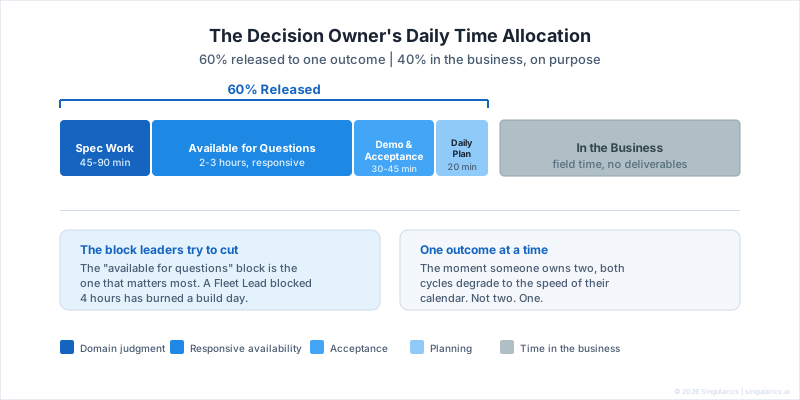
They own one active outcome at a time. Not two. The moment someone owns two, both cycles degrade to the speed of their calendar. The Flow Council has to hold this line, because the owner's instinct will be to say yes to a second.
Here is where a typical day goes:
| Activity | Time |
|---|---|
| Spec work on tomorrow's increment | 45 to 90 minutes |
| Available to the team for in-flight questions | 2 to 3 hours, responsive |
| Demo, judgment, and acceptance | 30 to 45 minutes |
| Daily planning | 20 minutes |
The "available" block is the one leaders try to cut, and it is the one to protect first. The spec and the demo have clean edges on the calendar. Availability is what absorbs the three to six questions that come up during a build day. A Fleet Lead blocked for four hours waiting on a judgment call has burned a build day.
Acceptance stays fast because most of the spec barely moves. The stable part, the outcome, constraints, policy, and data model, is 70 to 80% of the contract and changes rarely. Daily planning is a small delta decision against a mostly-written contract, not a fresh negotiation every morning.
Context engineering, the new fluency
This is the genuinely new skill in the role, and it is learnable in weeks rather than years. In practice it means four habits.
Knowing what the fleet needs to be told. Agents rarely fail because the work was hard. They fail because something was not stated. Fluency is noticing what you know that the fleet does not, and writing it down before it becomes a defect.
Writing criteria that are checkable. "Handles errors gracefully" fails the test. "Returns HTTP 400 with a structured error body naming the invalid field" passes it. See Spec-Driven Development for the checkability test.
Curating the context set. Which policy documents, prior decisions, and edge cases belong in the fleet's working context for this increment, and which are noise. More context is not better context.
Reading agent output critically. Recognizing when the fleet has produced something plausible and wrong. This is the skill that separates an owner who can accept in thirty minutes from one who needs a day.
It transfers by apprenticeship, not by training course. Pair a new Decision Owner with an experienced Fleet Lead for their first two weeks of spec sessions. The governing ratio: if the Decision Owner is typing more than they are deciding, the balance is wrong.
The arithmetic that changed
Fair question. The empowered owner has been asked for since the Agile Manifesto, and enterprises have declined every time. Four things change what granting the authority costs.
-
The envelope is set once, by the Intent Council. What the owner may accept unilaterally, what escalates, and the risk appetite are written at the start of the outcome, not renegotiated per decision. Functional behavior and reversible changes on a green harness, they accept. Anything touching a policy constraint, an external commitment, or spend above threshold escalates to the Flow Council. Regulatory interpretation and risk appetite stay with the Intent Council.
-
Every acceptance is made against evidence. The harness proves each increment, and the acceptance is recorded with its evidence in the ledger. Authority is exercised in daylight.
-
The blast radius is bounded. One increment, one day, rollback proven, policy checks enforced in CI. A wrong acceptance is a cheap, visible, same-day correction rather than a quarter of drift.
-
The sponsorship is an officer's. The sponsoring officer staked the outcome and released this person. The authority arrives with backing, not by exception.
Underneath the four sits a simpler law. Authority in an enterprise flows to wherever the apparatus for exercising it exists. Executive decisions have always traveled wrapped in staff work, controls, and audit, and the working level had none of that, so authority pooled at the top and the committee stood in below. The envelope, the harness, and the ledger are that apparatus finally arriving where the work happens. Nobody is asked to trust more. Trust just got cheaper.
The envelope is what makes daily acceptance safe in a regulated business. Without it, either everything escalates and the cycle dies, or nothing escalates and you have an audit finding.
When the owner is away
Daily presence is the mechanism, so absence is planned rather than absorbed. A day or two goes to a deputy named at formation, who accepts only increments where the harness is green and no policy constraint is touched. A week or more means the Effort transfers to a new owner with a real handover, or returns to Next until the owner is back. An open-ended absence is treated as a release lapse: the Effort returns to Next, capacity goes back to the pool, and the sponsoring officer is asked for a replacement.
Running a long absence on a deputy just produces a proxy owner by another route. Deputies are named at formation, not found on the morning someone calls in sick.
The failure modes
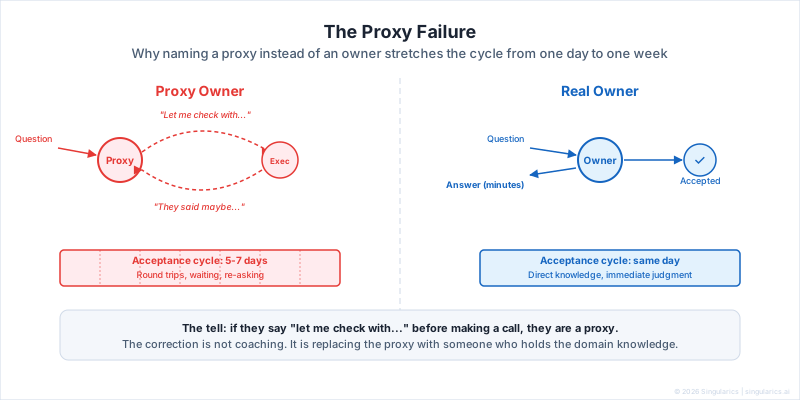
The proxy trap. The most common failure is naming a proxy instead of an owner. The tell is easy to spot: acceptance decisions consistently take more than a day, or the owner says "let me check with" before making a call. The correction is not coaching. It is seating someone who holds the domain knowledge directly, and finding the miscast owner the seat their knowledge actually fits.
Accepting on a red harness. Acceptance is a judgment call made against the harness evidence, not a rubber stamp on a demo. A demo shows one path through the system. The harness checks every path, every time. An owner who accepts on a red harness because "it looked right in the demo" has just taught the team the harness is optional, and within two weeks the team is back to demo-based acceptance, which is the process this model replaced.
The owner who used to be a business person. A subtler failure than the proxy trap, and slower. The owner was named for the currency of their knowledge, then spent a year embedded in delivery with no time in the business. The customer they carry is now last year's customer, and every brief they author is a memory rather than an observation. The tell is an owner who cites how it worked when they ran it rather than evidence from this quarter. The correction is structural rather than personal. Enforce the 40%, and rotate owners back into the business between outcomes.
Silence with the Fleet Lead. The Decision Owner and the Fleet Lead are a working pair, not a handoff. The owner says what is needed and judges whether it arrived. The Fleet Lead says how it will be built and whether the criteria are checkable. If the Fleet Lead asks no questions during a build day, they are either guessing or the spec over-specified the solution. Three to six questions a day is healthy. Zero is a warning.
Seeing yourself in the seat
Read the role against the job you hold now, because the model was built to be staffed from the jobs that already exist.
You carried the product owner title. You did this work for years without the authority it needed. The apparatus that was missing, the envelope, the harness, the evidence ledger, now exists, and the shortlist for the seat starts with you. The one genuinely new skill is context engineering, and it is learnable in weeks.
You are a business analyst. The institutional knowledge you hold is what the domain guild is made of. Analysts who can say what the business needs without leaving the room are owners waiting for a release, and the guild seat is a standing role either way.
You run part of the operation, or you face customers. The fourth qualification screen is already yours. The role was designed around presence in the business, and the 40% exists so you never have to stop being the person who qualified.
You are a project manager or a coordinator. The portfolio does not stop needing orchestration when the round trips go. Intake, triage, capacity planning, and the Flow Council's weekly machinery are staffed by people who can run a portfolio, and that work reads status from the ledger instead of compiling it.
The model is not short of places for any of these people. It is short of owners.
Its place in the Model
In The AI-Native Operating Model™, the Decision Owner sits in the Effort Teams + AI Fleets band with a green border, because the person comes from the domain knowledge guild. Green means domain judgment, and that is what the Decision Owner provides.
The role connects to:
- The spec, the Decision Owner's primary authored artifact, written daily with a spec agent
- The harness, their acceptance instrument, letting them accept work without reading code
- Daily planning, where they make the Confirm, Amend, or Replace call that sets the next cycle
- The Domain Knowledge Network, from whose guild they are drawn
- No Owner, No Now, the gate that ensures they are released before work begins
Read the essay Decision Ownership for the story of how this authority became grantable. Read the Decision Owner white paper (PDF). Return to the Model to see how the Decision Owner connects to the rest of the system.