
No Owner, No Now
Nothing enters active work without a named, released owner
Every organization has an approved-but-unfunded backlog. A list of initiatives that were approved, prioritized, and roadmapped, with no named owner and no funded commitment behind them. The backlog creates a comfortable illusion: the work appears to be in progress because it was approved, while nothing is actually happening because nobody is accountable for it daily. In the old model this was tolerable. Delivery was slow anyway, and the gap between approval and action was absorbed by the planning cadence.
In a daily cycle, that gap is fatal. An Effort without a Decision Owner cannot close the one-day cycle, because nobody can accept the work. Every acceptance becomes a round trip to someone outside the team, the cycle stretches from a day back to a week, and the week stretches back into a sprint, which is the operating model the organization just left.
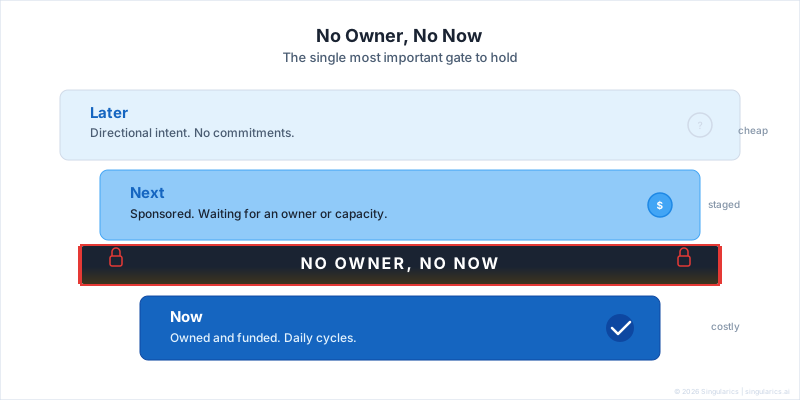
So the rule is blunt. Nothing enters the Now horizon without a named Decision Owner released to the committed level. Work without an owner waits in Next. It sounds like a simple intake rule. It is actually the gate that converts business ownership from an aspiration into a funded constraint, and it puts the true cost of an initiative on the table at intake rather than three months in.
Expect it to be tested repeatedly in the first quarter. Holding it is the difference between this model working and this model becoming vocabulary.
The problem the gate solves
Every prior operating model asked for business ownership of outcomes. The ask was rarely enforced, because enforcement means saying no to work that is ready in every other respect. A sponsored initiative with a clear business case, budget approval, and technical feasibility will stall at this gate if nobody from the business can be released to own it daily.
That stall is the point. Without the gate, the Flow Council would be asking teams to find owners it has no authority to free, and the cycle would start without anyone who can close it.
The gate is what makes the rest of the model possible. Not the daily cycle, not the spec, not the harness. The gate. Without an owner, none of those mechanisms have someone to close them.
The mechanics
The portfolio holds one roadmap in three horizons. Now is owned and funded, in daily cycles. Next is sponsored, waiting for an owner or capacity. Later is directional intent with no commitments. The boundary to guard is between Next and Now, and this gate guards it.
Released means released in practice, not on paper. At least 60% of the owner's working week to a single outcome, their officer's approval on the time, their standing obligations covered, and no second active outcome. The full shape of the owner's day is in The Decision Owner.
The sponsorship chain is what makes it enforceable. A request is approved by its own sponsoring officer before the portfolio ever sees it. Nothing arrives unowned and nothing arrives unsponsored. The sponsorship is not a formality, because the sponsoring officer is the only person who can release a business expert from their day job. Their approval is simultaneously the commitment of a Decision Owner.
Sponsoring officers decide that something is worth doing and fund the person to own it. The Intent Council decides where it sits against everything else in the portfolio. Keep these two decisions distinct.
Intake, triage, and formation then happen once per outcome. The request arrives with an officer's approval and a candidate owner. The Flow Council sets value, priority, and horizon, and a high-value request can still go to Next if no capacity is available. If it clears the gate, the council names the owner, commits capacity, and forms the team.
Where the gate gets tested
The "almost ready" request. Clear business case, approved budget, available team, and nobody from the business who can commit 60% of their week. The pressure to let it through is enormous, because letting it wait feels like waste. Hold the gate. The alternative is a team burning capacity without landing increments, which is the more expensive waste wearing a busier costume.
The proxy. The sponsoring officer names a coordinator or project manager as owner. The title test passes and the domain knowledge test fails. If they have to leave the room to answer a question about what the business needs, they are a proxy, and a proxy silently stretches the daily cycle back into a week. The tell in operation: acceptance takes more than a day, or the owner says "let me check with" before making a call. The correction is not coaching. It is replacement.
The dual assignment. An owner starts with one outcome and quietly picks up a second. Both cycles degrade immediately. The Flow Council holds the one-at-a-time constraint, because the owner's instinct will be to say yes.
The officer who will not release anyone. The hardest political test. The officer approves the initiative on paper and refuses to free the expert from their standing obligations. This is the gate working as designed. The officer is not being asked for a title. They are being asked for 60% of a specific person's week, which is a real cost, and if they cannot pay it, the initiative waits in Next until they can. If the business will not release an owner, it has not made the outcome Now, regardless of what the roadmap slide says.
Without it
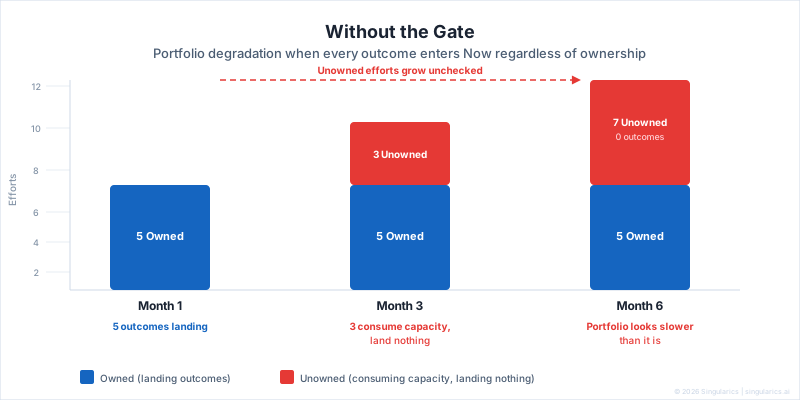
The unfunded Effort enters Now, the team starts building, nobody accepts daily, the Fleet Lead guesses, and after two weeks the rework cost exceeds the cost of having waited for an owner. The proxy cycle turns daily acceptance into a three-day round trip, the team adapts by batching, and within a month the organization has recreated sprints with new vocabulary. The overcommitted portfolio has five owners and eight Efforts in Now, and the three unowned Efforts consume capacity, produce nothing accepted, and make the healthy five invisible.
Underneath all of it is the ownership axiom. Machines can produce, and only humans can own. A fleet can generate output for a request whose trade-offs nobody is authorized to make. The gate keeps that ambiguity out of the daily cycle, and it forces the portfolio to reveal its priorities honestly.
The failure tells
| What goes wrong | The tell | The correction |
|---|---|---|
| Owner is a proxy | Acceptance takes more than a day; owner says "let me check" | Replace the owner |
| Owner released on paper only | Misses daily planning more than once a week | Raise release level or move outcome to Next |
| Gate not held | Work enters Now without a named owner | Flow Council enforces at triage |
| Dual assignment | Owner runs two outcomes | Flow Council enforces one at a time |
| Capacity never released | Same people on the same Effort beyond the outcome | Make release a minuted action with a date |
A related signal: an Effort that has produced no landed increment for a week is raised at calibration whether or not the owner proposes closure. That pattern usually means the outcome was reached, the Effort is blocked, or it should never have entered Now.
Its place in the Model
In The AI-Native Operating Model™, No Owner, No Now sits in the Portfolio Direction band as the gate between the Next and Now horizons. It is colored blue, because it is a Flow Council decision, and it connects directly to the demand intake flow on the left rail.
The gate connects to:
- The Intent Council, which sets the bounded authority envelope for each Decision Owner
- The Flow Council, which enforces the gate at triage and formation
- Fungible capacity, because releasing an owner is simultaneously a capacity commitment
- The three horizons, because the gate defines what moves from Next to Now
- The Decision Owner, whose qualification and release the gate tests
Read the No Owner, No Now white paper (PDF). Return to the Model to see how the gate connects to the rest of the system.