
The Intent Council
The officer body that sets direction and holds risk
The steering committee is a familiar room. Smart, senior people, receiving a curated status deck monthly or quarterly, making decisions on projections because that was what the process gave them. Between meetings, work either queued for their approval or proceeded without it, in which case the governance was theater. And because the process put operational questions in front of them, officers ended up deciding which team should work on what, decisions that then queued behind an officer calendar.
The Intent Council is what that body becomes when the queue is no longer survivable. It is the officer body that owns the outcome portfolio. It sets direction, holds risk appetite, and decides what only officers can decide. It does not run the work.
That last sentence carries most of the weight. The most common way this model fails at the leadership level is officers making work decisions, and when that happens the daily cycle dies regardless of how well the teams run.
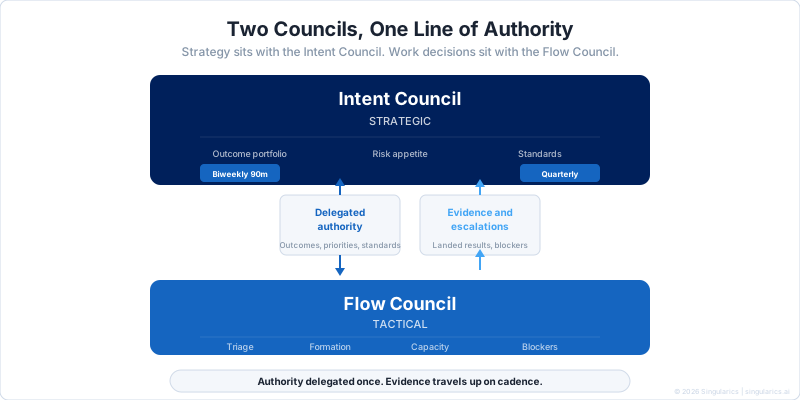
Authority is delegated down from the Intent Council once, and evidence and escalations travel back up on cadence. The Intent Council's discipline is to set the envelope and then let the Flow Council operate within it.
The steering committee's two habits
The steering committee, and specifically its two structural habits: reviewing progress at milestones from curated decks, and blurring strategy with operations. The Intent Council replaces it with a body that sets conditions once and lets the Flow Council operate within them.
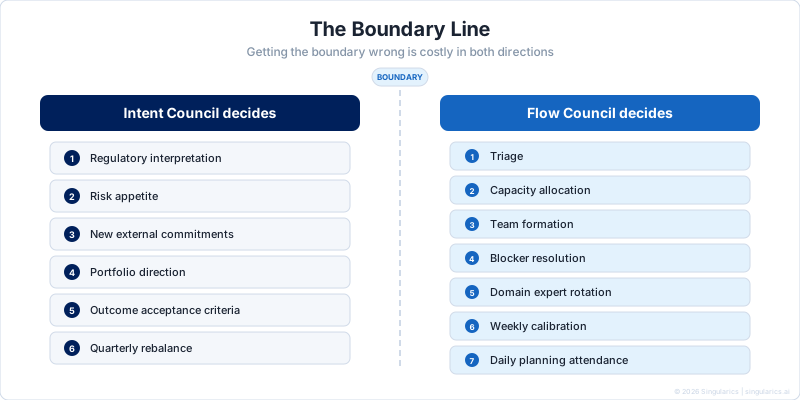
Getting the boundary wrong is costly in both directions. If the Intent Council makes work decisions, everything queues behind an officer calendar and the daily cycle dies. If the Flow Council makes strategy decisions, the portfolio drifts from the divisional objectives and nobody notices until a quarterly review.
The Intent Council's remit
The outcome portfolio. Strategic outcomes originate here. An officer declares an outcome, stakes it with sponsorship, and funds it by releasing a Decision Owner and committing capacity. The council holds the portfolio across all three horizons: what is worth doing, and in what sequence. It does not decide how the work is done, form teams, or clear blockers. Those are Flow Council decisions.
Direction and standards. AI governance policy, responsible use standards, data handling rules, and compliance frameworks are Intent Council decisions. Once set, they flow down as constraints in the spec and checks in the harness. Setting standards once and enforcing them through the harness scales. Reviewing each piece of work against the standards creates a queue.
Risk appetite. The council owns the dial. How much risk the enterprise will carry, by category. Regulatory exposure, financial thresholds, brand and customer harm, operational continuity, and the lines AI adds, model risk, responsible use thresholds, and blast radius tolerance, which this model holds to one increment, one day, rollback proven. The guardrails say never. The appetite says how far.
The declaration becomes real through the bounded authority envelope set for each outcome, once, at formation, and not renegotiated per decision. The workable default has three tiers. The Decision Owner accepts functional behavior, reversible changes, anything on a green harness touching no policy constraint. The Flow Council decides changes touching policy, external counterparties, or spend above threshold. The Intent Council keeps regulatory interpretation, appetite changes, and new external commitments. An appetite that lives in a policy document governs nothing. One that lives in envelopes governs every acceptance in the portfolio, every day, without the council in the room.
The limits
This list carries as much weight as the one above, because the temptation to do these things is where the model degrades.
It does not triage intake, form teams, or clear routine blockers. It does not review increments; the Decision Owner accepts daily inside the envelope, and the council sees individual increments only when an escalation brings one. And it does not write status decks, because nobody does. Status is read from the evidence ledger, not compiled.
Composition and cadence
The members must collectively be able to make three kinds of decisions without deferring to anyone: resource commitment, risk appetite, and strategic priority. If a member regularly says "let me check with my leadership" before a portfolio decision, they are a proxy for an officer rather than an officer. The same proxy test that applies to Decision Owners applies here.
The council runs on two cadences.
Biweekly working session, 90 minutes maximum. The Flow Council brings the portfolio evidence. The Now horizon is examined against landed results, direction is confirmed or adjusted, and escalations that exceeded the Flow Council's authority are resolved. This is a working session, not a readout. The council reads the evidence and makes decisions. If it takes more than 90 minutes, the evidence is not instrumented well enough, and closing that gap is Flow Council work. A healthy signal to watch here is the Confirm, Amend, Replace ratio across Efforts, which should sit near the ranges described in the one-day cycle.
Quarterly rebalance. The full portfolio against divisional objectives and the business environment. Outcomes reprioritized, the Later horizon pruned, risk appetite recalibrated, all informed by three months of accumulated evidence rather than projection.
Regulatory events, material risk discoveries, and external commitments do not wait for cadence. But if the council is handling ad hoc escalations weekly, either the envelope is too tight or the Flow Council is not empowered to resolve what it should.
A biweekly in ninety minutes
The session has a clock, and the clock is what keeps it a working session. The first ten minutes are silent, the council reading the ledger, not hearing it summarized. Thirty minutes on the Now horizon against landed evidence, outcome by outcome, with the Flow Council lead answering questions the ledger raises. Thirty minutes of decisions, every escalation that reached this level resolved in the room, because carrying one to the next session doubles its age. The last twenty minutes reset direction, confirming or adjusting what the next two weeks optimize for.
Compare the hour that the steering committee spent on the same portfolio. Forty minutes of presentation, fifteen of discussion, five of decisions deferred pending follow-up. The difference is not the people. It is that one room reads evidence and the other room watches slides.
One refused alternative deserves its sentence. Running this model under the old steering committee as a transitional courtesy produces two governance systems, and the old one wins, because it controls the budget calendar. The steering committee does not supervise the transition. It is what the transition retires.
The line between the councils
The two bodies form a single line of authority with a narrow boundary. The Intent Council sets the conditions: outcomes, priorities, risk appetite, standards, envelopes. The Flow Council operates within them: triage, formation, capacity, blockers, the daily run of the portfolio. Evidence and escalations travel up on cadence.
The reason the council exists at all is the first axiom of the model. AI amplifies direction; it does not choose it. The organization cannot delegate the choice of outcomes, the trade-offs between them, or the risk it is willing to carry. Those calls require officers who can bind the enterprise. A healthy Intent Council creates clarity that lets decisions move downward. An unhealthy one retains every decision and becomes the very queue the model was designed to remove.
See The Flow Council for the operating mechanics of the tactical body.
The failure modes
The officer who will not delegate. An envelope gets set, and then the officer overrides the Decision Owner's acceptances anyway, reintroducing the approval queue. Either tighten the envelope, if the concern is legitimate, or trust it and let the owner operate. Overriding it case by case is the one option that breaks the model.
The council that drifts back into a steering committee. The tell is a biweekly session that regularly runs past two hours and produces no decisions. Start every session with a decision agenda and end when the decisions are made.
The missing evidence. If the council relies on someone's summary instead of reading the ledger, the governance is weaker than it looks. The evidence ledger is the primary input to the session. If it is not readable or not current, that is an instrumentation gap to close, not a reason to reinstate the deck.
The sponsoring officer problem. The hardest political test: an officer wants an outcome in Now but will not release a Decision Owner. They want the work done without paying the cost. The council must hold the No Owner, No Now gate at its own level, because if officers do not hold it, the Flow Council cannot. Expect this gate to be tested repeatedly in the first quarter. Holding it is the difference between the model working and the model becoming vocabulary.
Its place in the Model
In The AI-Native Operating Model™, the Intent Council sits in the Portfolio Direction band, colored dark blue as the highest-authority direction body. It sets the conditions under which the entire model operates.
The Intent Council connects to:
- Strategic Outcomes, which it declares and prioritizes
- The Flow Council, which operates within the conditions the Intent Council sets
- Governance and Risk, because the Intent Council holds risk appetite
- The Decision Owner, whose bounded authority envelope the Intent Council sets
- The three horizons, which it owns and rebalances quarterly
Read the Intent Council white paper (PDF). Return to the Model to see how the Intent Council connects to the rest of the system.