
Strategic Outcomes
How enterprise strategy enters the operating model
Every organization has a strategy, and almost every organization has a gap between that strategy and the work its teams do each day. The gap is not caused by bad strategy or bad execution. It is caused by the translation layer between them, where strategic intent gets rewritten as projects, programs, and backlogs until the original meaning is diluted beyond recognition. A crisp officer-level intention passes through three planning layers and arrives at a team as a Jira epic nobody can connect to anything.
Strategic outcomes close that gap by stating what must become true, in terms that can be traced from an officer's declaration all the way down to a daily spec.
A strategic outcome is not a project name. It is not a deliverable. It is a statement of what the business needs to be true, owned by an officer and funded by a commitment of people and capacity.
The project charter and the initiative brief
The project charter and the initiative brief. An initiative carried a scope, a timeline, and a budget, and when the scope was delivered the initiative was done, whether or not the business condition changed. Organizations routinely closed initiatives as successful while the underlying problem persisted. The project model also separated funding from accountability: one group approved the budget, another did the work, and the business result was nobody's explicit job. The gap between "project complete" and "problem solved" was wide, expensive, and strangely normalized.
Three properties distinguish an outcome from that model.
It states a condition, not a task. "Reduce time-to-decision on customer requests from 14 days to 2 days" is an outcome. "Build an automated request workflow" is a project. The project prescribes a solution. The outcome states the condition and lets the team find the path. The team stops when the condition is met, not when the backlog is empty.
It is owned by a person, not a committee. An officer stakes it, and a Decision Owner is released to pursue it daily. If nobody will stake it, it does not enter Now. This is the No Owner, No Now gate applied at the strategic level.
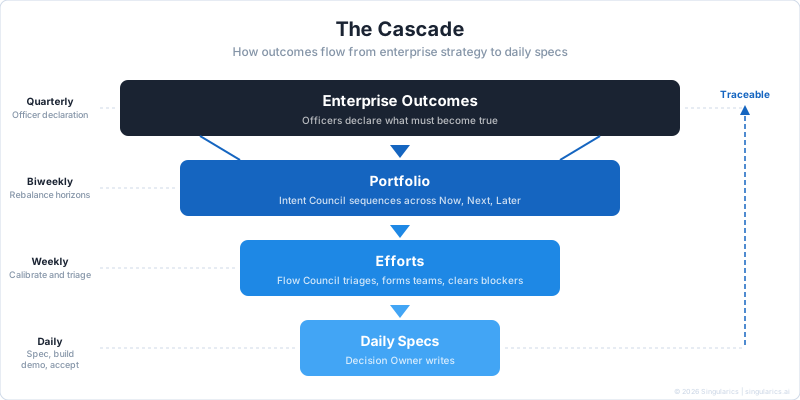
It is traceable to every daily increment. Every spec begins with a one-sentence trace to the outcome it serves. Not bureaucracy. It is how the organization knows, on any given day, whether the work across the portfolio connects to what the officers declared. The test is a one-minute walk. Pick any spec, read its trace sentence, follow it to the Effort, the Effort to the outcome, the outcome to its officer. If any hop needs a meeting to explain, the trace is broken at that hop, and the Intent Architect names the gap in the open.
How outcomes enter the model
They are declared, not requested. Outcomes originate with officers, out of the Intent Council's review of the business environment, divisional objectives, and risk appetite. The distinction does real work: a request goes into a queue, while a declaration carries the authority and resources to begin. An officer who declares an outcome is committing to fund it, which means releasing a Decision Owner and allocating capacity. The model runs on declarations because it runs on funded commitments, and anything less produces a shadow queue.
Keep the two officer functions distinct. Sponsoring officers decide something is worth doing and fund the person to own it. The Intent Council decides where it sits against everything else. Confusing the two is how intake turns back into a queue of unfunded good ideas.
They land on the horizons. Each declared outcome sits in Now, Next, or Later, as defined in Three Horizons. The Intent Council sets the horizons, the Flow Council enforces the gate between Next and Now, and the explicit cost of entering Now is what forces honest prioritization at the strategic level.
They arrive with a brief. Short, and for a specific purpose: enough for the Flow Council to triage, enough for the Decision Owner to write the first spec. The outcome statement in one sentence. Why now. The sponsoring officer. The candidate Decision Owner. The known constraints. What success looks like, in terms the harness can eventually check. What the brief does not contain is a solution, a timeline, or a resource plan. Those emerge from the one-day cycle.
A brief, worked
The artifact is small enough to show whole. An insurance claims division declares an outcome, and the brief that reaches triage reads like this. The outcome, first notice of loss to coverage decision falls from fourteen days to two. Why now, two carriers in the footprint already decide in under three days and retention is moving. The sponsoring officer, the claims VP, who has approved the release. The candidate owner, a regional claims director, four of four on the qualification screens. Known constraints, state notification rules and the fraud review threshold, both already encoded in the network. Success, a coverage decision recorded within two business days for 90% of standard claims, measured from the intake timestamp.
Seven sentences, and the Flow Council can triage it, the owner can write the first spec from it, and the harness will eventually check its success line. Notice what is absent. No solution, no architecture, no timeline, no resource plan. Those emerge from the daily cycle, and every attempt to front-load them into the brief is the project charter trying to come back.
Outcomes and Efforts
An outcome may take one Effort or several, and the distinction clarifies accountability. The officer owns the outcome; they declared it and funded it. The Decision Owner owns the daily cycle, accepting increments against the harness inside their envelope. The team owns the Effort, spec to landing, no handoffs. When an outcome needs multiple Efforts, the Flow Council sequences them, and decides whether the Decision Owner carries across or changes with the required expertise.
Underneath the mechanics is the model's first axiom. AI amplifies direction; it does not choose it. A model can generate options, expose conflicts, and execute a well-formed instruction at extraordinary speed. None of that answers the officer question: what should become true, and why is it worth pursuing now? The outcome is the human answer, and it only becomes useful when it changes what enters Now, whose judgment is present every day, and what every spec must prove. Not a longer cascade of plans. An unbroken line of decisions.
The failure modes
The outcome nobody will own. It sits in Next for a quarter because no officer will release a Decision Owner. That is a signal, and both readings are legitimate: the outcome is not as important as it appeared, or the cost of releasing someone is higher than the organization will pay. What is not legitimate is leaving it in Next indefinitely as a form of organizational politeness.
The shadow outcome. Work arrives as "technical debt remediation" or "infrastructure modernization" or "compliance readiness." Each may be real and necessary, and each still needs an outcome statement saying what becomes true when it is done. Without one, there is no way to know when to stop.
The project in outcome clothing. "Build a new servicing portal." The tell is that the statement can be satisfied without the business condition changing. Ask what becomes true for the business when this is done. The answer is the outcome.
The outcome that is too large. If the Decision Owner cannot trace a daily spec to the outcome in one sentence, the outcome is too far from the work, and the specs go vague. Split it until the trace is obvious.
The unfunded mandate. A named owner, nominally at 60%, operationally at 20% because the sponsor never actually covered their standing obligations. The cycle degrades, increments stop landing, and the organization concludes the model does not work. The correction is not coaching the owner. It is holding the funding commitment. Released means released.
Outcome, not initiative, not epic
An initiative is done when the scope is delivered, whether or not anything changed. An epic is a container for stories, with no built-in accountability for a business result. An outcome is a condition that must become true, and it is done when the condition holds, which may take less work than anyone imagined or more.
The distinction prevents the most expensive failure mode in portfolio management: delivering everything that was planned and achieving nothing that was needed.
One pacing note. An outcome should produce its first landed increment within the first week of a 90-day engagement. If intake to first landing takes six weeks, the constraint is upstream of the team, not in the daily cycle.
Its place in the Model
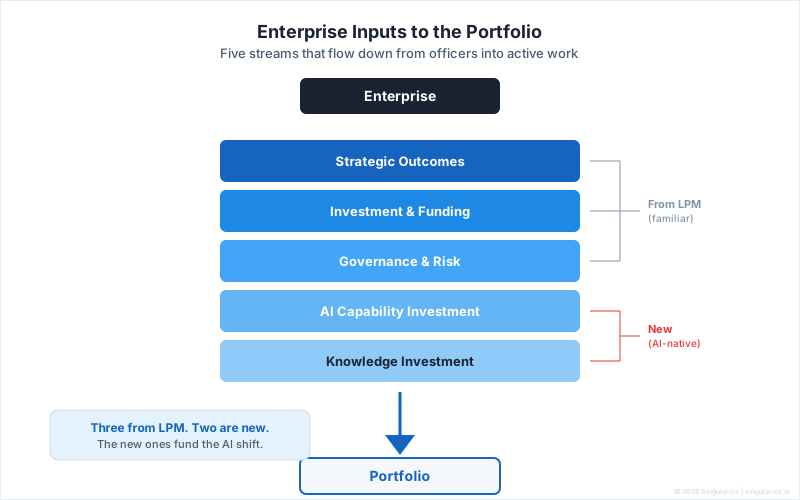
In The AI-Native Operating Model™, Strategic Outcomes sit at the top of the left rail, in the Enterprise Inputs band. They are colored dark blue, because they are officer-level direction that flows down into the portfolio.
Strategic outcomes connect to:
- The Intent Council, which declares and prioritizes them
- The three horizons, where they are placed on the roadmap
- No Owner, No Now, the gate that controls when they enter active work
- The Decision Owner, who pursues the outcome through daily cycles
- Investment and Funding, because declaring an outcome is simultaneously a funding commitment
Read the Strategic Outcomes white paper (PDF). Return to the Model to see how strategic outcomes connect to the rest of the system.