
Investment and Funding
How capacity is funded in an AI-native operating model
Annual budgets, project-based funding, and stage-gated approvals exist because committing resources used to be a high-stakes, hard-to-reverse decision. They were reasonable machinery for an expensive, slow world. When delivery time falls toward zero, that machinery does not disappear. It becomes the bottleneck. An organization that can build and prove an increment in a day but takes six weeks to approve the funding for it has moved the constraint from execution to finance.
Funding in this model follows outcomes, not projects. Capacity is pooled, committed to Efforts, and released when the outcome is met. The unit of financial commitment is the outcome, and the unit of financial accountability is the increment.
Project budgeting's three distortions
Project-based budgeting, and its three familiar distortions. Starting new work required a capital request that took weeks, so the organization over-committed at planning time to avoid going back. Redirecting capacity meant closing one project and opening another, which took more weeks, so an outcome that proved valueless in March kept consuming capacity until December. And the cost of any initiative was invisible until the project ended, because spending was tracked against the project code rather than against value delivered.
The pool model replaces all three. Funding goes to capacity. The Flow Council holds one pool of people and agent fleets, commits it to Efforts based on the priority the Intent Council sets, and redeploys it at release. The financial question at intake stops being "how much will this project cost?" and becomes "is this outcome worth the capacity it will consume, given what else the capacity could do?"
The PMO's people land well in the new machinery. The craft of tracking commitments and spend does not retire, it gets a live ledger instead of a monthly compilation. Portfolio operations, cost-of-delay analytics, and the minuted release discipline are theirs to run, and they are the shortlist for running them.
The three budget lines
People. Decision Owners, Fleet Leads, and domain experts. Their time is the most constrained resource, and funding their release is the real cost of an initiative. When a sponsoring officer releases a Decision Owner at 60% of their week, the cost is the work that person is no longer doing for their home function, and the officer can feel it.
Agent fleet capacity. Provisioning, model access, and compute. This line did not exist before, and treating it as a rounding error is how organizations end up with shadow AI spending scattered across team discretionary budgets. Fund it explicitly, meter it, and let the Flow Council allocate it from the pool alongside human capacity. See AI Capability Investment.
Domain knowledge. The 20 to 30% commitments that staff the Domain Knowledge Network. Knowledge that is unfunded becomes knowledge that is unavailable, which becomes work that is wrong. See Knowledge Investment for why this line pays for itself.
Token economics
Fleet spend arrives denominated in tokens, and the bill has a shape most finance teams do not expect. Production is not the expensive part. Context is. Every call an agent makes carries its working context with it, priced per token, and that context is paid for again on every call, multiplied across parallel agents and multiplied again when formations spawn. An organization that thinks of AI cost as "what the model writes" is budgeting for the cheap half of the bill.
Conservation is a discipline with named levers.
Curated context packs. More context is not better context, and in token terms it is not even neutral. Every unneeded document in a pack taxes thousands of calls a day. The pack that carries exactly what the increment needs, and nothing else, is a quality practice and a cost control wearing the same clothes.
Model routing. The right model for the task, reasoning tiers for spec and architecture work, workhorse tiers for production builds, utility tiers for the routine. The cost ratios run roughly 30 to 3 to 1, so routing discipline is worth more than any negotiated discount. See AI Capability Investment.
Reuse of the stable part. The stable 70 to 80% of a spec changes rarely and can be carried efficiently, while the knowledge graph serves targeted retrieval instead of wholesale context dumps. Pay for the delta, not the encyclopedia.
Spawning discipline. Formations swell, and every spawned agent inherits context. Metering catches the Effort that quietly doubles its agent count before it doubles the compute bill.
The standards behind the first lever belong to the Intent Architect, whose concerns include exactly this, the right knowledge at the right cost, a discipline described in Intent Architecture. Context curation turns out to be one of the quieter finance roles in the model. And the health test is one line: token spend per accepted increment trends down as packs mature, while coverage and acceptance hold. Rising token spend with flat acceptance is the fleet drowning, not working.
Portfolio economics
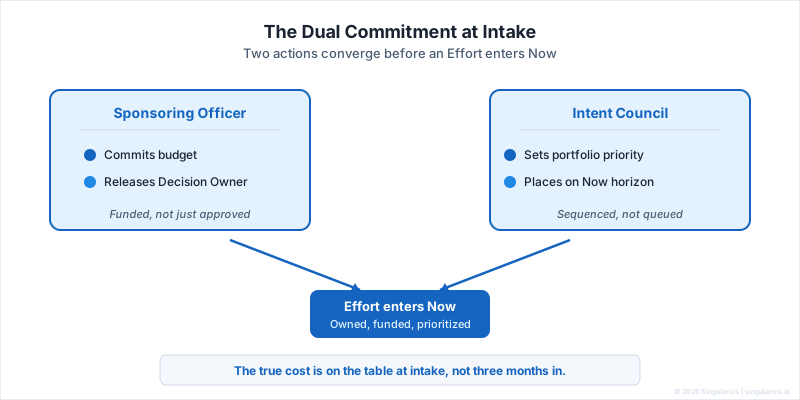
The cost of an outcome is visible at intake. Because No Owner, No Now requires a funded owner before work enters Now, the sponsoring officer is not approving a budget estimate. They are committing a specific person's time. This transparency is uncomfortable, and that is the point. An organization that cannot see the true cost of starting something new will start too many things, staff them thinly, and finish none of them well.
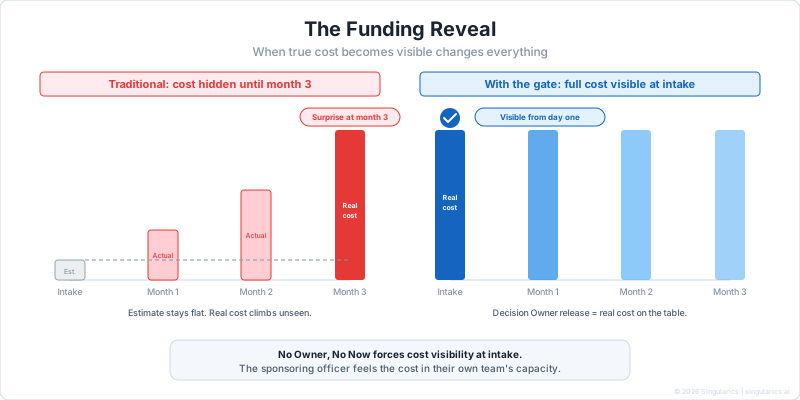
The cost of an increment is knowable. Each daily cycle consumes a known quantity of capacity: the owner's time, the Fleet Lead's time, the relevant expert time, and a metered quantity of compute. Cost per increment is calculable, which produces a unit economics picture that project budgeting never could. The purpose is not to optimize cost per increment. It is to make portfolio decisions honest.
Cost of delay is the only urgency metric. Every outcome in Now has a value lost per day it is not achieved, and it is the only metric that compares unlike work on a common scale. It also provides the exit: when the remaining increments cost more than the delay they prevent, the outcome is declared sufficient and the capacity releases. Without that number, Efforts drift past the point of value because nobody has a figure that says stop.
Underneath the mechanics, one thing has to be understood by the people who hold the money. Funding only developer capacity while treating owner time and expert time as free does not reduce cost. It hides the real cost in waiting, rework, and decisions that arrive too late. Money, authority, and attention move together in this model, and if any one of the three stays fixed while the others move, the portfolio is running the old model under new language.
The constants
Audit obligations remain, and the trail is stronger: every allocation recorded, every commitment sponsored, every release minuted with a date, continuously rather than at project close. Approval authority remains with officers: the Intent Council approves outcomes and priority, sponsoring officers approve releases, and the Flow Council allocates inside its envelope. Nobody spends without authorization; the chain is just shorter because each commitment is smaller. Financial reporting still happens, and what changes is the content: capacity against outcomes, cost per increment, and value against cost of delay, produced as a byproduct of the daily cycle rather than compiled by a PMO.
The failure modes
The unfunded mandate. A named owner, nominally at 60%, operationally at 20%, because the standing obligations were never covered. The cycle degrades and the organization blames the model. Hold the funding commitment. Released means released.
The shadow budget. AI tooling costs accumulate in team discretionary spend, invisible to the Flow Council, with inconsistent model selection and quarterly cost surprises. Centralize, meter, allocate from the pool.
The annual lock-in. Funding approved once a year, unredirectable mid-year. The pool model requires capacity to follow evidence, which means funding follows outcomes rather than calendar cycles.
The "free" knowledge network. Experts participate without explicit funding, their home functions treat network time as stolen from real work, and availability degrades until the network exists in name only.
Getting started with finance
The model does not require a new chart of accounts. It requires one conceptual shift, funding capacity instead of projects, and it can start with one outcome. Fund the owner, the Fleet Lead, and the fleet capacity from a single pool, track cost per increment, and after one quarter the unit economics will tell a clearer story than any business case written in advance.
As the portfolio grows, the pool gets more efficient, because redirection no longer carries the overhead of closing and opening projects. And when an outcome costs more than expected, the rising cost per increment is visible at weekly calibration, early enough for an informed call: continue, re-scope, or return the capacity to the pool.
Its place in the Model
In The AI-Native Operating Model™, Investment and Funding sits in the Enterprise Inputs band at the top left, colored dark blue. It is the mechanism by which strategic intent becomes a resource commitment.
Funding connects to:
- Strategic Outcomes, because declaring an outcome is simultaneously a funding commitment
- The Intent Council, which sets portfolio priorities and approves capacity allocation
- Fungible Capacity, because the pool model is how funded capacity is deployed
- AI Capability Investment, which is the new budget line for fleet provisioning
- Knowledge Investment, which funds the Domain Knowledge Network
Read the Investment and Funding white paper (PDF). Return to the Model to see how funding flows through the system.