
The Fleet Lead and Agent Fleet
Judgment stays human. Production does not.
The best senior engineers earned their standing at the keyboard. Their value was measured in the code they wrote and the design calls they made, and the team's throughput was mostly a function of their output. That era produced a deep instinct: when the stakes are real, do it yourself.
The Fleet Lead role asks those same people to give that instinct up. When agents produce far more implementation per day than any person can write, the senior engineer who keeps writing code has become a solo developer with expensive tools. The scarce contribution is no longer code. It is knowing when the fleet has produced something plausible and wrong.
One to three Fleet Leads in a crew, the small human complement wrapped around a fleet. They are the human component of the fleet itself, fleet drivers, knowledge-holding dispatchers of agentic coders. They specify the technical approach, drive the fleet, and make the call no agent can make. And the fleet is not a fixed size. Agents spawn agents when work splits, so the formation swells and thins under the lead's eye.
When the fleet produces several times more implementation per day than a person can read, line-by-line review stops being possible. Pretending otherwise is how defects get waved through. The Fleet Lead reviews at altitude.
The author and the gatekeeper
Two familiar figures. The senior developer as code author, whose personal output set the team's ceiling. And the tech lead as gatekeeper, who reviewed every pull request, approved every design decision, and bottlenecked the team through their calendar. Both were rational under scarce delivery capacity. Neither survives abundant delivery capacity, because both put a human keyboard in the middle of the throughput.
The Fleet Lead replaces the code-authoring senior with a technical director whose value is judgment, not production. The instinct being retired was never the point of pride. Caring whether the work is right was, and this seat keeps all of that. What it drops is the ceiling that one keyboard put on how much right work a day could hold.
The four skills
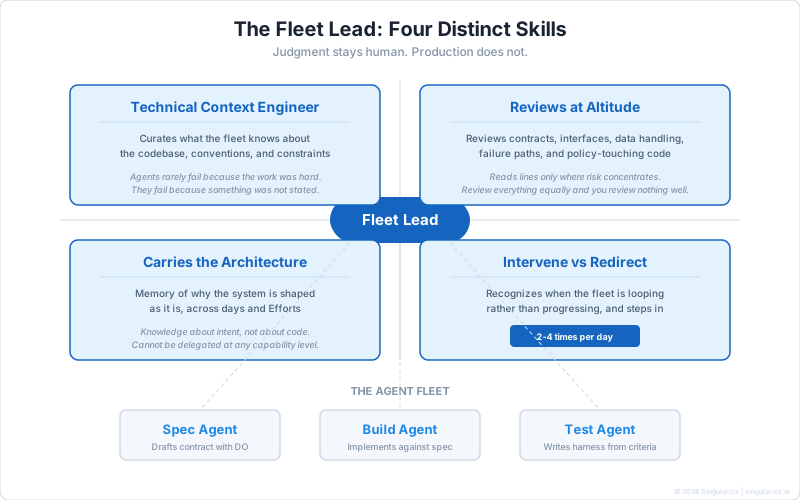
Technical context engineering. The mirror of what the Decision Owner does for business context. The Fleet Lead curates what the fleet knows about the codebase, its conventions, its prior decisions, and its constraints. A fleet working from thin context produces code that compiles, passes its own tests, and does not belong in the system. Agents rarely fail because the work was hard. They fail because something was not stated. This is not prompt engineering. It is the discipline of assembling and maintaining the information set the fleet needs to produce work that belongs in the codebase rather than merely works in isolation.
Reviewing at altitude. The Fleet Lead reviews contracts, interfaces, data handling, failure paths, and anything touching policy, and reads lines only where risk concentrates. This is not less review. It is review at the level where architectural integrity, security, and domain correctness are visible, while the fleet handles what syntax-level review used to catch. The skill is knowing where to look. A Fleet Lead who reviews everything equally reviews nothing well, because there are not enough hours.
Carrying the architecture. Agents have no memory of why the system is shaped as it is. Why this service uses this pattern. Why that field is nullable when the business rule says it should not be. Those answers are human decisions made for human reasons, invisible in the code itself, and the Fleet Lead is the one who injects them into the fleet's context when they matter. Without this, each day's work is locally optimal and globally inconsistent.
Deciding when to intervene. Recognizing that a fleet is looping rather than progressing, and stepping in, is a judgment call made several times a day. Let a stuck agent run and you burn compute and hours. Take over the implementation because "it is faster if I just do it" and you have removed the leverage the model exists for. The healthy pattern is two to four interventions a day, each for a specific named reason. Zero means the lead is not watching. Ten means the fleet is misconfigured or the context is too thin.
The agent fleet
Three agent roles are worth keeping operationally distinct.
Spec agents draft the contract with the Decision Owner, restate context, and propose criteria. Their output is a draft spec the Decision Owner corrects and signs.
Build agents implement against the signed spec and the technical context the Fleet Lead curates.
Test agents write and maintain the harness coverage, working from the spec's criteria, not from the build agents' implementation.
That last separation is the one to protect first. A single agent that both implements and tests its own work will converge on tests that pass, which is not the same as tests that prove the spec.
An agent that writes tests against its own implementation rather than against the spec produces a green harness that proves nothing. Confirming that the checks trace to the criteria is the single most important review the Fleet Lead performs.
How many agents can one lead direct? Treat it as a real capacity question. The constraint is not agent availability but how much output one person can meaningfully review at altitude. Start conservative, measure where review quality degrades, and let the observed number inform how the Flow Council sizes fleet capacity. Codebase clarity, context quality, domain risk, and the lead's experience all move the ratio.
And fleet capacity is real capacity. It is provisioned to Efforts by the Flow Council in the same pool as human capacity, with real budgets for models, compute, and infrastructure. See AI Capability Investment. Treat it as unlimited and you get cost surprises and review bottlenecks. Treat it as metered and the Flow Council can actually allocate it.
The working pair
The Decision Owner and the Fleet Lead form a working pair, not a handoff. The owner says what is needed and judges whether it arrived. The Fleet Lead says how it will be built and whether the criteria are checkable. The owner without a Fleet Lead has a spec and no one to build it. The Fleet Lead without an owner has a team and no one to accept the work.
The pair separates production from accountability without separating either from judgment. This is why more agent output is not automatically more capacity. Output becomes useful only when a human can review it at the right altitude, a harness can test it against the contract, and an owner can decide whether it changes the outcome. The Fleet Lead's job is not to keep every agent busy. It is to keep a tractable relationship between what the fleet can produce and what the human system can responsibly accept.
Watch for silence between them during the build day. Three to six questions a day is healthy. Zero means the lead is guessing, or the spec over-specified the solution.
The failure modes
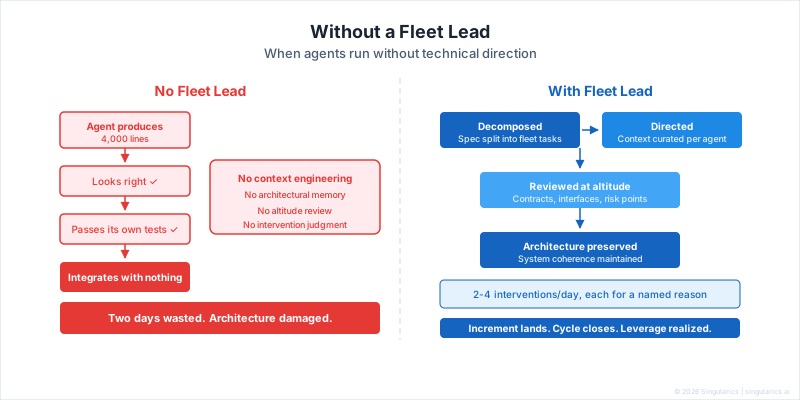
The lead who does the work. The strongest temptation for a skilled Fleet Lead is to implement directly. The tell is a daily output that looks like a developer's rather than a director's: pull requests authored by them instead of reviewed by them. The correction is not to prohibit direct implementation. A stuck fleet, work too subtle for current agent capability, or a security-sensitive component can all justify it. The correction is to treat it as an exception with a named reason, never as the default.
The lead without context skill. A Fleet Lead who can code but cannot curate context produces a fleet that generates plausible, disconnected output. The skill transfers by apprenticeship. Pair new leads with experienced ones for their first two Efforts, and budget two to four weeks before they are effective.
The review bottleneck. When the lead cannot keep up with the fleet's output, defects reach the demo that should have died in review. Reduce the fleet's parallelism or add a second Fleet Lead. Never solve the bottleneck by lowering review rigor.
The fleet that tests itself. When build and test agents are not kept separate, the harness converges on passing rather than proving, and green stops meaning anything.
The coordination arithmetic
Teams as delivery has known them were sized to production, and coordination cost climbed with every added member, the links between people multiplying far faster than the hands. A ten-person team is forty-five conversations. The crew around a fleet is three or four people, and machine parallelism adds no coordination channels between humans, because agents do not coordinate the way people do. They pass artifacts rather than interpretations, and most of their coordination is not pairwise at all. The fleet converges on the spec and the harness, a hub rather than a mesh. It scales linearly, it never tires, and it keeps no calendar.
A sharper law replaces the old one. A lossless network propagates everything losslessly, including mistakes. One wrong assumption injected at the hub reaches the whole formation with perfect fidelity. The communication bottleneck is gone, and the judgment bottleneck it was hiding is now the whole game. It sits where the model puts its people, at the spec, at the context pack, at the harness.
Where the theory meets the text
If the fleet writes all the code, someone still has to be able to read it. An organization whose systems no human can audit becomes a passenger in them, polite, hopeful, and unable to check. Aviation settled this long ago. The autopilot flies most of every flight, and a certified pilot sits in the seat because the person responsible must be able to take the controls. The Fleet Lead is that requirement, fluent upward in intent and downward in code, able to descend into the text on the day something breaks. Production no longer needs human hands. Accountability still needs human reading, and no enterprise gets to tell a regulator, a customer, or a court that the machine was the one who understood.
Machines store, and storage is not holding. A stored decision cannot notice the moment it becomes relevant. A held one can. That is why carrying the architecture cannot be delegated to the fleet at any capability level.
The way in
The entry-level path is not gone. It moved. The tasks juniors used to learn on were absorbed by the fleets first, and what replaces the old ticket ladder is the seat beside a senior Fleet Lead. New engineers arrive code-fluent, with orchestration instincts their elders learned late, and they spend their first years reading at altitude next to someone who carries a theory of the system, absorbing it the only way theory transfers, by working under one. The rungs change. The ladder does not go away.
The model makes the seat structural rather than hopeful. Any crew may carry a learning seat, named and funded the way the guild is funded, and a crew that has run a year with one should be able to say what its junior can now accept, review, and drive alone. If nothing has moved, the seat was a chair, not an apprenticeship.
Seeing yourself in the seat
You are the senior who ships. This is not a management detour. It is the purest delivery seat left, hands on the choreography instead of the keyboard, and your taste in what belongs in a system is the one thing the fleet cannot produce. The first Fleet Leads come from exactly where you are standing.
You are a tech lead or an architect. Carrying the architecture is a quarter of this job by name, and the review you already do at the level of contracts and failure paths is the altitude the role reviews from. What changes is the leverage underneath it.
You test for a living. The harness is authored by the fleet and owned by a human, and confirming that checks trace to the criteria rather than to the implementation is the deepest version of the work you have always done. Harness stewardship is the named seat for it.
You are starting out. The learning seat above is yours, funded and expected to move. Code fluency plus orchestration instinct is the strongest entering profile this field has had in years.
None of these paths asks anyone to stop being technical. Every one of them asks the technical judgment to sit where the fleet cannot go.
Its place in the Model
In The AI-Native Operating Model™, the Fleet Lead and Agent Fleet sit in the Effort Teams + AI Fleets band, colored gold because they are execution. The Fleet Lead connects upward to the Decision Owner and downward to the three agent roles.
The Fleet Lead connects to:
- The Decision Owner, forming the working pair at the center of the daily cycle
- The harness, whose integrity the Fleet Lead owns
- The spec, which the Fleet Lead decomposes into fleet-executable work
- AI Capability Investment, because fleet provisioning determines what the Fleet Lead can direct
- The one-day cycle, where the Fleet Lead directs the build and raises blockers
Read the essay Fleet Leadership for the craft as its first practitioners describe it. Read the Fleet Lead and Agent Fleet white paper (PDF). Return to the Model to see how the Fleet Lead connects to the rest of the system.