
AI Capability Investment
The new budget line that did not exist before
Every prior operating model assumed delivery capacity was human. The budget lines were headcount, contractors, and tools. AI-native work introduces a category of capacity with real cost, real constraints, and real provisioning decisions, and treating it as a rounding error inside "tools and infrastructure" is how organizations end up with shadow spending, inconsistent model selection, and cost surprises that arrive quarterly.
The old pattern is a natural consequence of treating AI as a tool, because tools are bought by the people who use them. The result is familiar: tooling purchased team by team on discretionary budgets, no central visibility into spend, models approved for internal process quietly used on sensitive data, and every team independently rediscovering which models work for which tasks. When AI becomes capacity, it needs to be planned, funded, and governed like any other capacity line. That is the shift.
Agent fleet capacity is provisioned to Efforts by the Flow Council in the same pool as human capacity, because in practice it is a real constraint with real cost. Treat it as capacity, not as an unlimited utility.
The funded lines
Fleet provisioning. The fleet is not a single tool. It is a set of models configured for specific roles, with access to specific data and systems, under specific constraints. The three agent roles described in The Fleet Lead and Agent Fleet have different provisioning profiles: spec agents need reasoning strength and access to briefs and the knowledge graph, build agents need code generation strength and codebase access, and test agents must be provisioned separately from build agents, working from the criteria, so the harness proves the spec rather than confirming the implementation.
Tooling standards. Standardization prevents the three divergences that emerge fast in unmanaged adoption. Cost divergence, where spend varies by an order of magnitude for equivalent work. Security divergence, where data governance decisions get made implicitly by whichever model a team picked. Quality divergence, where every team rediscovers the same lessons about which models fit which tasks.
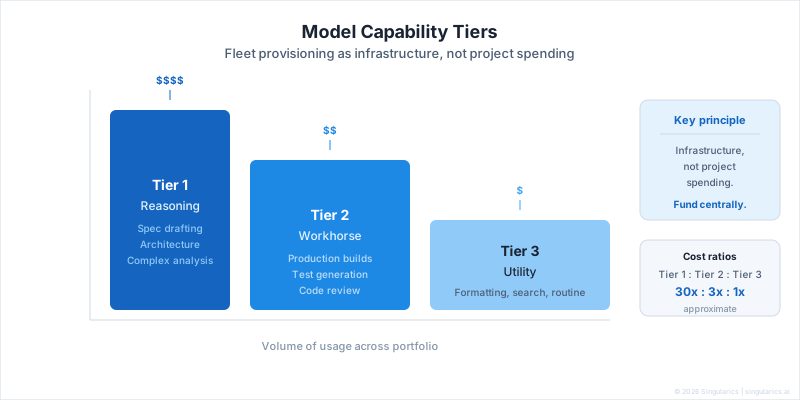
Model selection, at two levels. The Intent Council approves which models are available for which categories of work. The Fleet Lead selects among approved models per Effort. The two-level structure avoids both extremes: the free-for-all, and the bottleneck where every model choice needs officer approval.
Fleet capacity in the pool
Fleet capacity is metered and allocated alongside human capacity at the Flow Council's weekly calibration. This much compute is available this week, distributed this way across active Efforts. Metering exists because fleet costs can surprise: an Effort that quietly increases its agent count can double the portfolio's compute bill in a week.
The capacity math has a human constraint at its center. The limit is not how many agents can run. It is how much output one person can meaningfully review at altitude. Treating fleet capacity as unlimited produces cost blindness, a review bottleneck, and a quality illusion where more output looks like more progress while unreviewed defects compound across increments. The correction is the same fungible capacity discipline applied to machines: planned, committed, metered, released.
The reason the investment is structured this way is the accountability axiom. Provisioning more model capacity increases the amount of work the organization can generate. It does not increase the amount of direction, judgment, or responsibility available to govern that work. That is why fleet capacity ships paired with an owner, a Fleet Lead, a test agent, and a harness rather than being released as a general productivity utility. Buying only the production creates output without an operating system. Funding the whole arrangement creates governed capacity.
The capability being built
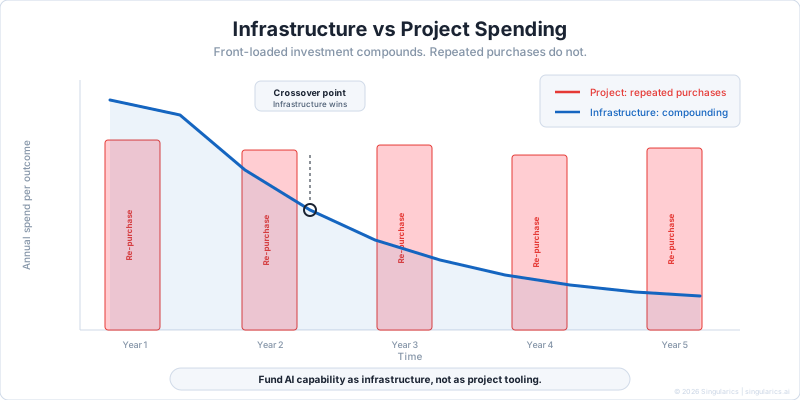
Infrastructure, funded as infrastructure. The fleet needs a control plane that connects model access, context management, execution environments, authority, and evidence to the organizational intent the fleet serves. Model access runs through a managed gateway that enforces availability and logs usage. Context management supplies each agent with the codebase, spec, and domain knowledge it needs. Execution environments are isolated, reproducible, and safe for agent-generated code. Cost metering attributes compute to Efforts. See Intent: The Organizational Intent Control Plane for the full picture.
Skills, transferred by apprenticeship. Fleet Leads learn to decompose specs, curate technical context, review at altitude, and intervene at the right moments. Decision Owners learn context engineering. Neither transfers through a training course, and both are covered in their role articles. Budget for the ramp.
Organizational learning. Which models work for which tasks, which context patterns produce good results, which failure modes recur. Formalize and share this, or every Fleet Lead rediscovers it. The Flow Council is its natural home, because it sees fleet performance across the whole portfolio.
The unit economics to watch
The number that compounds is cost per accepted increment. Not cost per token, which optimizes the meter instead of the outcome, and not cost per line, which rewards volume nobody asked for. Cost per accepted increment holds the whole arrangement accountable, because it falls only when context is curated well, the model fits the task, and the fleet converges instead of looping. It should fall over an Effort's life, since the context pack matures and the harness accumulates. Flat or rising cost per accepted increment while output volume grows is the quality illusion showing up in the finance data.
The levers are the conservation levers from Investment and Funding. Curate context instead of dumping it, match the model tier to the task instead of defaulting to the top shelf, and treat convergence discipline as a Fleet Lead skill. One scene shows the scale of it. A build agent retrying all afternoon against an ambiguous criterion can burn more compute than the rest of the fleet's day combined, and the fix was never in the infrastructure. It was one sentence of the spec, made checkable.
The enterprise license is not a strategy. Buying a seat of an assistant for every developer feels like AI investment and provisions none of this. Seats produce individually faster typists inside an unchanged system. Capacity means provisioned fleets, attached to Efforts, directed by leads, metered by the council, and proven by a harness. Fund the second thing. The first can ride along for whoever wants it.
The relationship to existing IT investment
AI capability investment sits alongside IT investment, not in place of it. The application portfolio, infrastructure, security controls, and data platforms remain. What changes is how new work is done against them.
The most common mistake is funding AI capability out of the existing IT budget without increasing the total. That creates a zero-sum competition between maintaining what exists and building what is new, and maintenance always wins, because the cost of not maintaining is visible and the cost of not building is not. Fund it as a new line, visible to the Intent Council, governed with the same rigor as any other capacity commitment.
The failure modes
The shadow fleet. Teams stand up their own tooling on personal accounts and departmental cards. Nobody can say what models are in use, what data they touch, or what the total spend is. Cost surprises arrive quarterly. Security incidents arrive sooner.
The unbounded fleet. A Fleet Lead scales the agent count because more agents means faster delivery. The fleet produces three times the output, the lead can review at altitude for the original volume, and two-thirds of the output carries unreviewed defects.
The governance bottleneck. An AI governance body approves each use case individually. By month two the queue is six weeks long. By month four half the fleet runs on unapproved models, and the body that was supposed to control adoption has become the reason it is uncontrolled. Govern by constraint, not by approval: approve categories, set the constraints per category, and let the harness enforce them.
Practical patterns
Start small and meter everything. One outcome, one fleet, four to six weeks. The cost per increment becomes knowable, and the organization has real data about what fleet capacity costs relative to what it produces. That data beats any business case written in advance.
Scale both sides together. Fleet compute scales more easily than human capacity because provisioning does not require hiring. The constraint remains the Fleet Lead's review capacity, so scaling compute without scaling leads degrades quality.
When costs surprise, look at utilization first. The reading order is utilization, then context, then model fit. Agents that loop, retry excessively, or work from thin context consume far more compute than well-directed agents, so a spike almost always traces to a convergence problem or a curation problem before it traces to pricing. Fleet cost is downstream of Fleet Lead skill, which is one more reason the skill deserves investment.
Its place in the Model
In The AI-Native Operating Model™, AI Capability Investment sits in the Enterprise Inputs band, colored gold because it is an execution-layer investment. It flows down into the fleet capacity that the Flow Council allocates from the pool.
AI Capability Investment connects to:
- Investment and Funding, as the new budget line alongside human capacity
- The Fleet Lead, who selects among approved models and directs fleet work
- Fungible Capacity, because fleet capacity is part of the pool
- The Flow Council, which allocates fleet capacity at weekly calibration
- Governance and Risk, because model selection and data handling are governance decisions
Read the AI Capability Investment white paper (PDF). Return to the Model to see how fleet capacity connects to the rest of the system.