
Intent: The Organizational Intent Control Plane
Governing organizational intent and agentic orchestration as one connected system
Intent is the first fully integrated control plane for governing organizational intent and agentic orchestration. It keeps what the organization means, who has authority, what humans and agents may do, the context they receive, the evidence they produce, and the judgment that accepts the result connected in one governed loop.
The spec and harness are important parts of that loop. The spec makes one slice of intent testable. The harness supplies repeatable evidence that the resulting work satisfies that contract. Neither is the control plane by itself. Intent governs the decisions that create the contract, the authority under which work proceeds, the orchestration of human and agent capacity, the evidence that returns, and the learning that changes what happens next.
A model that cannot be instrumented cannot be governed. A model that cannot be governed cannot survive its first encounter with organizational inertia.
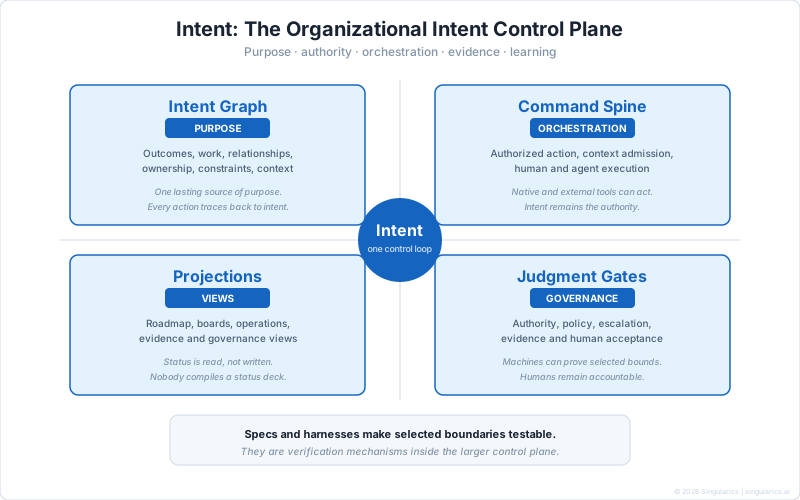
The control loop Intent closes
Most enterprises already have tools for strategy, work management, automation, testing, and reporting. The failure sits between them. Strategy becomes a deck. Work becomes a queue. AI agents receive local prompts. Test results remain attached to repositories. Governance reconstructs the story later from disconnected artifacts.
Intent closes that gap by maintaining one connected control loop:
- Purpose: What should become true, why it is wanted, and how it relates to the rest of the organization
- Authority: Who may decide, approve, execute, or escalate, and under what constraints
- Context: What each person or agent needs and is permitted to use for this decision
- Orchestration: How approved work moves through human and agent capacity, whether execution happens in Intent or an external tool
- Evidence and judgment: What happened, what the result proves, and which accountable human accepted it
- Learning: What the evidence changes in the graph, the next decision, and the next cycle
This is the difference between an AI work tool and an organizational control plane. A work tool helps produce an output. Intent preserves the relationship between purpose, permission, execution, proof, and learning across the full lifecycle.
One graph for purpose. One command spine for governed action. One evidence record for what happened. Many useful views, but no competing source of truth.
The reconciliation layer
Intent replaces the manual reconciliation layer between the spreadsheet roadmap, the shared drive of requirements, the work-management queue, the AI tool, the test pipeline, and the quarterly status deck.
Each tool may remain useful. The problem is that none carries organizational intent across the boundaries between them. Someone has to translate strategy into work, copy constraints into tickets, explain context to agents, collect evidence from delivery systems, and reconstruct status for governance. Every translation loses meaning and every manual compilation ages before it is presented.
Intent makes those tools projections and execution adapters around a canonical intent graph. Outcomes, ownership, constraints, authority, work, evidence, and decisions remain connected even when people and agents operate in different tools. Status becomes something the organization can read from evidence rather than something a person must write from memory.
Status is read, not written. Governance reads the work and its evidence directly.
Five capabilities of the control plane
The Model shows five cross-cutting capabilities at the bottom because every layer depends on them. They are not five separate systems. They are connected capabilities of Intent.
Intent graph
The graph is the lasting structure of organizational purpose and work. It connects outcomes, outputs, criteria, relationships, ownership, constraints, authority, and evidence. The three horizons are a portfolio projection of that graph, not a separate roadmap database.
What it provides: A traceable path from declared intent to the work it authorizes, with one current view of Now, Next, and Later.
Context and knowledge
Domain knowledge must survive the meeting where it was shared and reach the work that needs it. Intent connects policy sources, decision history, encoded expertise, constraints, and prior evidence to the relevant part of the graph.
When a domain expert contributes a constraint, that contribution becomes reusable context. It may shape an outcome, narrow an authority envelope, become a spec criterion, or become a harness check. The graph preserves why it exists and where it applies. See The Domain Knowledge Network for how inject, encode, and return make that knowledge compound.
What it provides: Admissible, attributable context assembled from the intent being served rather than from whichever documents an agent happens to retrieve.
Governed orchestration
Intent coordinates human and agent capacity around authorized work. It determines what is ready, who or what may act, which context travels with the action, what constraints apply, and where a human judgment gate is required.
Execution does not have to occur inside Intent. Native agents, coding tools, delivery platforms, and enterprise systems can remain the places where work is performed. They operate as execution adapters. Intent remains the authority for why the work exists, what it is permitted to do, and what evidence must return.
What it provides: A governed path from declared intent to execution without turning every external tool into a competing source of purpose.
Evidence and judgment
Every increment produces an evidence chain: the intent it served, the authority under which it ran, the applicable spec and criteria, the harness results or other proof, the acceptance decision, and who made it.
The evidence ledger is what makes the system governable and auditable. Governance does not wait for a report to be assembled. The accountable human can judge the result from evidence, and the record preserves that judgment with attribution.
What it provides: A continuous proof chain from authorization through execution to human acceptance.
Authority and policy
Intent represents the bounded authority around each outcome and action. It connects roles, permissions, policy constraints, escalation paths, and judgment gates to the work itself.
Some constraints can be enforced automatically through access controls, workflow gates, or the control layer of a harness. Others require human judgment. Intent distinguishes those cases and records the decision instead of pretending every governance question can be reduced to a test.
What it provides: Governance that travels with the work and remains attributable at machine speed.
Where the spec and harness fit
The spec and harness form a critical verification loop inside Intent.
The spec is a testable expression of a slice of intent. It translates an authorized outcome, its context, constraints, and acceptance judgment into a contract that can guide execution.
The harness is a proof mechanism. It continuously checks the parts of that contract that can be verified by machine and returns the results as evidence.
Human judgment closes the loop. A green harness proves that the implementation satisfied the specified checks. It does not prove that the organization chose the right outcome, that the contract captured everything that mattered, or that the result should be accepted. Those remain accountable human decisions.
Intent surrounds that loop with what a spec and harness alone cannot provide: canonical purpose, authority, context admission, orchestration, evidence lineage, acceptance, and organizational learning. This is why “the spec and harness system” is too narrow as a name for the platform. It describes one valuable mechanism, not the integrated control plane.
How Intent compounds
Intent becomes more valuable as the organization uses it because each cycle improves the next one.
The graph becomes more truthful. Declared outcomes meet execution evidence, making the gap between stated direction and actual work visible.
Context becomes more precise. Domain findings, constraints, decisions, and exceptions remain connected to the intent they informed.
Verification becomes stronger. Specs clarify the next slice and harness checks survive the increment that created them.
Orchestration becomes more governable. The organization learns which authority envelopes, context packets, agent roles, and human gates produce reliable outcomes.
Projections become more useful. Roadmaps, queues, boards, operations views, and governance views read from the same underlying state instead of reconciling separate records.
This compounding behavior is the asset. The platform is successful when the next decision is better informed, the next action is better bounded, and the next result is easier to judge.
The logic beneath the control plane
Direction remains human, but execution is becoming distributed across people, agents, and tools. That raises a structural problem. The organization must preserve meaning and authority while work moves faster than any periodic review process can follow. A shared control plane is the mechanism that keeps those elements connected without forcing all work into one application.
The graph carries purpose and relationship. The command spine carries authorized action. The evidence ledger carries what happened and what it proved. Human judgment gates decide what may proceed and what counts as accepted. Specs and harnesses make selected boundaries testable, while policies, context controls, and explicit authority govern the parts that testing alone cannot settle.
These elements have to remain one system. If the graph says why work exists but another system independently decides what agents may execute, authority has split. If the harness proves behavior but its result cannot be traced to the outcome and the person who accepted it, evidence has lost its meaning. If a dashboard reports status from a separate database, the organization is back to reconciling interpretations. Intent exists to prevent those fractures.
Skipping it, and paying for it
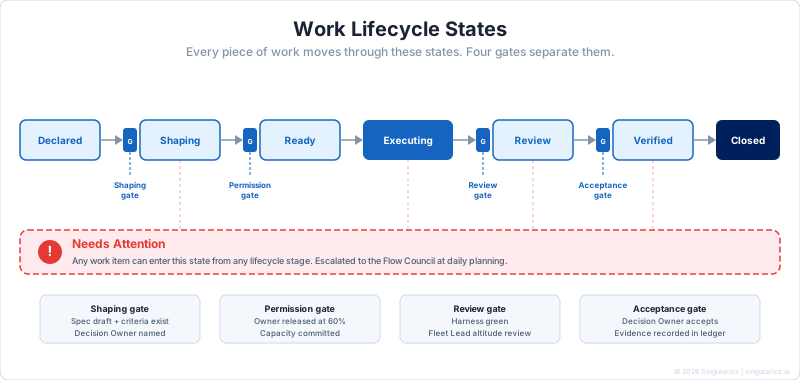
Purpose and execution separate
Agents receive a ticket, prompt, or local objective without the organizational context that authorized it. They may produce high-quality work that is locally correct and strategically wrong. Speed amplifies the divergence.
Authority becomes implicit
The person with access to a tool becomes the person who can cause work to happen. Policy is remembered inconsistently, approvals are reconstructed later, and nobody can answer precisely what an agent was authorized to do.
Evidence loses its lineage
Tests pass in one system, deployment events live in another, and acceptance happens in a meeting or message. The organization has data but no connected proof chain from intent to result.
Every view becomes another truth
The roadmap, work queue, operations console, governance dashboard, and status deck each maintain their own state. Teams spend time reconciling them, and leadership governs the reconciliation rather than the work.
Learning does not compound
Findings remain in conversations, retros, and local repositories. The next agent starts with an empty context window, the next team repeats the same discovery, and the portfolio pays for the same knowledge again.
Intent is not
It is not a project management tool
Intent can project work into boards and queues, but task movement is not its purpose. Its purpose is to keep work connected to organizational intent, authority, evidence, and judgment.
It is not an agent builder
Intent does not need to own every model, agent, or execution environment. It governs which agents may act, what context and authority they receive, and what evidence they must return.
It is not a testing platform
Harness results are one class of evidence. Intent also governs decisions that cannot be automated, including outcome selection, tradeoffs, exceptions, acceptance, and changes in direction.
It is not a reporting dashboard
Dashboards are projections. The canonical artifacts are the intent graph, the authority and decision record, and the evidence connected to the work.
Practical adoption
Intent does not require an enterprise to replace every tool at once. Start with one consequential outcome. Establish its owner, authority envelope, context, work relationships, evidence requirements, and judgment gates in Intent. Let teams continue executing in the tools they already use while returning proposals, state changes, and evidence to the control plane.
Then expand the connected graph outcome by outcome. Add orchestration only where the authority and evidence path is clear. Add automation only where the human judgment boundary is explicit. This preserves one canonical source of purpose while allowing the execution ecosystem to evolve.
Its place in the Model
In The AI-Native Operating Model™, Intent is the cross-cutting control plane beneath every layer. It connects strategic direction, portfolio decisions, domain knowledge, Effort Teams, AI fleets, governance, and learning without replacing the accountable humans in those layers.
Intent connects to:
- The three horizons, a portfolio projection of declared outcomes and their readiness
- The Domain Knowledge Network, which supplies attributable context and constraints
- Spec-Driven Development, where one authorized slice of intent becomes testable
- The harness, which returns repeatable verification evidence
- Continuous Governance, where authority, policy, escalation, and judgment travel with the work
- What to Measure, because measurement is derived from connected decisions and evidence
Read Intent: The Organizational Intent Control Plane (PDF) for a deeper treatment of the governed control plane. Return to the Model to see how Intent supports the whole operating system.