
Continuous Governance
Governance travels with the work instead of waiting at stage gates
Stage gates deserve a fair hearing, because the people who built them were not wrong. A six-month project reviewed at three milestones produced three real governance checkpoints, and the two months of delay between work and review was acceptable because the work itself was slow.
When delivery happens daily, the same structure breaks in two ways. The gates cannot keep pace: a gate that takes two weeks to clear holds up fourteen daily cycles. And the gates sit too far from the work: a review that examines a month of accumulated decisions cannot inspect each one with care, so it approves in bulk, and bulk approval is not governance. It is ceremony.
Continuous governance is the alternative, and the first thing to say about it is that it does not weaken control. It moves control from inspection after the fact to enforcement inside the work.
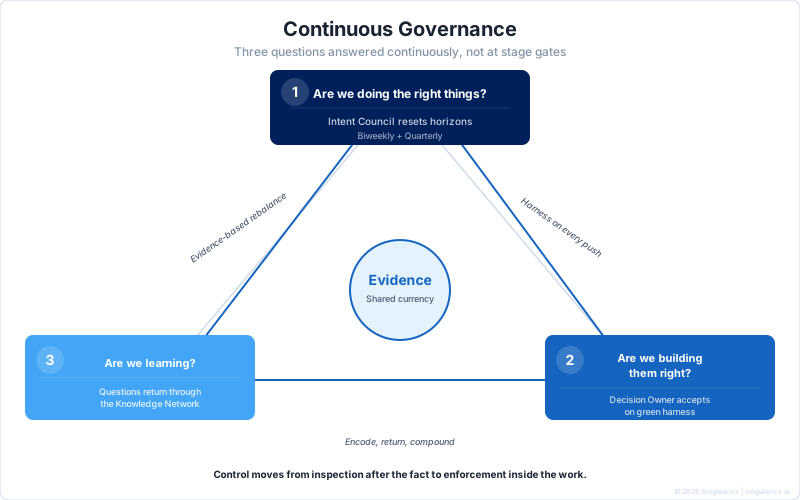
Governance answers three questions, and this model answers each continuously. Are we doing the right things? Are we building them right? Are we learning?
The quarterly gate review
The quarterly gate review. The gate served two purposes, and both are preserved. The moment of reflection now happens daily, at acceptance and daily planning. The approval decision is embedded in the bounded authority envelope, the harness, and the escalation chain. What disappears is the lag between work and review, and the ceremony of assembling documentation for a board that was not present when the work was done.
The audit trail actually gets stronger. A stage-gated process produces documents describing intent at milestones. This model produces evidence of behavior on every push: the spec, the harness results, the acceptance decision, and who made it, attached to every increment as a byproduct of the daily cycle. Finer grain, higher frequency, clearer attribution.
The nested cadences
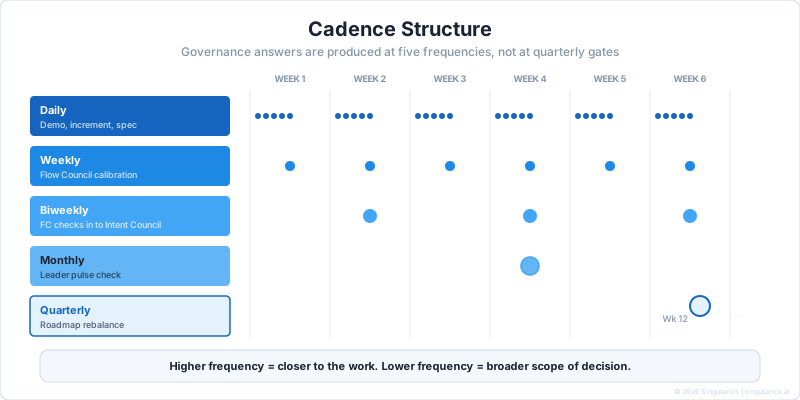
Every level of the organization has a defined cadence, and the cadences nest: faster levels produce the evidence that slower levels consume.
| Level | Cadence | What happens | Who is responsible |
|---|---|---|---|
| Individual | Continuous | The agent fleet never stops. The harness runs on every push, proving shape, behavior, failure paths, and policy compliance. | Fleet Lead directs; harness enforces |
| Team | Daily | The one-day cycle: specify, build, judge, land. A spec becomes a landed increment every working day. | Decision Owner accepts; Fleet Lead builds |
| Program | Daily | The Flow Council attends daily planning across all teams. Blockers are resolved the same day, not queued for a weekly meeting. | Flow Council lead at each team's planning |
| Portfolio | Weekly | Flow Council calibration. Capacity is re-planned against the Now horizon, domain experts rotate, the Now horizon is re-sequenced if evidence warrants it. | Flow Council |
| Division | Biweekly | The Flow Council checks in to the Intent Council at the strategic working session. Evidence is reviewed and direction is reset against landed results. | Flow Council presents; Intent Council decides |
| Board | Monthly | Pulse check against strategic outcomes. Portfolio progress is measured against the declared outcomes that sit above the portfolio. | Intent Council and enterprise leadership |
The quarterly roadmap rebalance sits above these, shifting the Now, Next, and Later horizons on accumulated evidence rather than forecasts. And note that two levels share the daily cadence for different purposes: the team's daily is about production, the program's daily is about flow.
The same loop at every altitude
The pattern is fractal. Officers judge outcomes on their cadence, the councils judge the portfolio weekly and biweekly, owners judge increments daily, and the harness judges every push. Zoom into any level of the organization and the same loop is running, intent flowing down, evidence flowing up, judgment at the boundary, with only the clock changing. That self-similarity is the reason a regulated enterprise can run daily cycles without losing its grip. Nothing is ungoverned at any scale, because the governance is native to each scale instead of bolted above them all.
The three questions
Are we doing the right things? Portfolio governance. The Intent Council resets the horizons against landed evidence, biweekly and quarterly. The strength over periodic review is the input: periodic review examines projections, while an officer looking at three months of daily increments sees what actually happened.
Are we building them right? Execution governance. The Decision Owner accepts on a green harness every day, inside guardrails set once per outcome, and the harness checks policy on every push. The strength over the phase gate is coverage. A gate sees one snapshot, so a constraint violated on Tuesday and patched on Wednesday is invisible to it. The harness sees every state the work passes through, and the ledger records all of it.
Are we learning? Adaptive governance. Every cycle's questions and edge cases return through the Domain Knowledge Network and update the playbooks, the spec queue, and the roadmap. The strength over the lessons-learned exercise is timing. Lessons-learned happens at the end of a project, when the lessons are stale and the people have moved on. Here, learning is encoded into the harness and the knowledge graph within the cycle where it was discovered.
How governance travels with the work
Policy constraints ride in the harness. A constraint injected at spec time becomes a criterion in the spec, a check in the harness, and a record in the ledger, running on every push for every team whether or not the team knows the constraint exists. Enforcement prevents violations. Inspection discovers them after the fact. That is the whole difference.
Authority rides in the envelope. The Intent Council defines once per outcome what the owner may accept, what escalates to the Flow Council, and what stays with the officers. The owner never asks permission per acceptance. The governance is in the boundary, not in the approval.
Status rides in the ledger. Status is read, not written. Every governance forum opens by reading the evidence rather than hearing it summarized, and a forum that cannot read the evidence directly has an instrumentation gap for the Flow Council to close.
Exceptions ride the escalation path. Any team raises a blocker any day. The Flow Council resolves it or carries it up. No blocker outlives one cadence.
Still on the old path
Claiming continuous governance replaces everything is how transformations lose credibility with the second line of defense. Three things keep their existing cadence. Regulatory interpretation stays with the Intent Council, because a changed interpretation needs deliberation that does not benefit from daily tempo. Risk appetite changes stay with officers; the daily cycle operates within the declared appetite, it does not change it. And new external commitments require officer approval, because a team cannot bind the organization to a counterparty from inside the daily cycle.
Name these boundaries explicitly when presenting to a governance audience. Showing where the model does not accelerate is what demonstrates the acceleration is deliberate.
While you are in that room: governance audiences care about control, not speed. Do not lead with "we ship every day," which creates anxiety. Lead with "we prove compliance on every push," which creates confidence. More evidence, more often, at a finer grain, with clearer attribution.
The failure modes
The missing control layer. The harness checks shape, behavior, and failure but not control, so the team ships daily without proving compliance. This is the gap that creates audit findings. When an outcome touches a policy constraint, the control layer is among the first things built, and ensuring that is Flow Council work.
The forum that ignores the evidence. It receives the ledger and asks for a presentation anyway. Run three or four forums entirely from the evidence. Either the evidence proves sufficient or it reveals instrumentation gaps, and both outcomes improve governance. Reverting to presentations because the evidence "is not quite there yet" is how the old process reasserts itself.
The slow escalation. Governance blockers that outlive a cadence stall the cycle. Either the cadence is too tight for the Intent Council or its delegation to the Flow Council is too narrow. Fix the delegation before blaming the teams.
The veto from outside. A body that can reject any increment without participating in the daily cycle is a queue the model cannot absorb. Move that body's constraints into the harness, so their judgment runs on every push rather than waiting for their calendar.
Its place in the Model
In The AI-Native Operating Model™, Continuous Governance spans the governance cycle in the direction band, colored blue. It shows the three questions as a continuous loop rather than as periodic checkpoints.
Continuous Governance connects to:
- The harness, which enforces "Are we building them right?" on every push
- The Intent Council, which answers "Are we doing the right things?" at the biweekly session
- The Domain Knowledge Network, which drives "Are we learning?" through the return loop
- What to Measure, where the evidence ledger makes governance readable
- Governance and Risk, the enterprise input that sets the standards governance enforces
Read the Continuous Governance white paper (PDF). Return to the Model to see how governance flows through the system.