
Governance and Risk Appetite
Guardrails that enable rather than block
The instinct when adopting AI-native ways of working is to treat governance as the thing that must be relaxed for speed. That instinct is exactly wrong, and the reason deserves precision. What must change is not the rigor of governance but its position in the workflow.
Governance in most organizations is a gate at the end of the process. Work is done, then reviewed, then approved, then released. Every gate introduces a queue, and every queue introduces delay. A week of review was a small fraction of a six-month delivery. When delivery takes a day, a week of review is the entire cycle repeated seven times. Meanwhile the board at the gate examines a month of accumulated decisions and approves in bulk, which means what it actually governs is the documentation presented to it, not the work.
The model does not weaken control. It moves control from inspection after the fact to enforcement inside the work.
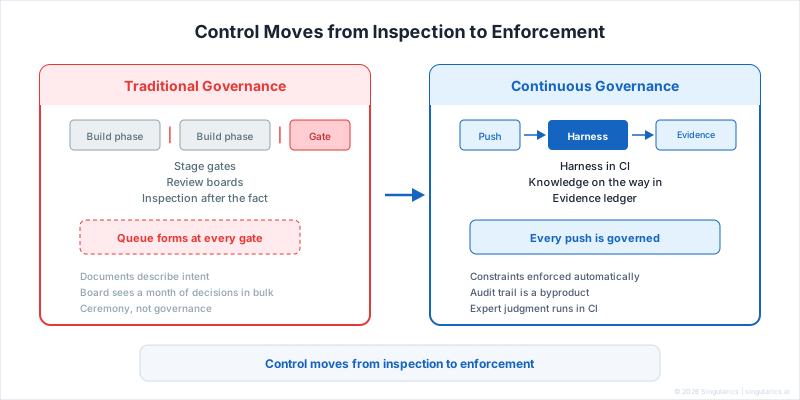
The stage gate's timing problem
Stage-gate governance: review at milestones, by a board that was not present when the work was done, using documents that describe intent rather than proof of behavior. It answered the right questions at the wrong time.
The replacement is control embedded in the work itself. The Domain Knowledge Network injects constraints before the build starts. The spec encodes them as criteria. The harness checks them on every push, and the audit trail writes itself. A constraint injected once is enforced for every team, whether or not the team knows the policy exists. The expert's judgment runs in CI long after the expert has left the room.
The three questions governance exists to answer, and the cadences at which this model answers them, are covered in Continuous Governance. This article is about the enterprise input: what officers declare, and how it becomes enforceable.
Risk appetite, made executable
Risk appetite is not a single dial. It is a set of statements about which risks the organization will accept and at what level. The categories run from the classic lines, regulatory exposure, financial thresholds, brand and customer harm, operational continuity, to the ones AI adds, model risk, responsible use thresholds, data boundaries for the fleet, and blast radius tolerance, which this model holds to one increment, one day, rollback proven. The guardrails say never. The appetite says how far. And in this model it is declared at two levels. At the portfolio level, the Intent Council decides which categories of work are permitted, which need enhanced oversight, and which are outside tolerance, shaping what enters the three horizons. At the outcome level, each outcome gets a bounded authority envelope, set once, in writing, with a tighter boundary for work touching regulatory obligations than for an internal process improvement.
A workable default envelope:
| Authority | What it covers |
|---|---|
| Decision Owner accepts | Functional behavior, user experience, internal process, anything reversible within one cycle, anything where the harness is green and no policy constraint is touched |
| Escalate to Flow Council | Changes touching a policy constraint, external commitments, spend above threshold, anything the harness cannot express as a check |
| Intent Council decides | Regulatory interpretation, risk appetite changes, new external commitments |
The envelope is what makes daily acceptance safe. Without it, either everything escalates and the cycle dies, or nothing escalates and you have an audit finding.
The chain from declaration to enforcement is short: the Intent Council declares, the network encodes, the harness enforces, the ledger records. At no point does risk appetite depend on someone remembering to check something. An appetite that lives in a policy document governs nothing. One that lives in envelopes governs every acceptance in the portfolio, every day, without a meeting.
Here is the chain running, end to end, on a real shape of day. A Tuesday increment touches the customer data retention window. The control layer flags the constraint at push, so the harness is red before the demo. The Decision Owner reads the failure, recognizes it sits outside the envelope, and escalates with the exact question. May the retention window extend to support the new dispute flow, given the state rule encoded as check R-114? The Flow Council pulls the network's policy expert into the thread, the answer is yes with a consent-notice condition, the criterion is amended in that day's planning, and the increment ships Thursday with the new check green. The auditor who asks about it next quarter gets the whole thread from the ledger. Question, authority, evidence, decision, and the check that now guards it for every future team.
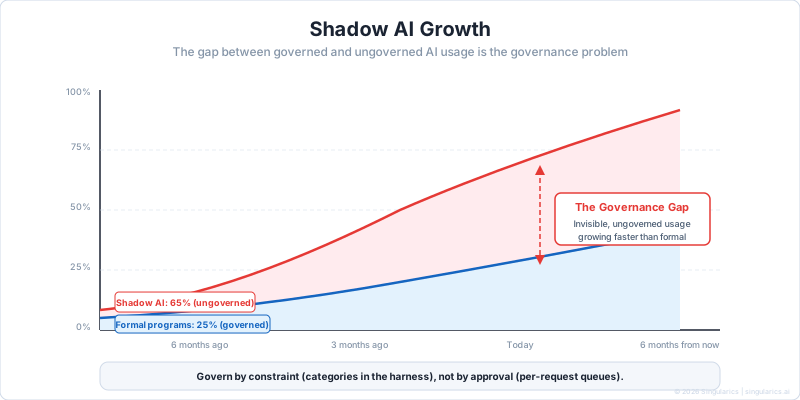
AI governance specifically
AI introduces governance questions that did not exist before, and bolting them onto an existing gate process is how organizations produce months-long approval queues for AI tooling while their people quietly work around them with personal accounts. The shadow organization grows precisely where governance is slowest.
Model selection and provisioning. Which models are approved for which use cases is an Intent Council decision, operationalized through fleet provisioning rather than per-request approvals. The Flow Council provisions approved models to the fleet, and the fleet works within that boundary. See AI Capability Investment.
Responsible use. Bias testing, output validation, and use standards are policy constraints like any other. A responsible-use check that runs on every push is more reliable than a responsible-use review that happens once before launch.
Data governance. Which data the fleet may access, how it is handled, and where it may persist belong in the spec and the harness, injected at spec time and enforced continuously.
The board that enables. An AI governance body that approves or denies each use case individually becomes a bottleneck within weeks. The alternative approves categories of use, sets the constraints for each category, and trusts the harness to enforce them. Governing by approval scales with the number of requests. Governing by constraint scales with the number of categories, which is far smaller.
Still on the old path
The model does not compress everything, and claiming otherwise is how transformations lose credibility with the second line of defense. Regulatory interpretation stays on the Intent Council's existing cadence. Risk appetite changes stay with officers. New external commitments require officer approval. Name these boundaries when presenting to a governance audience, because the most common objection is "you are moving too fast for us to govern," and showing where the model does not accelerate is how you demonstrate the acceleration is safe.
The same audience cares about evidence, so lead with it. Every increment carries its spec, its harness results, the acceptance decision, who made it, and which expert validated the constraints. That is a finer grain of evidence, produced more often, with clearer attribution than any phase-gated process. The value proposition for governance is not "we move faster." It is "we produce more evidence."
The failure modes
Governance as a veto. A body that can reject any increment without participating in the daily cycle is a queue the model cannot absorb. Move its constraints into the harness so its judgment runs on every push rather than waiting for its calendar.
The unset envelope. No envelope means every decision is an implicit escalation, and the one-day cycle stops closing. Set it at the start of each outcome, without exception.
Governance theater. The harness is green, the evidence is strong, and the forum still requires a presentation before approving. The organization is performing governance rather than practicing it. The evidence should be sufficient, and if it is not, fix the evidence.
The missing control layer. Shape, behavior, and failure are checked, and compliance is not. In a regulated environment the control layer is built first when an outcome touches policy, not last.
Its place in the Model
In The AI-Native Operating Model™, Governance and Risk Appetite sits in the Enterprise Inputs band at the top, colored dark blue. It flows down into the model as the bounded authority envelope, the policy constraints in the harness, and the escalation rules at each tier.
Governance connects to:
- The Intent Council, which sets risk appetite and the bounded authority envelope
- The harness, which enforces policy constraints on every push
- The Domain Knowledge Network, which injects constraints at spec time
- Continuous governance, which is the mechanism for answering the three questions daily
- What to Measure, where the evidence ledger records the audit trail as a byproduct
Read the Governance and Risk white paper (PDF). Return to the Model to see how governance flows through the system.