
The Flow Council
The governing body closest to the work
The PMO existed for a reason, and the people who ran them were doing genuinely hard work. Standing teams worked in silos, someone had to manage the handoffs, and the PMO was the glue holding the seams together. The release train existed for the same reason at a bigger scale. It enforced a cadence, which coordinated across teams, and it also enforced a batch size, which meant work that could have shipped daily waited for the train.
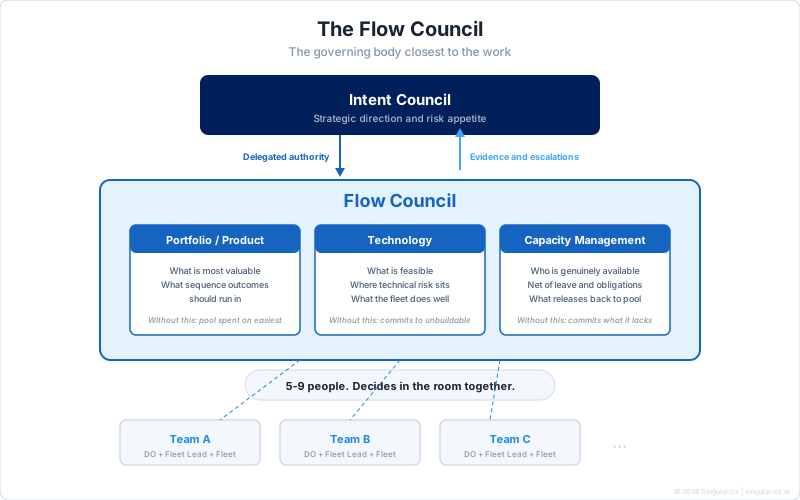
The Flow Council replaces both, not by coordinating better, but by removing the thing that needed coordinating. There are no standing teams with handoffs to manage. There is one pool of fungible capacity, one front door for intake, and one body that makes every allocation decision in the room, together.
It triages intake, allots capacity, forms and reforms teams, routes knowledge, and clears blockers within hours. Almost every decision a team feels comes from the Flow Council rather than the Intent Council. If the Intent Council names the destination, the Flow Council makes the journey happen.
The call is made in the room, together. The pattern this replaces is sequential: product sets priority, technology estimates afterward, and capacity is found later still. That sequence stretches a decision that should take minutes across a fortnight.
The Flow Council's work
Triage. Every sponsored request enters the same front door and is triaged against the portfolio, not against the area it came from. The council sets value, priority, and horizon, placing work on the three horizons. The boundary to guard is between Next and Now, and the No Owner, No Now gate guards it. Anything can be added to Later cheaply, which is exactly why commitments live only in Now.
Demand originates in the areas, and technology is one of them. A platform extension, a security upgrade, a migration off a dying system, a modernization the business will never ask for by name, all of it enters through the same sponsored front door, raised by technology's own officers rather than smuggled in as background work. The bar is identical. A named sponsor, a committed owner, and a chain of service the work ultimately serves, because an internal outcome earns its capacity the same way a customer-facing one does, by tracing to someone the organization exists to serve. The model refuses the third lane, the unsponsored technical backlog that grows in the dark and gets paid for out of everyone's velocity. If the work is worth doing, an officer stands behind it. If no officer will, the portfolio has its answer.
Formation. When an outcome clears the gate, the council forms a team: a named Decision Owner, an assigned Fleet Lead, committed fleet capacity, and a deputy named now rather than found on the morning someone calls in sick. A team is fluid between Efforts and stable within one. The council reforms it at the boundary, on three triggers: the outcome is accepted and capacity releases, a higher-value Effort outranks it, or the Effort needs different expertise than formation assumed. Convenience, utilization smoothing, and a manager wanting someone back are not triggers. A team mid-Effort holds spec history, domain context, and harness knowledge that does not survive a handover.
Capacity. One pool for the portfolio, people and agent fleets together. Each week the council sizes what is genuinely available against the Now horizon, net of leave, standing obligations, and the unreleased portion of Decision Owners' weeks. The output is a plain statement, refreshed weekly: this many owners at the committed release level, this many Fleet Leads, this much fleet capacity, therefore this many Efforts in flight.
Release is the half most organizations skip, and skipping it is what rebuilds standing teams. If capacity never returns to the pool, within two quarters you have permanent teams with new labels and the model has failed silently.
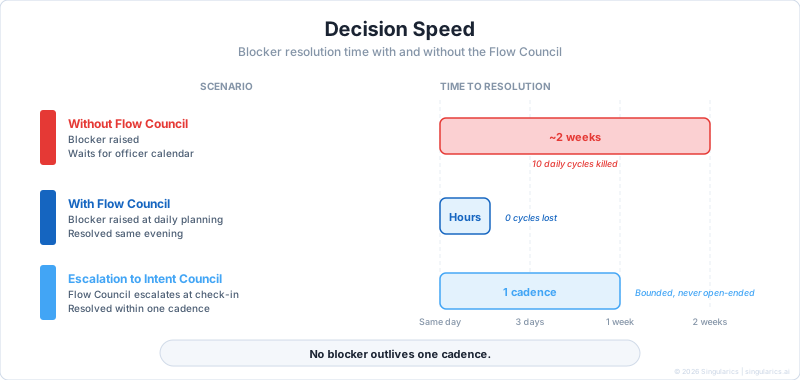
Blockers. Any team can raise a blocker on any day. The council resolves it or carries it to the Intent Council at the next check-in. No blocker outlives one cadence. This is the most time-sensitive thing the council does. A blocker that sits for two days has killed two daily cycles.
Knowledge routing. Each evening's daily planning names the expert tomorrow's spec needs, and the council makes sure that expert is available in the morning. The rota is set at weekly calibration alongside capacity, so expertise is planned rather than begged for. See The Domain Knowledge Network.
Composition
Three perspectives must be in the room when capacity is allocated, because an allocation made without any one of them fails predictably.
Portfolio and product, or the pool gets spent on whatever is easiest to start. Technology, or the roadmap commits to work that cannot be built the way it was imagined. Capacity management, or the group commits capacity it does not have.
These are perspectives, not seats. In a smaller portfolio one person can carry two. Five to nine people is the workable range. Below five it is a single point of failure. Above nine it is a committee, and committees do not decide within hours.
Cadence
Daily, a Flow Council lead attends each team's daily planning, and blockers raised there are resolved or escalated the same evening. Weekly, full calibration: capacity re-planned, experts rotated, the Now horizon re-sequenced if the week's learning warrants it, producing a refreshed capacity statement and rota. Biweekly, the check-in to the Intent Council, bringing landed evidence, blockers above its authority, capacity constraints, and learning that might change direction, and receiving priority changes, risk adjustments, and resolved escalations back.
The shift members must make
This is the hardest part of the transition, and it is behavioral rather than structural. Most Flow Council members arrive from a role that rewarded them for one part of the portfolio. A product lead was rewarded for their product's progress, a technology lead for their platform's stability, a delivery lead for their team's throughput.
A Flow Council member is rewarded for the whole portfolio's outcome, and that regularly means giving capacity away from work they personally care about. The tell that the shift has not happened is a member advocating for "their" teams at calibration. The correction is not a conversation about behavior. It is a change in what they are evaluated on. Leave the old incentive in place and you will have rebuilt organizational silos with new names.
Underneath this is what the council actually is. Not a coordination forum, but the mechanism that organizes the portfolio around knowledge throughput. As execution gets cheaper, delay concentrates in missing owners, unavailable expertise, unclear boundaries, and decisions waiting on the wrong calendar. The test of a good meeting is not whether every Effort reported status. It is whether the right owner, context, capacity, and authority will be present for the next decision.
The failure modes
The status meeting. Calibration drifts from making capacity decisions to hearing updates from each area. The tell is a session that runs past 90 minutes and produces no reallocation. Start every calibration with the capacity statement and the decision queue.
The council that cannot say no. Every sponsored request enters Now because nobody will hold the No Owner, No Now gate. Efforts start without owners, cycles do not close, and the model appears to fail. Holding the gate means telling a sponsoring officer their work waits in Next until they release an owner.
The train problem. Members quietly rebuild what they came from: standing teams, dedicated capacity, protected roadmaps. The diagnostic is whether capacity actually moves at release, or whether the same people stay together indefinitely.
Blockers that outlive the cadence. Either the council lacks authority, which is a delegation gap the Intent Council must close, or it lacks discipline, which is fixed by naming one owner and one deadline per blocker.
Its place in the Model
In The AI-Native Operating Model™, the Flow Council sits in the Portfolio Direction band, colored lighter blue than the Intent Council because it is closer to the work. It is the body that converts strategic direction into daily operations.
The Flow Council connects to:
- The Intent Council, which sets the conditions the Flow Council operates within
- No Owner, No Now, the gate the Flow Council enforces at triage
- Fungible Capacity, the pool the Flow Council manages
- The three horizons, which the Flow Council sequences at weekly calibration
- The Domain Knowledge Network, whose expert rota the Flow Council sets
Read the Flow Council white paper (PDF). Return to the Model to see how the Flow Council connects to the rest of the system.