
Three Horizons
One roadmap. Now, Next, Later. No shadow queues.
Every organization has more work than it can do, so the question is never whether to prioritize. It is whether the prioritization is visible, honest, and enforceable. Most portfolio roadmaps pass the first two tests and fail the third. The backlog could be reordered by anyone with access. The quarterly roadmap deck showed intent without revealing the capacity it would consume. And nothing prevented anyone from starting work outside either one, so the shadow queues formed: urgent requests that skipped intake, officer requests that arrived directly at a team, quick wins that consumed capacity without appearing on any plan. Within a quarter, the roadmap described what should be happening while something else actually was.
The three-horizon model makes the roadmap enforceable by making the cost of entering each horizon explicit.
Anything can be added to Later cheaply, which is exactly why commitments live only in Now.
The same three words at different altitudes
Before going further, one thing has to be said plainly, because it is the most common way this vocabulary gets muddy. Now, Next, and Later recur at every level of the model, and they do not mean the same thing at each level. The three states are the same. The unit of work, the deciding body, and the clock are different.
| Level | The unit | Who shuffles it | How often |
|---|---|---|---|
| Team | The daily spec and its queue | The Decision Owner at daily planning | Every day |
| Portfolio | Outcomes pursued through Efforts | The Flow Council, inside the Intent Council's priorities | At Effort boundaries, roughly monthly |
| Enterprise | Strategic outcomes against divisional objectives | The Intent Council | Quarterly at the rebalance |
At the team level, inside one Effort, the spec queue is the team's version of the horizons. Today's signed spec is Now, the one to three queued specs are Next, and everything else is Later. It shuffles every day.
This article is about the portfolio level, where the unit is the outcome and the clock is set by Effort boundaries. Confusing the levels breaks things in both directions. Leadership that treats the portfolio like the team level demands a reshuffle every week and turns the Flow Council into a dispatcher. Leadership that treats the portfolio like the enterprise level locks the Now horizon for a year and rebuilds annual planning under a new name.
The three states
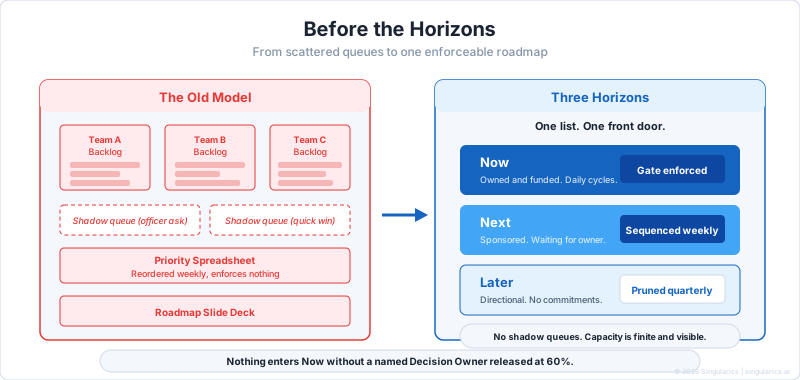
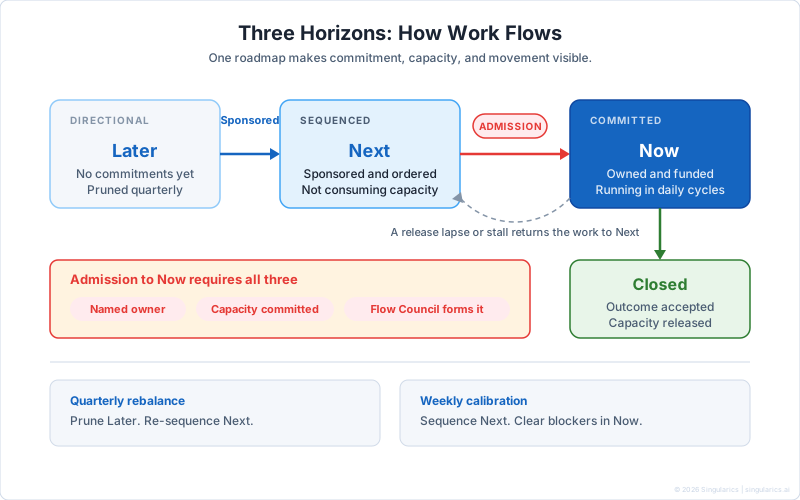
Now is owned and funded, in daily cycles. Every outcome in Now has a named Decision Owner released to the committed level, committed capacity, and a formed team. It is the most expensive horizon: an owner's 60%, a Fleet Lead's time, fleet capacity, and 20 to 30% of the relevant domain experts' weeks. Those costs are real, which is why the No Owner, No Now gate exists. And the count is bounded by the pool. Five Decision Owners at the committed release level means five outcomes in Now. Not six. Not "five plus one that is almost ready."
Next is sponsored and waiting for an owner or capacity. Officer sponsorship, a clear business case, ready to enter Now when both conditions hold. The Flow Council sequences Next at weekly calibration on value, cost of delay, and availability. The discipline of Next is that it consumes nothing. No team, no fleet allocation, nobody working on it. Waiting is its correct state.
Later is directional intent with no commitments attached. The safety valve for organizational ambition. When someone proposes something not yet ready for Next, it goes to Later without argument, at no cost, with no expectation beyond a look at the quarterly rebalance. The moment someone attaches a date to a Later item, it is really a Next item that has not been honest about its horizon.
Why exactly three? Because they map to the only three states an organization can actually enforce. Now has a team. Next does not. Later has nothing. Working on it, ready to work on it, and not yet. A fourth horizon would need a fourth level of commitment, and there isn't one.
How work moves
At the portfolio level, movement between horizons happens at Effort boundaries, because a team is stable within an Effort and reforms only between them. That makes Effort size the portfolio's real tuning knob. Efforts sized in weeks to a couple of months give each team slot roughly a dozen genuine reallocation points a year. Sometimes fewer, sometimes more, and the exact number counts for less than the honesty behind it: the portfolio can only re-decide when capacity actually frees. Efforts sized in quarters starve the portfolio of decision points and quietly rebuild annual planning. Efforts sliced into days give the portfolio more decision points than the councils can use and turn the roadmap into churn.
The cadences layer on top of that physics rather than replacing it. Weekly calibration re-orders Next, so the sequence is always current when a slot opens. The quarterly rebalance restructures the whole portfolio. But neither creates a reallocation the pool cannot deliver. The shuffle rate is set by how often Efforts end.
Later to Next on sponsorship, usually at the quarterly rebalance. The trigger is an officer stepping forward to fund it, not readiness. A well-understood outcome can sit in Later forever if nobody will sponsor it, and a poorly understood one can move to Next because an officer stands behind it.
Next to Now through the No Owner, No Now gate: a released owner, available capacity, and the Flow Council's decision to commit both. This is the transition that carries the most weight and the one most frequently compromised. Every time something slips into Now before the owner is truly released, an Effort starts without the resources to run a daily cycle, and the cycle degrades silently.
Now back to Next on three triggers: the owner's release lapses, a higher-value Effort outranks it when capacity cannot expand, or the Effort stalls. An Effort with no landed increment for a week gets raised at calibration, and if the stall cannot be resolved, returning it to Next beats consuming capacity without results.
Release. When an outcome is accepted, the Effort ends and capacity returns to the pool. The outcome does not move to another horizon. It is done, and the release is a minuted Flow Council action with a date, because release by drift is how standing teams quietly rebuild.
The shadow queue problem
Shadow queues form when work enters the system outside the roadmap, and the horizons kill them with three properties. There is one front door, so every sponsored request is triaged against the portfolio. Every piece of work has exactly one horizon, so there is no "untracked but in progress." And capacity is finite and visible, so if the weekly statement says five Efforts, a sixth cannot start without one releasing.
The most common way shadow queues reassert themselves is the officer who asks a team directly to "just take a quick look at something." The team complies, because the officer has authority. The quick look consumes a day, which means one cycle of a funded Effort did not happen. Multiply by five officers and three teams, and the portfolio runs at 70% of its capacity while appearing to run at 100%.
The protection is the front door, applied upward. Officers who want something prioritized use their authority at the Intent Council to move it up the horizons, not at the team level to bypass them.
The quarterly rebalance
The Intent Council reviews the full portfolio quarterly, and this is where the horizons shift significantly. Later is pruned: an outcome that has sat there for two quarters without attracting sponsorship is removed, because if nobody will fund it after six months of visibility, it is not a priority. Next is re-sequenced on three months of evidence. Now is examined: Efforts running longer than expected either continue, re-scope, or release. And new outcomes enter as the business environment changes.
Between rebalances, the Flow Council handles the daily and weekly adjustments. The division of labor is clean: the Intent Council owns the horizons, the Flow Council runs them.
One more thing worth saying plainly. The horizons are states of commitment, not loose estimates of time. AI can analyze the portfolio, propose sequences, and model cost of delay, but it cannot decide which commitment the enterprise should make. That discipline grows more valuable as execution accelerates, because a fast system multiplies whatever enters it. A single roadmap keeps the multiplication attached to the organization's actual priorities instead of to the loudest local queue.
The failure modes
Everything is Now. The organization has not prioritized. It has made a list. No outcome has enough capacity, every cycle is compromised, nothing lands. The diagnostic takes one minute: count the Efforts in Now against the Decision Owners in the pool. More Efforts than owners means something is in Now that is not really in Now.
The stale Next. Outcomes sitting in Next for more than two quarters get raised at the rebalance. Fund them or admit they are Later items.
The Later that acts like Next. Stakeholders ask when Later items will start and plan dependencies against them. Remove the dates and the expectations. Later means "we believe in this, and we have committed nothing."
The missing release. Efforts complete, capacity is never minuted back to the pool, and the same people drift onto "the next thing" together. Within two quarters you have permanent teams with new labels.
Its place in the Model
In The AI-Native Operating Model™, the three horizons sit in the Portfolio Direction band, colored blue. They are the roadmap structure that the Flow Council manages and the Intent Council owns. The gate between Next and Now is the No Owner, No Now gate.
The three horizons connect to:
- The Intent Council, which sets and rebalances the horizons quarterly
- The Flow Council, which sequences work within the horizons weekly
- No Owner, No Now, the gate that controls the Now boundary
- Fungible Capacity, because the pool's size determines how many outcomes can be in Now
- Strategic Outcomes, which populate the horizons
Read the Three Horizons white paper (PDF). Return to the Model to see how the horizons structure the portfolio.