
The One-Day Cycle
Specify, Build, Judge, Land
The sprint was right for its time, and that deserves to be said clearly. Work in small increments, sequence the highest value first, get feedback quickly. That principle has not changed in twenty years and it does not change here. What changed is the cost of an increment.
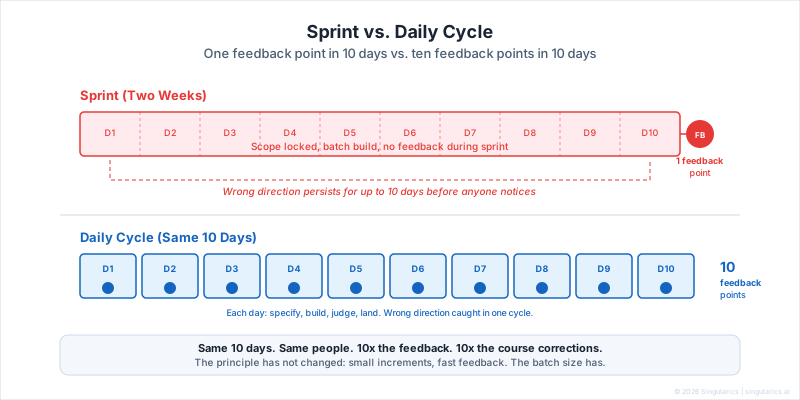
The two-week batch made sense when it took a week to build something meaningful and days more to test it. It also carried a cost everyone learned to live with: scope locked for two weeks, feedback arriving in batches, and wrong direction persisting for a full sprint before anyone could see it. When delivery time for a unit of work falls toward zero, that trade stops being worth it. The constraint moves from execution to the slowest remaining human step: deciding what should be built, judging whether what came back is right, and supplying the domain knowledge for either call.
The one-day cycle is not a process improvement. It is a different clock speed for the organization, and it is what a team looks like when it reorganizes around the new constraint. The batch size shrinks from two weeks to one day. Feedback arrives daily. Wrong direction survives one cycle, not a sprint.
The sprint and its scheduling machinery
The sprint, and the coordination machinery around it. Sprint planning, standing teams, stage-gate review, and ceremony all exist to schedule scarce delivery capacity. Point them at abundant delivery capacity and they hold it back rather than release it.
And the people who ran that machinery well are not retired with it. A good scrum master or agile coach spent years teaching teams how to work, which is precisely the scarce skill of this era. They are the shortlist for teaching the new fluency, spec writing, context curation, reading machine output critically, and for running Flow Council calibration, and the best of them are early candidates for the Intent Architect path. The calendar of ceremonies goes away. The craft of making teams better does not.
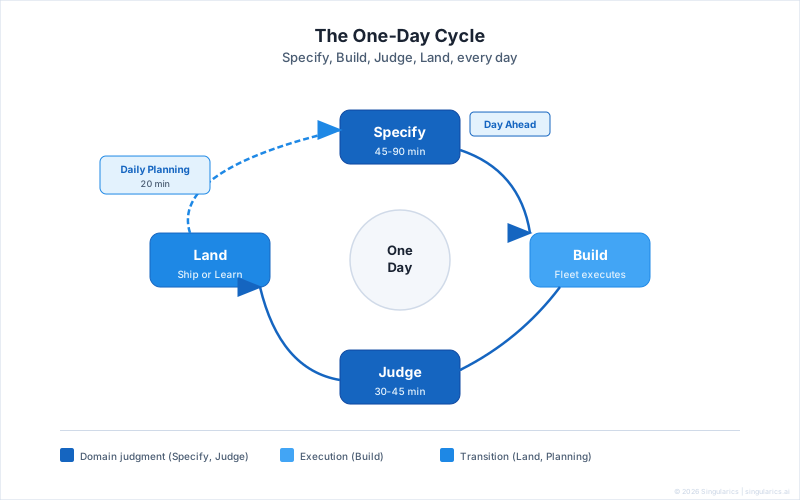
Two daily cadences replace them, and they serve different purposes. The team's cycle is the build loop: specify, build, judge, land, turning a spec into a landed increment every working day. The program's cycle is the governance loop: the Flow Council attends daily planning across teams and clears blockers the same day, so no team waits overnight for a decision the council can make now. Beneath both, the fleet runs continuously and the harness runs on every push. Blockers that used to wait for the next program sync now resolve in hours.
The shape of a day
Before the day starts, the spec exists, reviewed and signed, with the domain context already injected by the Domain Knowledge Network. Nothing about the day's direction is open. Teams resist this at first, because it asks the Decision Owner to commit before seeing what the fleet produces. The tension eases once you notice that 70 to 80% of the spec is stable context. The daily decision is a small delta, not a fresh negotiation.
First hour. The Fleet Lead reads the spec with the fleet, decomposes it, and confirms every criterion is expressible as a check. If one is not, that surfaces now, not at 4pm. The Decision Owner is reachable for this hour specifically.
Middle of the day. The fleet implements against the contract. The harness grows alongside, because agents write coverage as they build. The Fleet Lead directs and course-corrects, intervening two to four times for named reasons. The Decision Owner answers the three to six questions that arrive, each taking minutes rather than a meeting.
Late afternoon. The harness runs clean, or it does not. The demo is prepared against the criteria in the spec, not as a happy-path walkthrough.
End of day. Demo, judgment, acceptance or a named blocker, landing, then daily planning. Budget 45 to 60 minutes for all of it.
Two of the steps deserve a word, because they are the ones the old mental model misreads.
Judge sits inside the loop. Drawn as a late step it reads as an approval gate, which is exactly the thing this model replaces. Judgment happens every day, on every increment, by the person who has been present the whole time. Acceptance is made against evidence, not against a demo. The harness proves the work. The demo builds intuition. Those are different things. If the harness is red at close, the increment does not land, whatever the demo looked like.
Land is a binary. Every day ends in one of three places, and this is the ship-or-learn mechanism. Preferred: shipped to users the same day. The floor: a hands-on environment with realistic data that stakeholders can open without a scheduled session. Never a slide, never a status report, never a recorded walkthrough. Or learn: the increment is not accepted, the blocking constraint is named that day, and it redirects tomorrow's spec. Nothing sits in an ambiguous state overnight.
Daily planning
Twenty minutes, immediately after the demo while the evidence is fresh. It is a decision forum, not a status meeting. The Decision Owner, the Fleet Lead, and a Flow Council lead attend. The domain expert joins when the next increment touches their specialty, perhaps two days in five.
The agenda is five items: what landed and where, what the demo and the harness told us that we did not know this morning, the Confirm-Amend-Replace call, which domain expert tomorrow needs, and anything the Flow Council must clear tonight.
| Call | Frequency | Meaning |
|---|---|---|
| Confirm | 60-70% of days | Pull the next queued spec as written |
| Amend | 20-30% of days | Adjust criteria but not direction |
| Replace | 5-15% of days | New direction needed, rewrite the spec |
Those frequencies are diagnostic. Replace persistently above 30% means the slices are too big. Replace at 0% means the work is so well understood it may not need this model. And a team that Amends every day for two weeks is not learning from the cycle. It is building one large thing in daily pieces, which is a sprint with different vocabulary.
Every planning session ends with a named decision on tomorrow's spec, a named domain expert if one is needed, and a named blocker with an owner and a deadline, or an explicit statement that there are none. If the session routinely runs past 30 minutes it has become a working session. Split it. Decisions happen in the twenty minutes, spec authoring happens after.
When a day fails
A failed day is one where the increment is not accepted. This is normal and should happen regularly. The requirement is that the failure is precise.
The unacceptable end to a day is "it is not quite there yet." The acceptable ends are: accepted and landed; not accepted because criteria three and seven fail and here is the evidence; or not accepted because a decision is required that the owner cannot make inside their envelope, with the exact question for the Flow Council attached. If a team ends days vaguely, the spec was vague. Go back to the checkability test.
The cycle also runs on working days, not on guilt. A four-day week is four cycles, and the spec queue absorbs the gap. Teams that double a spec to make up a lost day produce the oversized increments that break the model. The same discipline applies to an increment that will not finish: split it, land what is provable today, and carry the remainder into tomorrow's spec as a new increment.
The team
A team is two or three humans plus their fleet, and it holds together for the life of one Effort. The Decision Owner owns the outcome. The team owns the Effort, spec to landed increment, no handoffs. The Domain Knowledge Network owns correctness against policy and domain rules.
Nobody owns a system. That absence is what makes capacity fungible.
One more thing the cycle is not. It is a decision cadence, not a demand to manufacture output every day. A day may end with a landed increment or with a precise finding that changes the next decision. Both close the loop. The speed comes from closing the loop daily, not from forcing more work through it.
The failure modes
The morning scramble. The spec is not ready, so the Fleet Lead loses the first hour to waiting. The build runs short, the harness is thin, the demo is weak, the acceptance is uncertain. Fix it upstream: no build day starts without a signed spec.
The expanding demo. Past fifteen minutes, a demo has become a working session. The demo shows the increment against the criteria. What to build next belongs in daily planning.
The cycle that never closes. An unfinished increment carried forward for "just one more day" is the ship-or-learn binary eroding. Split the increment and land the provable part.
Its place in the Model
In The AI-Native Operating Model™, the one-day cycle is the gold execution band in the center. It is Zone 2 of the work lifecycle: the loop that repeats every day. Zone 1 (intake, triage, form) enters once. Zone 3 (release) closes once. Zone 2 turns daily.
The daily cycle connects to:
- The spec, written each day by the Decision Owner
- The harness, which proves each day's increment
- Ship or Learn, the landing mechanism that closes each daily turn
- The Flow Council, which clears blockers within hours
- The Domain Knowledge Network, which injects context at spec time
Read the One-Day Cycle white paper (PDF). Return to the Model to see how the daily cycle connects to the rest of the system.