
Knowledge Investment
Funding the Domain Knowledge Network
Every prior operating model treated domain knowledge as something people brought with them. It was implicit, carried in the heads of experienced staff, passed along informally. Nobody funded it because nobody could see it. It was the air the organization breathed. The expert spent an hour in a meeting, explained what was needed, went back to their desk, and months later, during UAT, everyone discovered the gap between what was explained and what was built.
That worked tolerably when delivery was slow, because there was time to discover the misunderstandings. In a one-day cycle there is no time. Missing knowledge on Monday is a wasted cycle on Monday, and missing knowledge on three of five days means 60% of the team's capacity is rework.
When execution stops being the constraint, domain context becomes the scarce resource, and the invisible asset becomes load-bearing. Load-bearing things need to be funded, staffed, and governed, or they fail under weight.
Knowledge Investment is the deliberate, funded commitment to making domain expertise available, encodable, and reusable across the portfolio. It was implicit before. Now it is infrastructure.
The funded lines
Expert time. Members of the Domain Knowledge Network stay in their home functions, with an additional, named, funded commitment of 20 to 30% of their week, released by their home officer and paid for by the portfolio. The split is the same design decision as the Decision Owner's 40%. Domain knowledge is perishable, and the 70 to 80% the expert keeps in the function is what keeps their contribution worth funding. A guild extracted from the business would be carrying last year's rules within a year. The funding must be explicit for the same reason the Decision Owner's release must be explicit. An expert whose network time is "whenever they can fit it in" will not be available when the spec needs them, because home functions always reclaim unfunded time. Their own obligations do not pause.
The encoding layer. A conversation between an expert and a team is valuable and perishable. Encoding is what makes it persist: criteria into the harness, context into the knowledge graph, constraints into checks that run on every push without the expert in the room. Encoding takes longer than explaining and produces something that lasts, so it is funded as part of the expert's commitment, with tooling from the platform investment.
Coordination. The push model needs someone reading the day's specs each morning and connecting the right expert to the right team before anyone asks. The rota is Flow Council work at weekly calibration, with daily attention from whoever holds it.
The learning loop. A monthly two-hour network session to absorb what came back from teams and revise the shared context. Skip it and the network becomes a rota of interruptions rather than a learning system.
Sizing it for a real portfolio
The numbers are calibrated starting points rather than constants, but they make the shape concrete. A portfolio running eight active Efforts typically needs a guild of ten to fourteen named experts across its domains. At 20 to 30% each, that is roughly three full-time equivalents of expert capacity, plus a coordination rota that costs a fraction of one more, plus the encoding tooling from the platform line. Against the total cost of eight crews and their fleets, the network is well under a tenth of portfolio spend.
Hold that against what a single miss costs. One policy interpretation discovered at UAT instead of at spec time can consume more capacity in rework than the guild costs in a month, and it is never one. The network is not an overhead line next to delivery. It is the cheapest capacity in the portfolio, because every hour of it multiplies through every team that inherits the encoded result.
The alternatives that keep getting proposed
The dedicated knowledge team. Extract the experts, staff a standing group, make availability someone's whole job. It fails on the same law the Decision Owner's 40% exists to defeat. Knowledge is refreshed only by doing the business, and a fully extracted expert is a fading one. The guild stays in the business because that is where the knowledge is made.
The documentation drive. Fund a quarter of wiki-writing instead. The result is storage, and storage is not holding. A stored page cannot notice the moment it becomes relevant, and nobody trusts it enough to build against unchecked. Encoding into checks that run on every push is what makes knowledge active rather than archived.
Hiring it. A strong new hire carries another company's domain. What the network runs on, this company's policy history, this customer base, these regulators, exists only inside the building and takes years to acquire. Hiring grows the guild eventually. It does not substitute for releasing the people who hold the knowledge now.
The economics
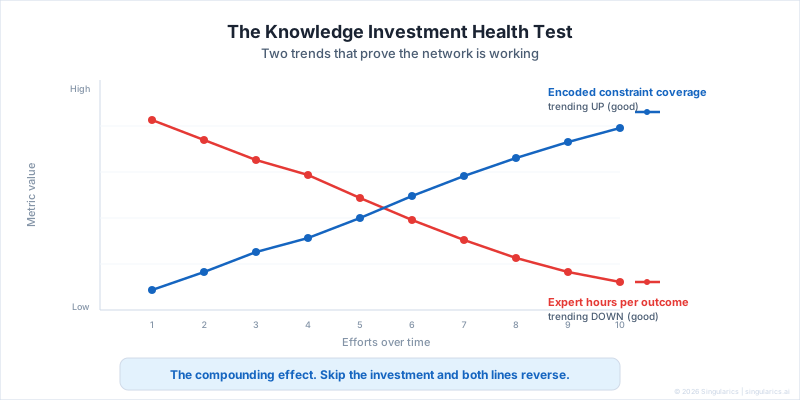
The return shows up in one crossing pair of lines: expert hours per outcome trend down while coverage of encoded constraints trends up.
The mechanism is encoding. Each contribution leaves checks and context that the next team inherits automatically, so the expert's time is spent only on what is genuinely new. After six months, the portfolio's harness holds hundreds of domain-specific checks running on every push. Demand on expert time has fallen not because the work got simpler but because previous contributions are still working.
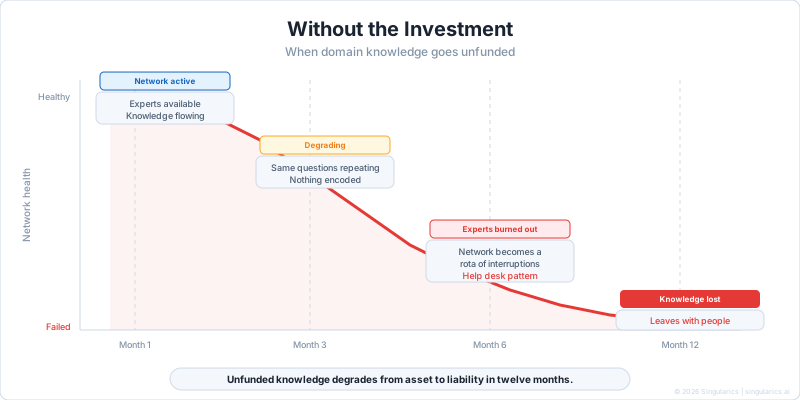
The cost of not investing arrives in a predictable sequence. First, experts become unavailable, because network time has no formal standing and their home functions need them. Teams wait for knowledge or proceed without it. Second, defects arrive later. Work built without the right knowledge passes the harness and fails in the domain, surfacing at the demo or after release, at an order of magnitude more cost than an injection at spec time. Third, the same questions recur, because nothing persists, and the portfolio pays for the same knowledge over and over.
The total of those three failures almost always exceeds the cost of funding the network explicitly. And the deeper point is worth stating without hedging: expert attention is production capacity in this model, even though the expert may never touch the implementation. A missing policy interpretation can stop a fleet completely, or worse, let it produce the wrong thing quickly.
The political challenge
Every expert in the network is also a key person in their home function, and their officer will resist releasing 20 to 30% of their time. Two conditions unlock it.
The release is funded. The home function receives something for the capacity it loses, and the arrangement is explicit rather than a favor that erodes.
The contribution is visible. Report the encoding output to the releasing officer: how many harness checks their expert's knowledge produced, how many teams inherited them, how many domain defects were caught in CI instead of at the demo. Those numbers make the contribution tangible in a way that "your expert attended our meetings" never will.
One edge case deserves naming at funding time. The one-deep domain, where a single person holds knowledge the whole portfolio depends on, is a risk the weekly calibration should carry by name. The duty there is encode-first, so that every contribution lands in the harness and the graph before it is needed twice, and a second slice of guild time gets funded early in that domain, apprenticed beside the expert while the expert is still in the room.
The operational failure modes of the network itself, the help desk pattern, the expert who explains but does not encode, the expert who leaves, are covered in The Domain Knowledge Network. The funding failure is upstream of all of them: an unfunded network fails on availability before it ever gets the chance to fail on encoding.
Its place in the Model
In The AI-Native Operating Model™, Knowledge Investment sits in the Enterprise Inputs band, colored green because it is a domain-judgment investment. It flows down into the Domain Knowledge Network, which in turn feeds the spec, the harness, and the knowledge graph.
Knowledge Investment connects to:
- The Domain Knowledge Network, which it funds and staffs
- Investment and Funding, as a named budget line alongside people and fleet capacity
- The harness, where expert knowledge is encoded as automated checks
- The Decision Owner, who is the first line of domain knowledge for each team
- The Intent Council, which approves the funding and the release of experts
Read the Knowledge Investment white paper (PDF). Return to the Model to see how knowledge investment feeds the rest of the system.