
The 90-Day Engagement
The 18-month stall
The enterprise transformation program follows the same arc every time. A consulting engagement produces a beautiful target state. A roadmap describes the 18-month path. The first three months go well because the energy is high and the changes are easy. Months four through nine hit resistance as the changes become structural. By month twelve, the organization has absorbed enough of the new vocabulary to appear transformed while operating essentially as before. The transformation had its own PMO, its own budget, and its own executive sponsor, and by the time anyone noticed it was not working, the investment was too large to reverse and the program too visible to cancel. The organization declared success and moved on, having spent millions to rename its existing practices.
The 90-day engagement exists because the only honest way to adopt a new operating model is to prove it works before asking anyone to believe in it. One outcome, one team, one Decision Owner. The investment is small, the risk is bounded, and the evidence is real within weeks. If the model works, the evidence creates demand for more. If it does not, the organization has lost 90 days of one team's time rather than 18 months of disruption.
Do not roll this out. Prove it on one outcome, then let demand pull it.
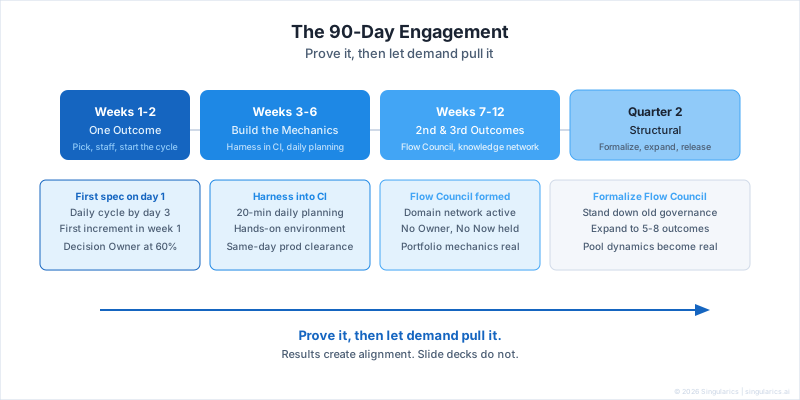
Weeks 1 and 2: One outcome
Pick something real, bounded, and visible. Real means the business feels it. Bounded means it can show results in weeks. Visible means stakeholders will notice when it lands.
Find a Decision Owner who passes the screens. Can they describe what the outcome is worth? Can they say no to a stakeholder? Have they been accountable for a business result? Two of three is enough. Release them to 60%, and remember: if they have to leave the room to answer a question about what the business needs, they are a proxy, not an owner.
Stand up one team. A Decision Owner, a Fleet Lead, and a fleet. No larger.
Write the first spec together, with a domain expert present. Accept that the first week's specs will be slower than they will be. The owner is learning context engineering, the Fleet Lead is learning to direct agents, the expert is learning to inject rather than review. Everyone is building new muscle.
Start the daily cycle on day three. Do not wait until everything is perfect. The model improves by running, not by planning to run. The first landed increment should arrive within the first week.
Weeks 3 to 6: Build the mechanics
This is where the daily cycle becomes a practice rather than an experiment.
Get the harness into CI. The single most important infrastructure step. On every push it is a gate. Before demos it is a suggestion.
Make daily planning a 20-minute decision forum. The Confirm, Amend, or Replace call made explicitly and recorded, because the ratio becomes your first real diagnostic.
Establish the hands-on environment. Every increment lands somewhere a stakeholder can touch it. See Ship or Learn.
Get one class of change cleared for same-day production. This single achievement changes the conversation more than any deck. When a stakeholder sees an increment in production the same day it was specified, the model stops being theoretical.
Start measuring the leading indicators. Owner presence, the Confirm/Amend/Replace ratio, blocker resolution time. See What to Measure.
Weeks 7 to 12: Second and third outcomes
This is where a single-team experiment becomes a portfolio practice.
Add outcomes two and three. The Flow Council becomes real here, because capacity now has to be planned and released across more than one Effort. One team does not need a Flow Council. Three do. By week 8 the council has named members with changed objectives, evaluated on the whole portfolio's outcome rather than their area's progress.
Activate the Domain Knowledge Network. With multiple teams in different domain areas, the network moves from a list of names to a working rota. Experts are assigned, the push model starts, and encoding begins.
Hold the No Owner, No Now gate. Expect it to be tested right here. A fourth outcome will be proposed, ready in every way except for a released owner, and the pressure to let it through will be significant. Holding the gate is the difference between the model working and the model becoming vocabulary.
The 90-day proof
At the end, the organization has evidence rather than a business case. The daily cycle works: increments land daily, and an owner accepts every day. The model produces results: real outcomes in the hands of real users, or at minimum in an environment stakeholders can use. The mechanics hold: the Flow Council allocates, the network injects and encodes, the gate is enforced. And the evidence trail exists: every increment carries its spec, harness results, and acceptance decision, which means governance is already continuous.
That evidence is what creates the demand for expansion. Teams that see it ask "when do we get that?" instead of being told "you must adopt this."
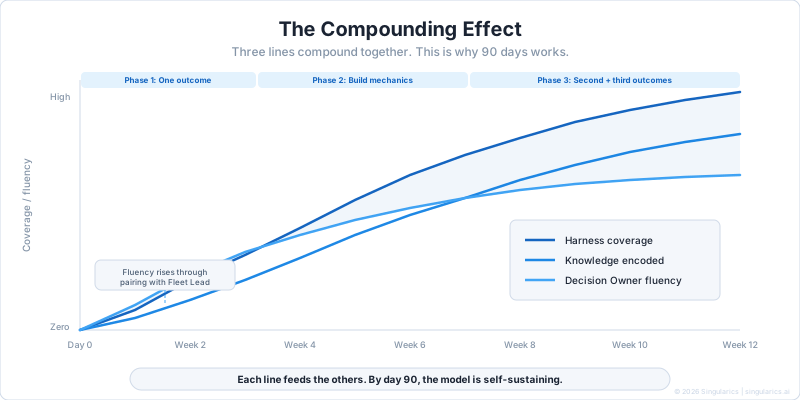
The design principle underneath is worth naming, because it is what separates this from a pilot. Training attendance, tool activation, and a completed rollout plan can all look healthy while no business outcome changes. The engagement starts with one owned outcome precisely so the mechanics get proven against real work and real consequences. The first outcome reveals where authority, context, policy, or capacity actually binds. The second and third test whether the correction transfers. Only then is portfolio expansion justified. Land something, read the evidence, alter the system, and widen the boundary only as far as the evidence supports.
After the 90 days
Quarter 2 is structural. Formalize the Flow Council with standing membership, the weekly calibration, and the biweekly check-in with the Intent Council. Stand down the program governance the model has made redundant, and not earlier: removing the old structure before the new one has demonstrated it works is a common way these transitions die. Expand to five to eight concurrent outcomes, which is where pool dynamics become real and where you watch for standing teams quietly reforming.
Quarter 3 and beyond is portfolio scale. The model is no longer an experiment, and the focus shifts from proving to improving. Deepen the harness until the control layer covers every policy constraint the portfolio touches. Grow the knowledge graph until expert hours per outcome visibly trend down. Give the metrics baselines and diagnose from trends. See From Pilots to Production for the scaling path.
Week one, in plain words
They will ask what happens to them, and the question deserves a real answer rather than a deferral. It also deserves more care than a mapping table, because where any individual lands depends on the person and the organization, not on the model.
What can be said without guessing: the work changes shape rather than disappearing. Judgment, domain knowledge, and accountability all become more valuable as production becomes cheaper, and expertise is not discarded. What thins out is coordination that exists only to manage handoffs.
Say that, then run the actual conversation role by role with the people concerned. Publishing a migration map before those conversations happen turns a discussion into an announcement, and the announcement will be wrong for enough people to cost trust.
The failure modes
The wrong first outcome. Not the most important thing in the portfolio. Important enough that success is felt, bounded enough to show results in weeks, visible enough to be noticed. A back-office improvement that saves three hours a day beats a customer-facing transformation that takes six months.
An outcome that is too easy. If the first outcome is trivial, the organization dismisses the result as "that only worked because it was easy." Pick something with domain knowledge, policy constraints, and stakeholders with opinions. The model has to prove itself on real work.
The first outcome fails. That is information. The model has specific mechanics, and when it fails, the failure is usually specific and nameable. Was the owner a proxy? Was the harness not in CI? Was the network never activated? Diagnose before concluding.
The missing executive sponsor. The engagement needs a sponsor who can protect the team from organizational antibodies in the early weeks. They do not run the work. They make sure the owner is truly released, the Fleet Lead has the fleet, and the daily cycle is not interrupted by standing meetings that served the old model.
Its place in the Model
In The AI-Native Operating Model™, the 90-Day Engagement is not a permanent element of the model. It is the entry point, the way the model enters an organization. Once the model is running, the engagement is complete and the portfolio operates on its own mechanics.
The 90-Day Engagement connects to:
- The one-day cycle, which is proven in weeks 1 and 2
- The Flow Council, which becomes real in weeks 7 to 12
- No Owner, No Now, the gate that is tested and held during the engagement
- The Domain Knowledge Network, which is activated as the portfolio grows
- From Pilots to Production, the scaling strategy that follows the engagement
Read the 90-Day Engagement white paper (PDF). Return to the Model to see how the engagement fits the rest of the system.