
From Pilots to Production
The people problem underneath
Every large organization has run an AI pilot. Many have run dozens. The pilots work. They demonstrate capability, produce impressive results in controlled conditions, generate enthusiastic slide decks, and then they stall. The technology is almost never what failed. The pilot team had a clear mandate, direct access to the business, and freedom from the standing process. The production organization has none of those things. The gap is not technical. It is structural.
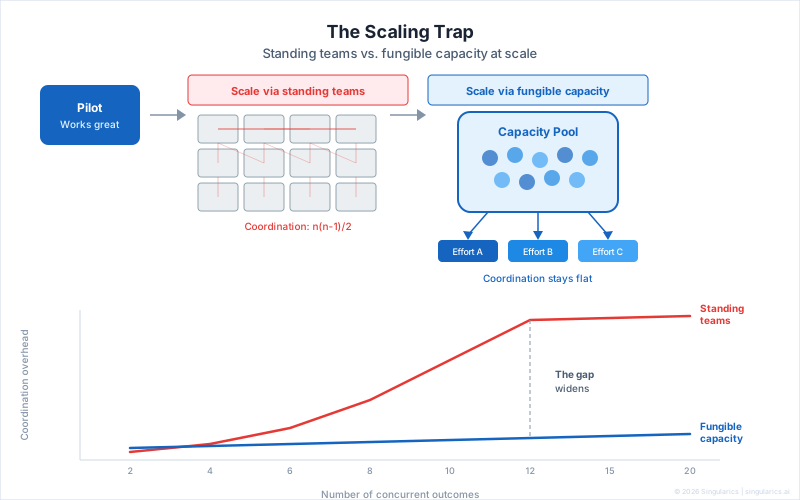
The most common mistake is to treat scaling as a technology rollout. Buy more licenses, train more people, stand up more pilots. This produces more pilots. It does not produce production outcomes.
Two rollouts that stalled
The center of excellence and the training-first rollout, and each failed for its own reason. The center of excellence created a separate group that ran pilots, proved capability, and then tried to transfer the learning outward. The transfer consistently failed, because the center had pilot conditions and the rest of the organization did not. The training-first rollout trained hundreds of people on AI tools before changing the operating model, and the trained people returned to their standing teams, their existing processes, and their unchanged governance, and discovered they could not use what they learned.
Both shared the same root error: they treated AI adoption as a capability problem. It is a structure problem. The capabilities exist. The question is whether the organization is structured to absorb AI output and turn it into business results.
The pilot plateau
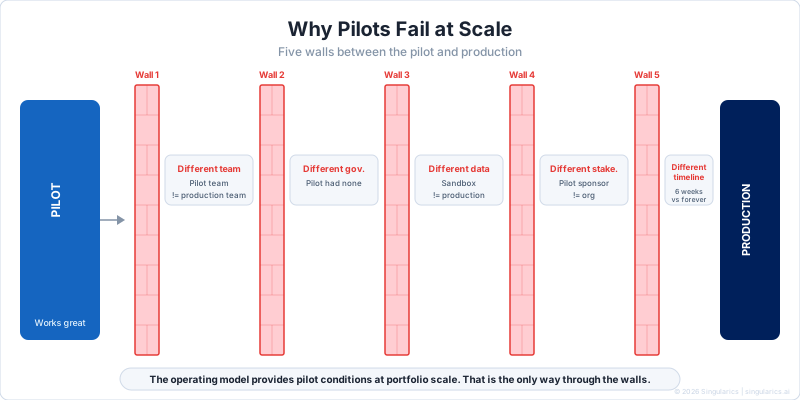
A successful pilot typically enjoys five conditions the broader organization lacks. A clear, bounded outcome instead of dozens of competing priorities. Direct access to a business expert, in the room, answering in real time. Freedom from the approval process. A small, self-contained team that decides without committees. And executive attention, which means blockers clear quickly.
Those five conditions are not luxuries. They are the minimum conditions for AI-native work to produce results, and every one of them maps to a mechanism in the operating model:
| Pilot condition | Operating model mechanism |
|---|---|
| Clear, bounded outcome | Strategic outcomes declared by the Intent Council |
| Direct business access | Decision Owner embedded in the team |
| Freedom from approval queues | Continuous governance, bounded authority envelope |
| Small team | Tiny teams with fungible capacity |
| Executive attention | Intent Council and Flow Council structure |
Scaling is not about recreating the pilot's magic. It is about building the structure that provides pilot conditions as the standard operating environment.
The scaling path
Start with one outcome, not with infrastructure. The 90-Day Engagement is the entry: one outcome, one team, one owner. It is a pilot, but a pilot designed to prove the operating model rather than the technology. A technology pilot proves AI can produce output. An operating model pilot proves the organization can absorb that output and turn it into business results. The second is harder and worth more.
Prove the mechanics before expanding. The daily cycle closing regularly, the harness in CI, the owner accepting on evidence, planning producing real Confirm-Amend-Replace calls, the hands-on environment current. If any of these fail for one outcome, they will fail for three. Fix the mechanics first.
Add outcomes, not teams. The scaling unit is the outcome. Each new one gets an owner, a Fleet Lead, and fleet capacity from the pool, and the team dissolves at the end. The instinct to hire more people and form more standing teams produces exactly the structure the model is designed to replace.
Activate the Domain Knowledge Network early. It is the mechanism that breaks most often during scaling, because one team can often live off its owner's knowledge, and three teams in different domains cannot. Identify the experts, fund their time, establish the rota, and start encoding before the need is urgent. The encoding done in the first weeks compounds for every subsequent Effort.
Build the Flow Council when the portfolio hits three. One team does not need one, and five teams cannot function without one. Form it deliberately at three concurrent outcomes, with named members and changed objectives. The common mistake is waiting until the need is obvious, by which point capacity allocation has been ad hoc for weeks and the habits are set.
The organizational antibodies
Every organization has immune responses to change. Naming them in advance makes them easier to handle.
"We need to finish the pilot first." The pilot never finishes. Results raise questions, questions become experiments, and the pilot expands indefinitely without becoming production. Set a date. At week 12 the first outcome proves the model or it does not, and you move either way.
"We need a center of excellence." That builds a separate organization with pilot conditions the rest of the company will never have. Build the operating model instead, so every team gets the conditions.
"We need to train everyone first." Training without practice does not transfer. Context engineering, spec writing, altitude review, and fleet direction transfer by apprenticeship on real work, experienced practitioners paired with new ones.
"We need to align all the stakeholders." Alignment through meetings produces agreement to proceed and no change in behavior. Alignment through evidence produces demand. Run the 90 days, produce results, and let the results do the aligning.
"Our situation is different." Every organization is different in details and the same in structure. The constraint has moved from execution to human judgment, and the mechanisms that address it are structural, not contextual. Implementation details vary. The mechanisms do not.
Production scale
At portfolio scale the model runs as a continuous flow rather than a set of projects. Outcomes enter Now as owners are released and capacity frees, with no annual planning cycle gating starts. Capacity flows between outcomes through the pool, so the organization neither hires per initiative nor carries idle capacity between them. The harness and the knowledge graph compound across Efforts, so the cost of proving the next increment keeps falling. Governance reads a ledger that is always current. And the organization learns at the speed of the daily cycle, not at milestone reviews.
The test for "are we there" is three conditions: the Flow Council is making portfolio-level capacity decisions, the network is operating as a push model with real encoding, and capacity is genuinely flowing between Efforts rather than pooling into standing teams.
One structural point explains why this works when adding teams does not. A pilot proves a small group can produce an artifact under favorable conditions. Production requires proving the organization can repeatedly supply direction, ownership, domain context, policy, judgment, and evidence under ordinary conditions. Scaling by teams multiplies output before it strengthens those scarce parts. Scaling by outcomes exercises them, then returns what was learned. The portfolio grows when the mechanisms can absorb another outcome without weakening accountability, not when another demo is ready.
The failure modes
The portfolio grows too fast. Too many outcomes in Now before the mechanics are proven, which recreates the unscalable pilot at triple size. If the pool supports three Efforts, three is the number, regardless of how many outcomes have been declared.
An area resists. Some parts of the organization have regulatory constraints that need clearance work, some have cultural resistance that needs more evidence. Scale where the model is welcomed and let results create demand in the rest.
The release mechanism goes missing. Efforts complete, capacity never returns to the pool, and within two quarters the portfolio has permanent teams with new labels. Release is a minuted Flow Council action with a date.
Its place in the Model
In The AI-Native Operating Model™, From Pilots to Production is not a permanent element. It describes the journey from the first outcome to portfolio scale. Once the organization is operating at scale, the journey is complete and the model sustains itself through its own mechanics.
From Pilots to Production connects to:
- The 90-Day Engagement, which is the entry point for the first outcome
- The Flow Council, which becomes the portfolio management mechanism at scale
- Fungible Capacity, because the pool model is what makes scaling possible without standing teams
- The Domain Knowledge Network, which must be activated as the portfolio grows
- Continuous Governance, which replaces stage-gate review at scale
Read the From Pilots to Production white paper (PDF). Return to the Model to see the system these scaling decisions feed into.