
A domain expert, borrowed from their real job, is explaining to a delivery team how claims actually adjudicate. Or how the ledger closes, or what the regulator meant in that bulletin. The expert is brilliant for an hour. The room is engaged, the notes are careful, and the expert goes back to the day job. Months later, in acceptance testing, the team discovers the distance between what was said, what was heard, what was written, and what was built. The distance was there the whole time.
For decades the scene was survivable, because everything else was slow too. Misreadings surfaced in weeks and were argued back into shape before much compounded on top of them. Delivery was the constraint, so knowledge could afford to be casual.
Then the constraint moved. When execution compresses toward a day, the work turns on exactly one thing, the knowledge that never got written down. A fleet of coding agents pointed at a spec, the day's written contract, that is missing the regulator's bulletin does not slow down to ask. It builds, confidently and wrong, and the harness, the automated checks that prove the work, proves that the wrong thing works. In Intent Architecture I argued that ambiguity used to be absorbed and now it compiles. This is where the absorbing used to happen. A layer of people who knew things, connected by hallways and favors.
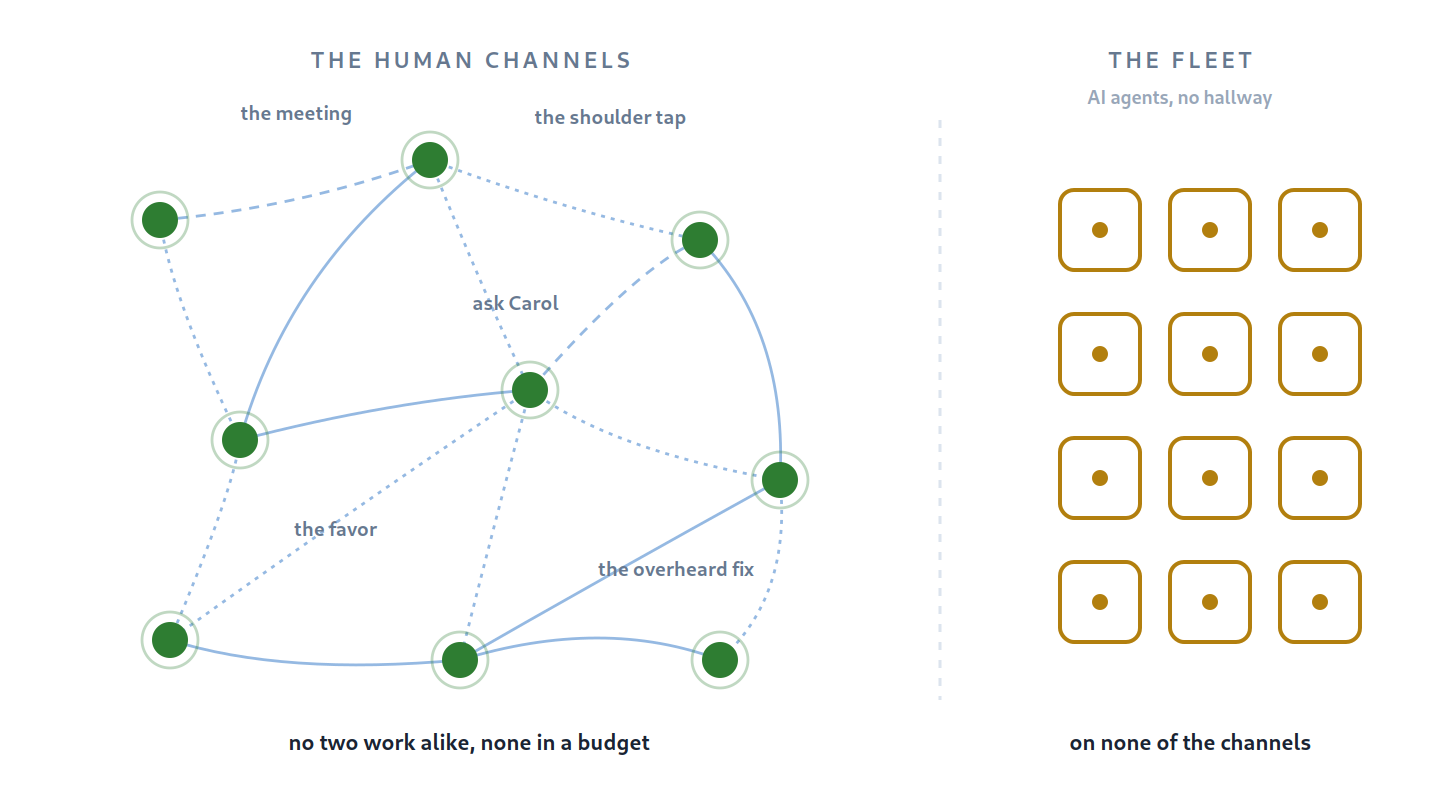
Everyone in that layer drew a salary, and the salaries bought the knowing. The moving of it was never bought at all, because it never needed to be. Put people near the work and near each other, and knowledge moves on its own, through the meeting, the shoulder tap, the favor called in, the question asked over a cubicle wall. No two of its channels work alike, half of them are informal, and none of them appear on an org chart or in a budget, which is why the enterprise is discovering so late what it has been standing on.
The hallway was the infrastructure
Sixty years of research says the knowledge that runs an organization mostly cannot be written down on demand. Polanyi said it plainest, we know more than we can tell [1]. Nonaka and Takeuchi built a theory of the firm on the conversion between that tacit knowing and its explicit forms, and argued the conversion is the engine of everything the company creates [2]. Wenger showed that the real channels are communities of practice, informal, self-organizing, and almost always invisible to the formal structure [3]. Davenport and Prusak watched knowledge actually move inside companies and found not a library but a market, running on reciprocity, reputation, and favors [4]. And Szulanski measured what every program manager knows in their bones, that even inside one firm, best practice is sticky, and moving it is slow and expensive [5].
Agile understood all of this and built the workspace around it. The open team room, the information radiators, the pairing, the whole floor plan existed to maximize what Cockburn called osmotic communication, knowledge absorbed from the background hum of a shared room, questions answered by being overheard [6]. It was the hallway, engineered. The best process minds of a generation looked at how knowledge actually moves and concluded that the highest-leverage act available was to arrange the desks. They were right.
The Greeks understood this well enough to give it a god. Hermes carried the messages, and he was also the god of boundaries, the marketplace, travelers, and thieves, because moving meaning between worlds is all of those trades at once. Half formal and half not, part favor, part market, part gossip, part apprenticeship, and never reducible to a procedure. That is not a flaw in how enterprises moved knowledge. It may be the nature of the thing, a mercurial layer nobody designed, everybody depends on, and no one ever needed to design, because every human in the building was born able to work its channels. You do not proceduralize a god. The Greeks never tried, and they took him seriously in ways worth paying mind to. They set his face on stone pillars at every crossroad and doorway, so that nobody crossed a threshold without passing him. Interpretation still bears his name, hermeneutics, the art of getting meaning across. And their word for a lucky find on the road was a hermaion, his gift, because whatever arrived through him arrived looking like luck [7].
The enterprise absorbed all of this research by ignoring it structurally and accommodating it socially. Nobody funded the flow, but everybody used it. The architecture was a person. Ask Carol. Carol knows the general ledger, Carol remembers why the interface was built that way in 2016, Carol can tell you which of the four documented processes is the one that actually runs. The hallway conversation, the shoulder tap, the meeting where the expert explains for an hour, these were the load paths of the invisible layer, and proximity did the engineering. It worked, more or less, because human delivery was slow enough to wait for Carol, and Carol was usually only one floor away.
AI did not attack this layer. It just built a production floor the layer can't reach. A fleet does not attend meetings, does not overhear the hallway, can't tap a shoulder, and does not know that Carol exists. Every channel the tacit layer used to move through is a channel machines are not on. The fastest producers in the building are now the most knowledge-starved things in it, and they do not know enough to stop and ask.
The quiet inversion
Expert attention used to be overhead, the cost of keeping delivery from drifting. Now it is the thing production waits on. Stated as a law, because it behaves like one. Expert attention is production capacity. A missing policy interpretation can stop a fleet completely, which is expensive, or fail to stop it, which is worse. Where attention never arrived, a call still gets made, by a default, an assumption, or whatever stood nearest, and the fleet executes that arbitrary call with total fidelity, inside a day. Everything downstream of it will be rigorous. In Decision Ownership I gave briefs their rule. Evidence, not assumption. The knowledge layer is where the evidence lives. Diligence can carry it to the spec on any given day, and only structure carries it there every day.
The same expert hour is worth wildly different amounts depending on when it arrives. At spec time, it shapes work the fleet builds right the first time. After the build, it goes to rework. After release, it goes to an incident. That spread always existed, but when a build took months, the timing of one hour disappeared into the calendar. When a build takes a day, that timing decides whether the week lands five increments or two. The scarcest input in the system is no longer engineering time. It is the attention of the people who know.
The enterprise has tried to structure that attention before, and each attempt failed in its own instructive way. The subject matter expert on request failed on the calendar. Two weeks to get an hour, so the work waited or guessed. The embedded analyst failed on extraction. Pulled from the business, the expert went stale inside a year. The review phase failed on timing, judging work after it was built that it could only have shaped before. And the knowledge base failed on trust. A wiki is storage, and as Fleet Leadership argues, storage is not holding. A page cannot notice the moment it becomes relevant. Four partial answers to a question the enterprise could still afford to dodge. It cannot anymore.
The network
Here is the heart of the answer. Enterprises have always kept the knowing and the making apart. The people who understand the business stand in one place, the people who build stand in another, and everything between them is translation. The Domain Knowledge Network ends the separation. It takes the people who hold what the organization intends and wires them into the making itself, at the speed the making now runs. And what the organization intends is the meaning it makes of the world so that it knows how to appear for the people it serves. Everything else here is machinery for that.
The network is a governing layer of the organization, standing beside portfolio direction and the execution teams, with its own funding, its own membership, and its own accountability. It is not a center of excellence, which extracts. It is not a help desk, which waits. And it is not a department. A department has a manager and a queue, and knowledge that waits its turn arrives too late. A layer runs through everything, the way the old hallway did, except this one is named, funded, and wired to the work.
Aristotle, in the Physics and the Metaphysics, held that a made thing is intelligible through its telos, the end it exists for, and that the form of an artifact lives in its maker before it lives in the material [8]. A knife means cutting because cutting is what it was made for. Grice, in a 1957 paper titled simply Meaning, made the modern version exact [9]. Meaning is derived from intention. An organization is a made thing, a network of commitments in language, so what it means is downstream of what it intends. The model's word for a declared telos is an outcome, the condition that must become true, and the network is where that intending is carried as living knowledge and translated into deliverables that add value for the people the organization touches. The Intent Architect engineers how intent moves. The network holds what intent is made of.
The people who can hold that intention already exist in every enterprise. They feel what the organization intends in their beings. What they lack is the position. Their calendars are full of other work, so the feeling runs on stolen time.
And the part that cannot be done from a desk mostly does not happen at all. Holding intention means watching the people the organization serves, in the claims office, at the gate, wherever the service actually lands, and almost nobody inside was ever sponsored to do that as a job. A whole consulting industry lives on the gap. Half of it does the watching for you. Half of it coaches you to do it yourself. When delivery was slow, skipping the watching was affordable. Now it is fatal. The only thing more expensive than moving slowly is moving fast in the wrong direction.
So the network's founding act is not hiring. It is positioning. The people were always there. The sponsorship, the funded time, and the standing to act on what they feel are what never existed. That is what the layer is.
Day to day, the holding expresses itself as correctness, right against the rules and honest about what customers value. And the correctness call is rarely a finger to the wind from a very senior chair, though it can be. More often it comes from someone standing deep in the space of the decision they will own.
The shape is a guild, the oldest structure crafts ever built for keeping their knowing alive, masters beside apprentices. Wenger would recognize it as a community of practice, with the one property his communities almost never got. A budget line. The seats are regulatory, compliance, policy, data, the business analysts who hold institutional knowledge, and the customer-facing people who carry the evidence of what customers actually do.
That last seat runs on the shortest clock. Customer knowledge often decays in months rather than years, so the seat trades in dated evidence. Things a customer said, showed, or did, with the date attached. When the dates age, the network can see it has started guessing.
Everyone floats. No one is dedicated to any single team. Membership is named and funded, a committed slice of each expert's week, released by their home officer and paid for by the portfolio. Not a favor, because favors erode the first time the home function gets busy. And the slice is deliberately partial, for the same reason the Decision Owner keeps 40% of their week in the business. Knowledge is refreshed only by doing the business. A fully extracted expert is a fading one. The guild stays where the knowledge is made.
Do not mistake the part-time arithmetic for a side-of-desk arrangement. The splits are how the layer breathes. This is a change to the shape of the organization itself, a standing layer beside portfolio direction and delivery, chartered like them, funded like them, permanent like them. And the timing is a gift. AI is handing enterprises a greenfield moment, the first genuine license to redesign in decades. Spend it here. This is the thing that has always been missing.
The owners
The network is also where the Decision Owners come from. An Effort is the work that flows through the fleet, an outcome is the hypothesis it drives toward, and a crew ships in one-day bursts, so the judgment that guides an Effort cannot wait on a calendar. It lives with the crew. The intake rule is blunt. No Owner, No Now. Nothing green-lights until at least one named person is dedicated to owning it daily, and the owners are not hired or drafted for the purpose. They already exist as a job family inside the guild, better paid than the peers they left, past the qualification screens. Intake assigns them, one per Effort at minimum, two or three where the scale justifies it, each owning distinct ground. Ownership never becomes a committee. Their whole job is the continuous governance the speed demands, definition at the front of each day and acceptance at its close, split between the crew and the business on terms Decision Ownership lays out in full.
The guild is home and deployment is temporary, because an owner's qualification decays on the domain's clock and only time in the business winds it back. The split week keeps the clock wound while the owner is out. The outcome made true sends them home entirely, and the guild expects them, carrying what the work proved and every question it raised. Embedding is a tour, not an emigration. And the tour repairs an old injustice. The embedded business person of the last era, half detached from the function that lent them, read as nobody's core and went first when the layoffs came. An owner who ships value and comes home a hero is the hardest person in the business to cut.
Inject, encode, return
The network governs in three verbs, and the order is the point. Knowledge lands ahead of the work, never behind it, and what the work teaches lands ahead of the next.
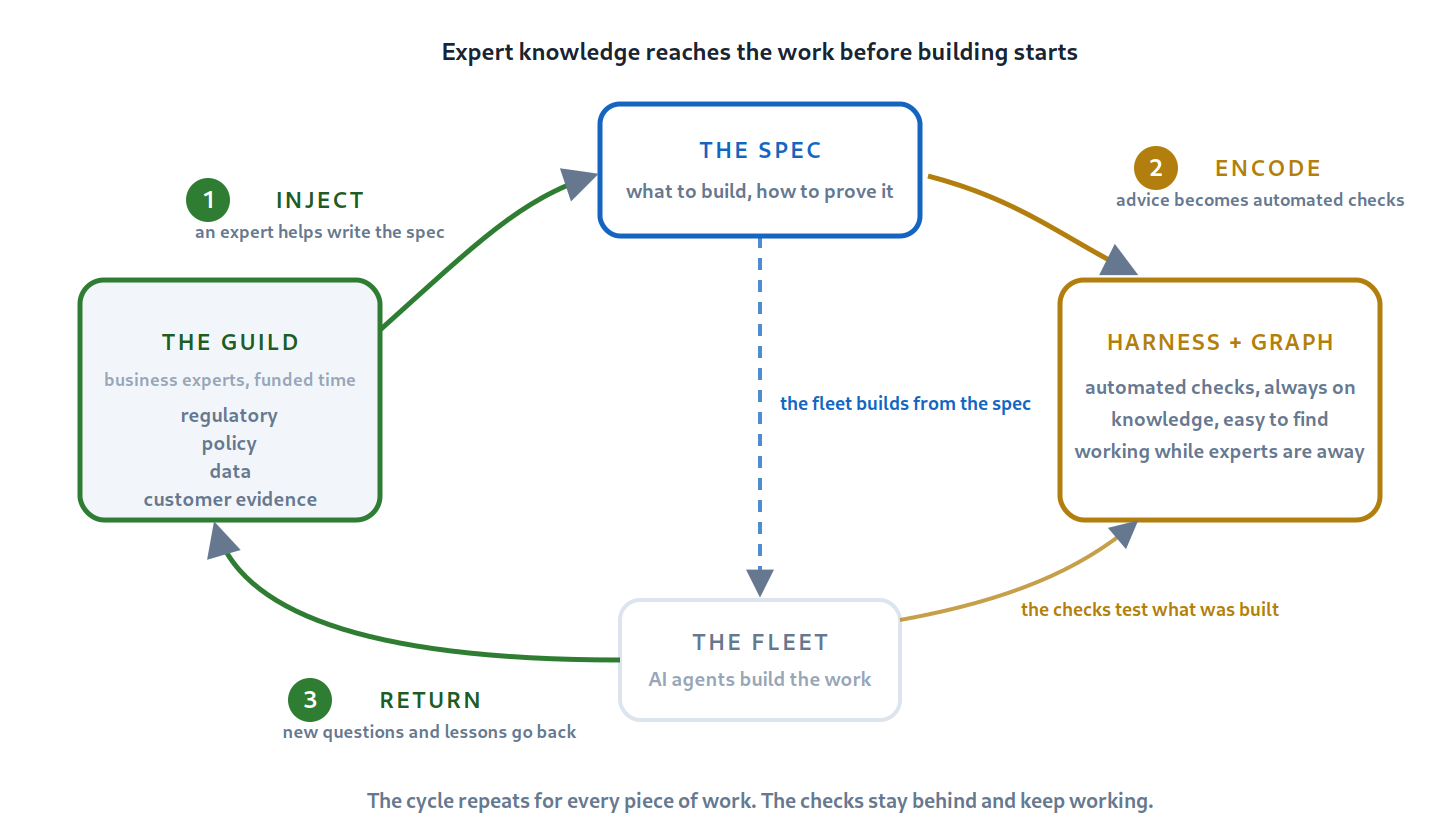
Inject. At spec time, before the fleet starts, the expert works the spec directly with the Decision Owner. Context, policy constraints, validation criteria, the edge cases only a veteran knows to name. Thirty minutes, into the spec, as a working session rather than a review meeting. The expert shapes the work while it is still a sentence, which is the cheapest moment any expert will ever touch it. Szulanski found that knowledge sticks to its source and moves slowly even inside one firm. It moves easily at exactly one moment, when the person who holds it and the work that needs it are in the same half hour, and inject is that moment made routine.
Encode. The verb the old arrangements never had, and the one that changes the economics. The expert does not just explain. The explanation becomes an artifact that outlives the conversation. Criteria become checks in the harness that run on every push, for every team, forever. Context joins the knowledge graph wired to the work that needs it. The wiki page was storage. A check that runs on every push is enforcement, the expert's judgment still on duty years after the afternoon it was written. Nonaka named the tacit-to-explicit conversion externalization and put it at the center of how firms create anything. Encoding is externalization with a compiler behind it. Not knowledge written down and filed, knowledge written down and running. It takes longer than explaining, and it is the difference between a layer that compounds and a layer that repeats itself.
There is a boundary, and the design depends on it. Not everything encodes. The threshold, the rule, the criterion, the constraint, everything that can be phrased as a check, encodes and compounds. The other half of what an expert knows, the reading of a situation, the sense of which question to ask, the feel for when a case is about to go wrong, does not. Polanyi again, and no tooling roadmap repeals him.
The Greeks, who sorted everything, sorted this too. Episteme was knowledge that can be stated, and it encodes. Techne was craft, and it moves by apprenticeship. Phronesis was practical wisdom, the right call in this situation for this case, and they insisted it lives only in a person who has judged many [8]. And metis was the fox's knowing, Carol's kind, the cunning that notices what the procedure missed [10]. The harness holds the first. The guild holds the rest. The network is built for the split rather than embarrassed by it. It encodes what checks, and it seats what judges, which is why the guild is made of people and the Decision Owner sits with the crew instead of leaving behind a document. The unencodable half is not a gap in the system. It is the reason the system has chairs.
Run the loop once at ground level. On Tuesday a spec touches payout timing, and the network's rota flags it to the fraud analyst, who spends the thirty minutes with the owner and names the threshold rule nobody outside the fraud team knows about. That is inject. The rule becomes two harness checks before the fleet starts, and the reasoning behind it joins the graph beside them. That is encode. On Thursday a different crew in a different portfolio band trips one of those checks, reads the reasoning, and never has to find the analyst at all. The check answers, nobody is interrupted, and the question that did reach the analyst that week was genuinely new, so it became a third check, which is return doing its quiet work. The guild governed two teams that week and attended one meeting.
Return. Every cycle sends something back. The question the fleet asked that revealed missing context. The edge case the spec never anticipated. The pattern that worked and belongs in a playbook. Customer signal that confirms or contradicts what the brief assumed. The network absorbs what returns, revises the shared context, and the next team inherits what this team learned rather than rediscovering it. This is how a guild of a dozen governs a portfolio of hundreds of daily cycles without becoming a bottleneck. The knowledge does the scaling, not the people.
The guild stays current
The same law that governs owners governs the layer. Knowledge decays on the domain's clock, and only time in the business winds it back. The network's defenses are structural rather than aspirational. The partial slice keeps every expert in the operation that makes their knowledge worth encoding, and the one-deep domain, the single person a whole portfolio depends on, is named as a risk and treated with the only mechanism that transfers theory, an apprentice beside the expert while the expert is still in the room. Fleet Leadership made that argument for code. It holds for claims adjudication too.
Which is also the answer to the oldest fear in the building, the week Carol retires. In the unfunded layer, Carol leaves and the organization discovers what Carol was holding by watching things fail, one surprise at a time, for a year. In the funded one, most of what Carol knows is already on duty, running in checks and wired into the graph, and the part that could never be written down has spent two years transferring to the apprentice at the next desk. Carol still leaves. What Carol held does not.
The economics of the seam
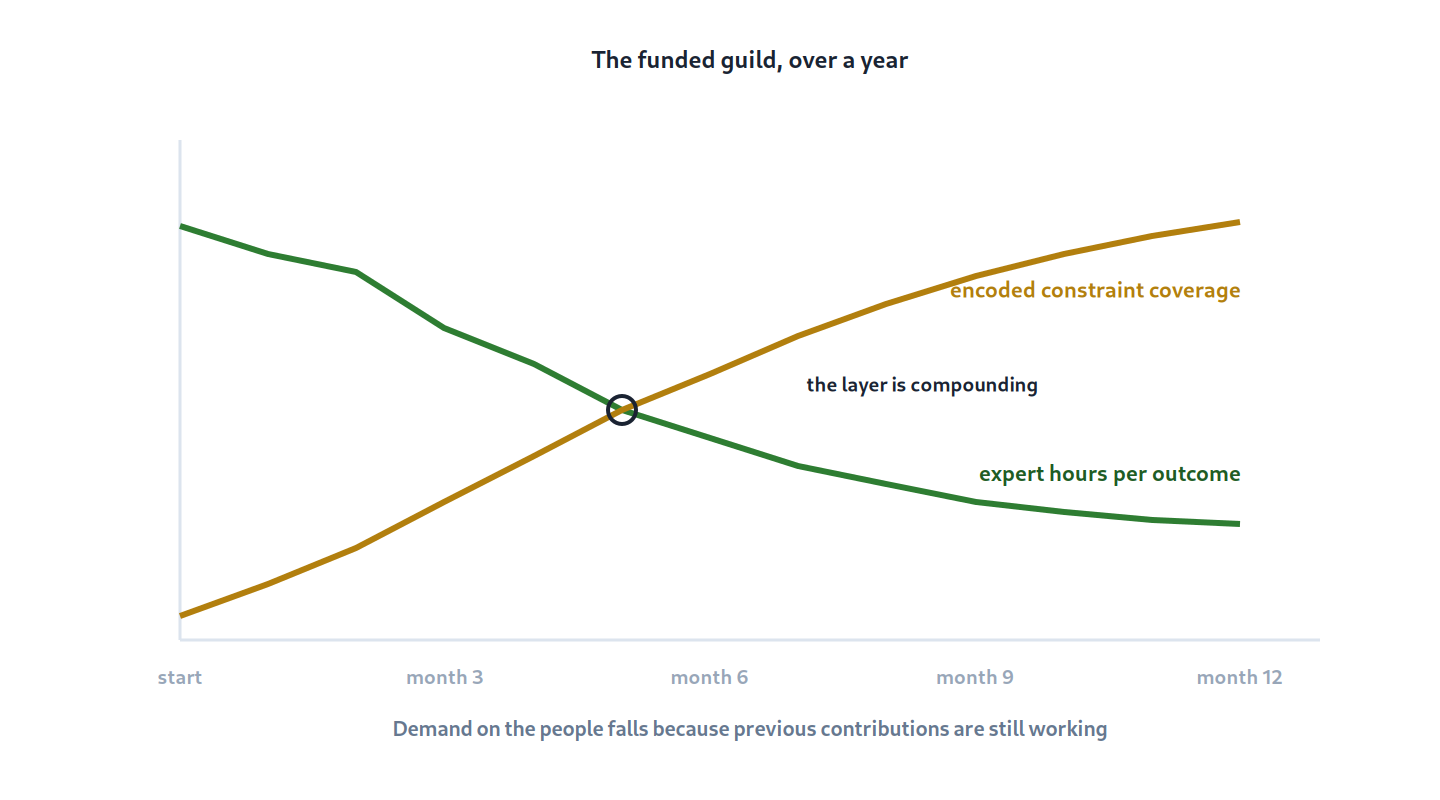
On the Model's chart the network is drawn as its own band, a green seam running the width of the organization with its own funding and its own name. Seams are how miners price a mountain, the thin layer worth more than the strata above it. The return on this one shows up as two crossing lines. Expert hours per outcome trend down, because encoded contributions keep working after the expert leaves the room. Coverage of encoded constraints trends up, because every cycle adds checks that no future team has to ask for. After six months a portfolio's harness can hold hundreds of domain checks running on every push, and demand on the guild has fallen not because the work got simpler but because the layer compounds. Argote and Ingram located competitive advantage exactly here, in a firm's ability to move knowledge internally, because rivals can copy a product and cannot copy the transfer [11]. The funded layer is that ability, made deliberate.
Against that, the cost of leaving the layer unfunded arrives in a sequence every veteran of a stalled transformation will recognize. Experts become unavailable, because unfunded time is always reclaimed. Teams proceed without them, and defects arrive later, at the demo or in production, at multiples of what injection would have cost. The same questions recur across teams, because nothing persists. The total always exceeds the price of the guild, but it arrives scattered across rework, delay, and incident lines, while the guild would arrive as one visible number. Organizations reliably choose the invisible larger cost over the visible smaller one. Naming the layer is how the choice becomes honest.
The people already holding it up
Here is the part I most want the people inside these organizations to hear. The knowledge layer is not a new species of employee. It is a promotion of work you are already doing off the books.
The analyst everyone actually asks, whose calendar is a shadow help desk. The compliance veteran who catches the gap at review, too late to be cheap, every single time. The operations manager who knows which documented process is fiction. The customer-team lead who could tell the product organization exactly what customers stopped tolerating last quarter, if anyone had a slot for hearing it. Every one of these people has been doing knowledge-layer work on stolen time for years, unfunded, uncounted, and structurally invisible, precisely because they were good enough to keep the layer standing.
What unites them is a disposition and a skill. The disposition is the scout's, never off duty, always tracking what customers care about, which is what is good for the business, which is what value is. The skill is newer. Context engineering, the fluency to put what they know into briefs and specs that describe the need precisely enough for machines to run against, the business half of the work finished before a Fleet Lead ever takes it down to technical text. The old layer ran on people who could explain. This one runs on people who can author.
The network gives that work a name, a funded slice of the week, and a mechanism that multiplies it. An hour that used to help one team once becomes a check that guards every team indefinitely. For the people who hold institutional knowledge, this is the difference between being interrupted for a living and governing for one. The guild is not a sidebar to a delivery career. In an organization whose constraint is knowledge, it is the load-bearing wall, and the pay should say so. These are the business people who turn the technology investment into edge in the market, and the machines just made them fast at it. Pay them above any other business seat, and support them like the yield depends on them, because it does.
Funding what holds the weight
The layer was always there. Every transformation that stalled on "change management" was partly this, a structure of knowing that the program depended on and never named, running on favors while the formal plan ran on slides. What AI changed is not the layer's existence but its position. When production is abundant and instant, the thing that was ambient becomes the thing that is binding. The constraint does not disappear when it moves. It concentrates.
Anyone who ran delivery long enough has already seen the pattern. The teams that delivered the most, year after year, were the ones whose product owner was a true business person, genuinely given to the team rather than borrowed by it, and every one of those stories got filed as luck instead of design. Of course they were. Whatever arrives through Hermes arrives looking like luck. The network institutionalizes the luck, and adds the piece the old arrangement never had, the scouting seat that keeps the person worth embedding. AI did not invent the truth underneath. It raised the price of ignoring it, because machine-speed production runs on the constant injection of human judgment, and constancy cannot be staffed by accident.
The network runs today inside the operating model we are building at Singularics, and the claims here are the ones the work keeps proving back. A guild that stays in the business stays worth consulting. Encoding beats explaining by more every month the harness grows. And the organizations that fund the layer stop having a certain kind of quiet, expensive failure, the one that was always blamed on requirements.
The hallway still hums, and the people still use it, but the builders moved out of earshot. Fund the channel that reaches them. Build a Domain Knowledge Network and train your Decision Owners in context engineering. Or keep leaving it all to Hermes, who has carried the messages alone this long. Even a god appreciates infrastructure.
References
- Polanyi, M. (1966). The Tacit Dimension. Doubleday.
- Nonaka, I., & Takeuchi, H. (1995). The Knowledge-Creating Company: How Japanese Companies Create the Dynamics of Innovation. Oxford University Press.
- Wenger, E. (1998). Communities of Practice: Learning, Meaning, and Identity. Cambridge University Press.
- Davenport, T. H., & Prusak, L. (1998). Working Knowledge: How Organizations Manage What They Know. Harvard Business School Press.
- Szulanski, G. (1996). Exploring Internal Stickiness: Impediments to the Transfer of Best Practice Within the Firm. Strategic Management Journal, 17(S2).
- Cockburn, A. (2004). Crystal Clear: A Human-Powered Methodology for Small Teams. Addison-Wesley. Osmotic communication, defined.
- Burkert, W. (1985). Greek Religion: Archaic and Classical (J. Raffan, Trans.). Harvard University Press. Hermes, the herms at the thresholds, and the hermaion.
- Aristotle. Physics II and Metaphysics VII for the telos and the form in the maker; Nicomachean Ethics, Book VI for the distinctions between episteme, techne, and phronesis.
- Grice, H. P. (1957). Meaning. The Philosophical Review, 66(3).
- Detienne, M., & Vernant, J.-P. (1978). Cunning Intelligence in Greek Culture and Society (J. Lloyd, Trans.). Harvester Press. The study of metis.
- Argote, L., & Ingram, P. (2000). Knowledge Transfer: A Basis for Competitive Advantage in Firms. Organizational Behavior and Human Decision Processes, 82(1).
Alex Petty is the founder of Singularics. He has spent 20 years leading enterprise transformations and now helps organizations redesign how work is defined and coordinated when AI changes the operating model.
Ready to see the layer in practice? The Domain Knowledge Network, its guild, its funding, and its three verbs, is specified in The AI-Native Operating Model™. Take the free Readiness Assessment to see where you stand, or book a call to talk about what the shift looks like for your organization.