
The Intent Architect
The role that engineers how intent moves
Every organization already has an architecture for its systems and a named person who owns it. Almost none has an architecture for what it means. Strategy falls through layers of translation, each handoff losing meaning, until the daily work enforces something the officers never said. That was survivable when humans built slowly enough to argue about it. Pointed at fleets that build the wrong thing before lunch, it is the most expensive defect an enterprise can carry.
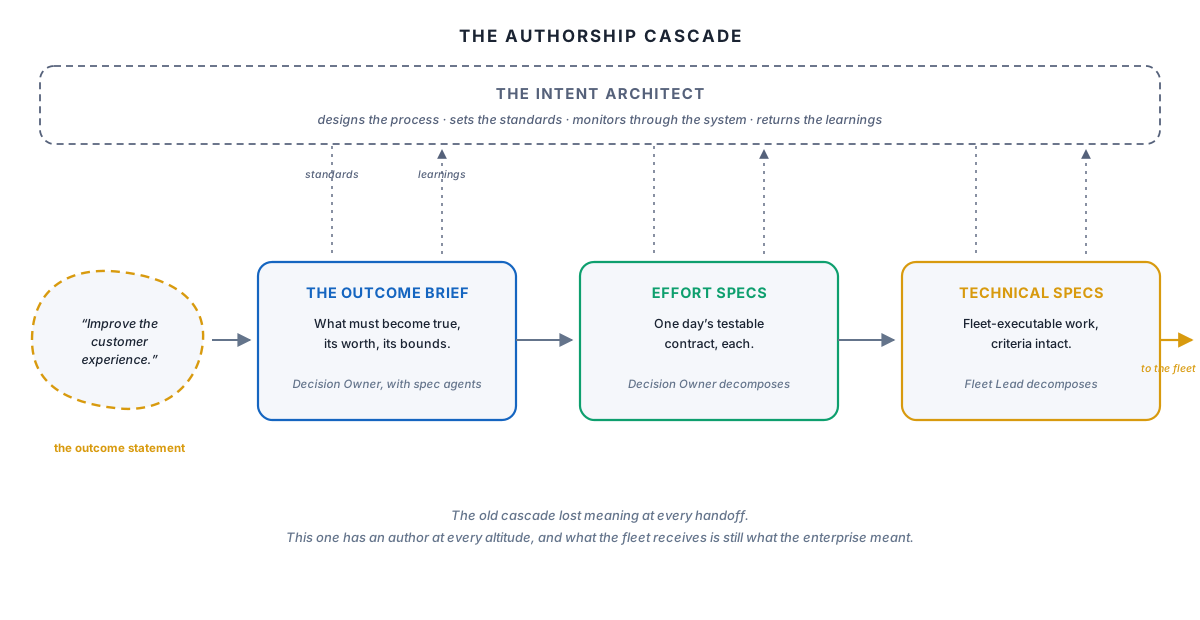
The Intent Architect is the role that closes the gap. What the enterprise architect is to systems, the Intent Architect is to what the organization means. They engineer the written artifacts, the quality standards, and the flows that turn strategy into work machines can run and people can judge. The field they practice is named in the essay Intent Architecture. This page is the role in operating terms.
The moment work waits on the Intent Architect's approval, the role has failed.
The two verbs
The role runs on two verbs, and it is the pair that makes it work.
They teach. Authors at every altitude learn what good means through worked examples rather than mandates. The Decision Owner writing an outcome brief, the Fleet Lead decomposing a spec, the officer stating a strategic outcome, each gets better because someone whose job is authorship quality worked beside them. Half the discipline is raising the organization's authorship, not doing its authoring.
They hold the bar. The standards each artifact is held to are defended, revised only by evidence, and never lowered for convenience. A brief without dated customer evidence goes back. An acceptance criterion no check can be written against is not done being written.
Teaching without the bar produces drift. The bar without teaching produces a gate. The role is the two together, and an organization that staffs only one half gets the failure mode of the half it staffed.
The seven concerns, operationally
Intent topology. Outcomes decompose cleanly, nothing contradicts, and the trace from any day's work back to strategy actually walks. The trace strip at the top of the Model is this concern made visible. Orphaned work gets named in the open, and the warning stands: untended, your intent topology will mirror your org chart rather than your strategy.
Checkability. An adverb in an acceptance criterion is a defect. "Gracefully" is a wish. "Returns the named gap the same day" is a contract. The architect holds this standard across every altitude of the spec discipline.
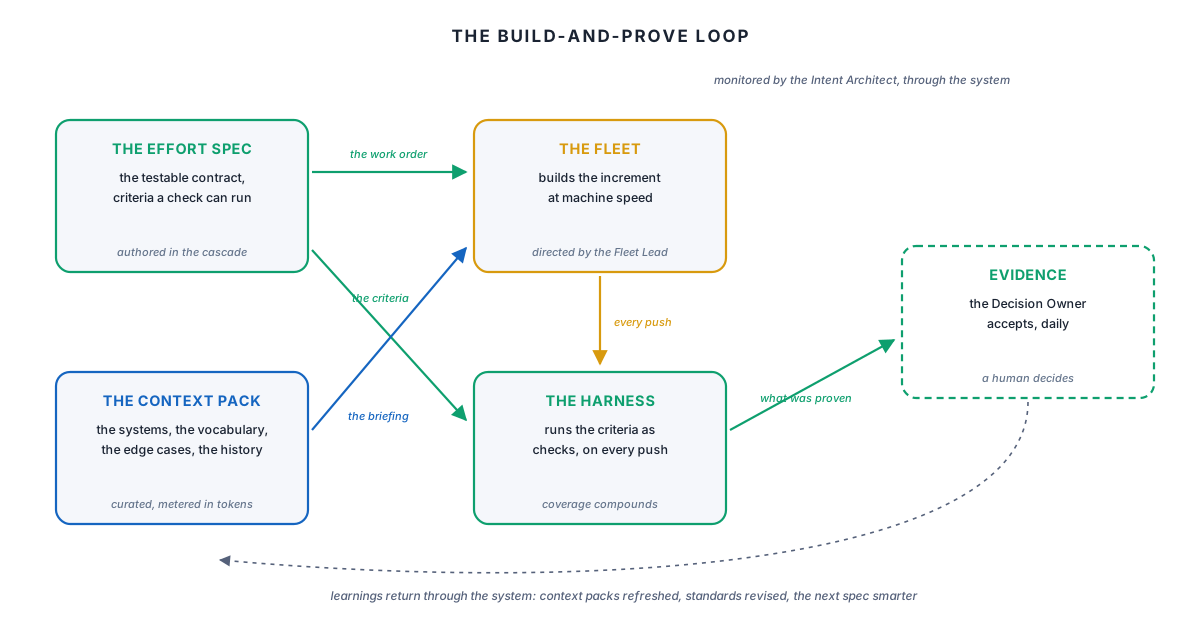
Context economics. Fleets fail on unstated context far more often than on capability. The architect tends two layers, the global context every fleet and person must know, and the local context each domain and Effort needs today, and curates both for correctness and token cost in the same motion. Dumping documents into a briefing and calling it context is the amateur tell.
The model landscape. Which model fits which task is real knowledge that shifts monthly. The councils approve categories, the leads choose per task, and the architect is the reason those decisions are informed rather than folklore.
Authority boundaries. A declared outcome without a declared decision boundary is incomplete intent. The envelope, what the Decision Owner may accept alone, what escalates, what never proceeds, is part of the intent artifact itself, not process bolted on afterward.
Evidence semantics. Green and right are different words. A passing check proves the contract was met. Whether the contract captured the intent is a human judgment, and keeping that judgment sharp and fed with readable evidence is an architectural concern. The proof frontier also moves, and part of the job is growing the organization's proof discipline as verification tooling matures.
The conversation record. The exchanges between people and the system hold intent in its rawest form, the moment a wish got clarified, the question that revealed missing context, the reasoning behind a judgment call. Today that record evaporates in chat scrollback. The architect treats it as the asset it is.
The artifacts
The architect authors none of the work and is accountable for how well all of it gets authored. What they tend directly:
- The trace. The living map from every active Effort back to the outcome it serves, walkable in under a minute.
- Authorship standards with worked exemplars. Each artifact class, outcome statement, outcome brief, Effort spec, technical spec, has a standard and a best-in-class example beside it. The exemplars do most of the teaching.
- Context pack standards. What belongs in the global layer, what in the local, what gets retired, and what the token budget says about all three.
- Model guidance. The current read on which models fit which categories of work, kept honest as the landscape shifts.
- The envelope template. The starting shape for bounded authority that the Intent Council tailors per outcome.
- The conversation record. Captured, organized, and mined for the next generation of context packs and authors.
The boundaries
The never list is short and absolute. The Intent Architect never accepts work, which belongs to the Decision Owner. Never allocates capacity, which belongs to the Flow Council. Never sets risk appetite, which belongs to the Intent Council. Never directs the fleet, which belongs to the Fleet Lead.
They serve every team and sit on none. The role carries no decision authority over the work, only over the standards the work's artifacts are held to, and even the standards move by evidence rather than preference. This is what keeps a quality function from becoming a bottleneck. The cascade runs at full speed whether or not the architect is in the room, and the bar is enforced by the artifacts themselves, not by an approval step.
The first ninety days
Days 1 to 30, make the trace walk. Take the live portfolio and walk every active Effort back to its outcome. Name the orphans in the open. Publish the first exemplars by taking two real specs and working them to the standard beside their authors.
Days 31 to 60, stand up the cascade on two Efforts. Author standards land for briefs and specs. The two pilot crews' artifacts meet them, and the difference shows up in fleet output within days, which is the evidence the bar will be defended with.
Days 61 to 90, make it the house style. The exemplar library covers every artifact class. Context packs for the pilot domains are curated and metered. The first future architect is identified from inside and apprenticed. If the ninety days end with the architect as approver rather than teacher, restart the role, not the person.
The failure modes
The gate. Work queues for the architect's review. This is the role's cardinal failure, and the correction is structural: standards live in artifacts and exemplars, never in an approval step.
The ghost author. The architect quietly writes everyone's briefs and specs because it is faster. Authorship without ownership recreates the proxy problem one level up, and the organization's authorship never improves.
The librarian. The role collapses into documentation upkeep. Standards exist, nobody is taught, the bar is not defended, and within two quarters the artifacts describe a model the organization no longer runs.
The org-chart mirror. Topology drifts until it reflects reporting lines instead of strategy. The tell is two portfolios pursuing contradictory conditions without knowing it. The correction is the trace walk, done in the open, on a cadence.
The ratio
One Intent Architect serves three to five crews at maturity. Start with one, prove the craft on real Efforts, and grow the guild from inside, because the apprenticeship is the training program. The role scales by raising authors, not by adding architects.
Seeing yourself in the seat
You are an enterprise, solution, or system architect. This is the closest chair. The instinct for decomposition, standards, and topology transfers whole. What grows is business depth.
You are a program leader or release train engineer. Years of cross-team peripheral vision become topology sense the day the value stops being facilitation and becomes structure.
You are a senior business analyst or product owner. You carry the authorship craft already. The path from writing requirements to writing contracts is the shortest one on this list.
You are a coach. Half the discipline is teaching, and the teaching instinct is the rarest half. What you take up is the bar.
Every origin has one thing to build, evidence literacy, because nobody arrives fluent in asking whether the checks were the right checks.
Its place in the Model
In The AI-Native Operating Model™, the Intent Architect appears in the Portfolio Direction band's roles row, serving every team and sitting on none, and tends the trace strip that runs above the whole chart. The role is cross-cutting rather than band-bound, which is why it carries no band color of its own. It stands on the first axiom of the foundation. AI amplifies direction; it does not choose it, and the trace, the standards, and the authorship cascade are how the choosing stays human at every altitude.
The role connects to:
- Spec-Driven Development, whose checkability standard the architect holds
- The Decision Owner and the Fleet Lead, the authors the architect teaches and never replaces
- The Domain Knowledge Network, whose encoded knowledge rides in the context packs the architect's standards govern
- The Intent Council, which sets the envelopes the architect's template shapes
- Continuous governance, whose evidence loop the architect keeps readable
Read the essay Intent Architecture for the field and its ancestry. Read the Intent Architect white paper (PDF). Return to the Model to see how the role connects to the rest of the system.